Fractional SDR: Define the Work Before You Hire
Define a fractional SDR assignment with a clear account brief, timing notes, handoffs and a review process before comparing providers.
By Lead Scorer 7 min read
A fractional SDR is a sales development representative who works with a company for a defined portion of their capacity. The arrangement can cover account research, initial conversations, qualification and follow-up. Before comparing providers, decide which work you need, who will review it and how a sales colleague will continue a conversation when the SDR is unavailable.
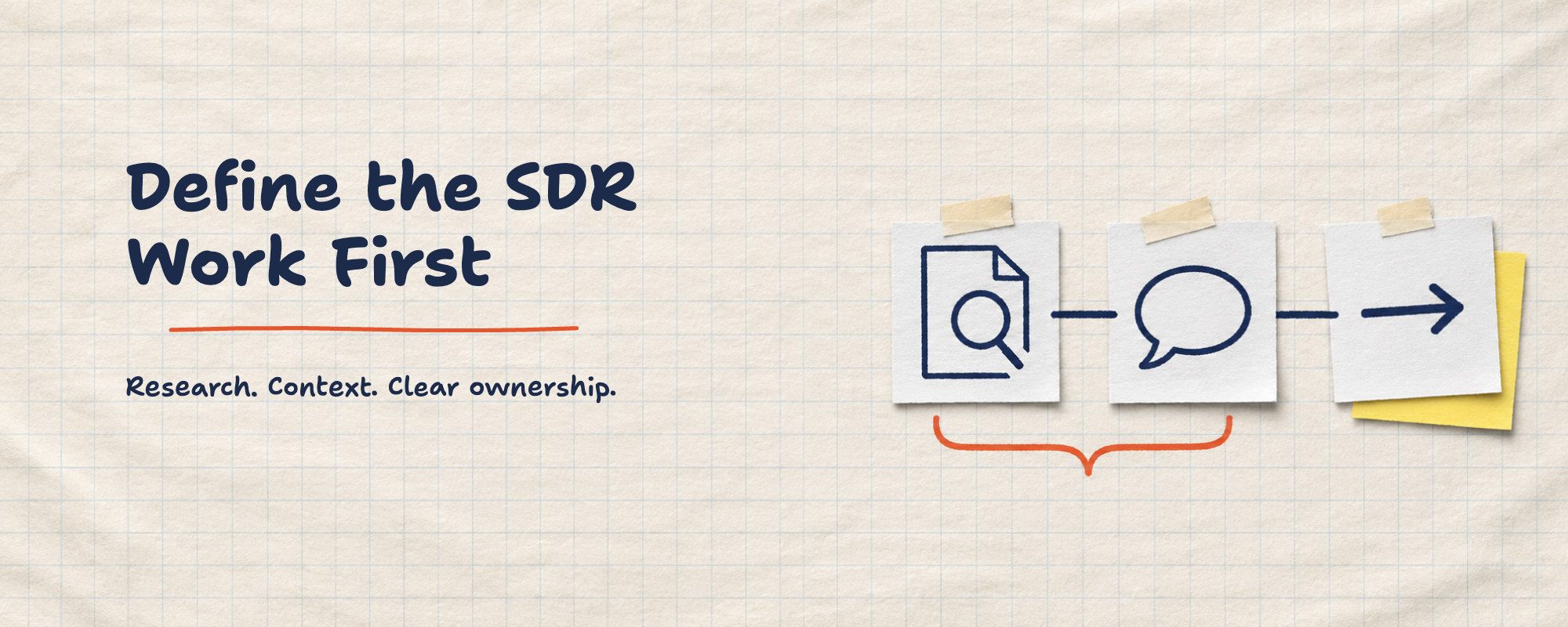
This guide gives you a brief and a review method for that decision. It focuses on the operating work rather than a promised number of meetings. The examples are fictional and should be adapted to your own buyer, offer and capacity.
Define the task you are delegating
A founder may say “we need more meetings” when several different problems sit underneath. Perhaps the team has no reliable account list. Perhaps it reaches relevant people but records very little about their priorities. Or perhaps good conversations reach sales without a clear request or owner. A part-time resource can work on one of these gaps if the assignment names it.
In Closed Circuit Selling, with Jake Rivera, Rivera describes a prospecting practice built around profiling accounts and learning when a buyer might consider a change. He talks about fractional SDR work in that context. His point about following up is especially practical: the reason to write again should come from the earlier conversation. His experience does not establish that one rep can handle your workload or that the approach will produce a particular pipeline result.
Write the task as an output. For example, an industrial maintenance supplier might ask for a reviewed list of regional plants, an account note for each researched organization, and a record of what the contact says about their maintenance planning. “Get us access to procurement” leaves the SDR to invent the route. “Find who coordinates planned maintenance and learn when the supplier list is reviewed” gives the work a purpose.
Put boundaries in the brief
A usable brief needs five decisions before outreach starts:
- Audience. Which type of organization, operating context and role can use your offer?
- Problem. What work do you help with, and which observations make it worth asking about?
- Exclusions. Which accounts, situations and claims are outside scope?
- Ownership. Who reviews research, approves messaging and handles an answer requiring expertise?
- Continuation. Who owns a conversation, where are its notes stored, and what happens when capacity changes?
For the maintenance supplier, a plant hiring a maintenance planner is a reason to investigate how planning works. It is not evidence that its current supplier is failing. The brief should identify the public observation, the uncertainty to test and the claims the rep may actually make. Use the prospecting plan if you still need to define the target and capacity of the whole program.
Ask the provider to walk through a sample account with you before scaling. You are testing whether they can separate verified information from an assumption, describe what they would ask and identify when to stop. A polished sequence without that explanation gives you little to review.
Keep the timing in the contact’s words
Rivera describes a situation where a prospect has another implementation consuming attention and budget. A later follow-up has a reason because the earlier conversation supplied it. You can apply that principle without turning an estimated date into a buying commitment.
Suppose a contact says, “We are reviewing the maintenance roster after the shutdown. Try us when that review is finished.” Record that wording, who said it, when it was said and what remains unknown. If no date was agreed, record that too. A CRM field containing only “Q1 opportunity” loses the distinction between a review, a decision and a signed order.
A sensible next task might be to confirm the planning checkpoint and ask whether it is useful to reconnect then. If the contact declines, keep that preference visible. If another employee in the same business spoke about a different project, keep the two observations separate. A company-level change is research context. A person’s request belongs to that person.
Specify the handoff before you need it
An SDR can find a relevant issue without being the right person to answer it. The account owner needs enough context to pick up the discussion. A handoff row should contain the contact, current workflow, exact question or request, source of that information, unresolved point, next owner and agreed action.
For a fictional maintenance conversation, the row might read: “Alex coordinates the supplier review. Asked whether we cover emergency work outside the region. Coverage answer needs confirmation from operations. Owner Sam will verify and reply.” That is more actionable than a calendar invitation marked “qualified.”
Before you accept the meeting, check whether the buyer understands the topic, whether the right colleague can attend and whether the question is in your scope. A discovery conversation may then be useful. A request for a simple coverage answer may be completed by sending that answer. Count each outcome according to what actually happened.
Review capacity and quality together
Part-time capacity needs a calendar you can inspect. Agree when the provider will do research, handle replies and review notes with your team. Ask who covers an absence, how ownership changes and where account history remains available. Where several client assignments could affect availability or create conflicts, clarify the provider’s process before giving access to accounts or messaging tools.
Review the records alongside the activity totals. Separate researched accounts, connected conversations, timing learned, requested next steps, accepted meetings and meetings held. Examine why a prospect was ruled out. A low meeting count can coexist with useful evidence that your target or offer needs work. It can also reflect poor execution. You need the records to tell those explanations apart.
Start with a bounded segment and a review point you can support. If the research is unreliable, fix it before adding volume. If the conversations are relevant but replies sit unanswered, resolve coverage before requesting more meetings. If handoffs repeatedly lack a real buyer request, revisit the definition of an accepted next step. Retain the account history and current owners when the assignment ends.
What this choice can establish
Fractional support gives you a way to assign specific prospecting work without allocating the entire task to a single full-time schedule. Whether it suits your company depends on the work, supervision and continuity available. The podcast offers a practitioner’s approach. It does not supply a universal staffing ratio, fee or guarantee. Use the brief to compare proposals on the same tasks and decide from a small set of work you can actually inspect.
Frequently asked questions
What is a fractional SDR?
A sales development representative who works for a company for a defined part of their capacity. The agreed work can include account research, initial conversations, qualification and follow-up.
What should a fractional SDR brief contain?
Define the audience, problem to explore, exclusions, available evidence, review owners and how conversations will continue. Test a sample account before increasing the scope.
How do you evaluate outsourced SDR work?
Review account research and conversation notes alongside activity totals. Separate requested next steps, accepted appointments and held meetings, and inspect why accounts were excluded.
Does a fractional SDR guarantee qualified meetings?
No universal meeting count or outcome follows from the staffing model. The result depends on the offer, target, capacity and execution. Agree on what an accepted next step means.