Sales Champion: Build a Case They Can Defend Internally
Identify a sales champion, distinguish advocacy from enthusiasm, and build an evidence brief your buyer can defend internally. Includes a B2B example.
By Miljan @ Lead Scorer 9 min read
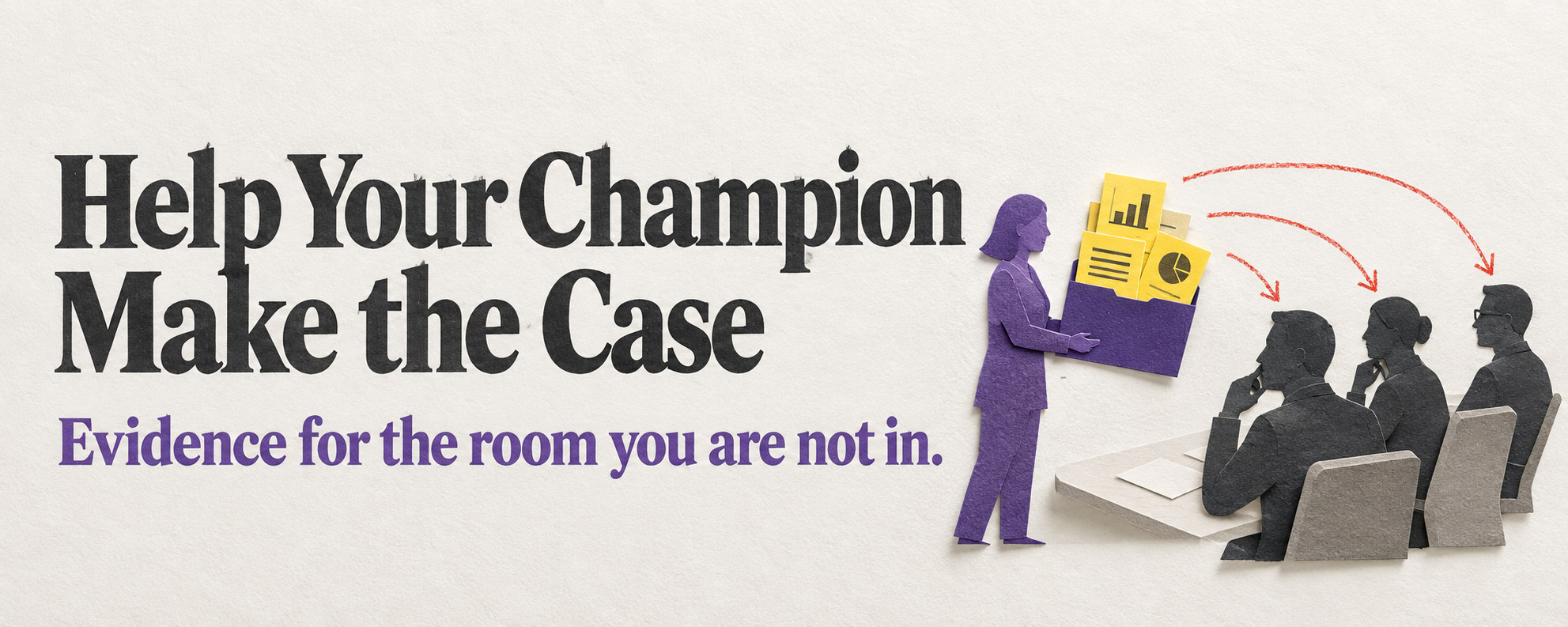
A sales champion is an influential person inside a prospective customer who actively supports the purchase. A friendly contact is a useful starting point. A champion also needs a reason to act, the ability to influence the decision and evidence they can explain to colleagues when you are absent.
This guide focuses on that last job: helping an internal advocate make a defensible case. It proposes a practical evidence brief, questions to check the relationship and a worked example. The method draws on Sohrab Hosseini's account of Orq.ai's champion toolkit and Cos Nicolaescu's approach to transparency at Accrual. Neither interview establishes a universal win-rate improvement.
What makes someone a sales champion?
MEDDICC's definition of a champion identifies three characteristics: organizational influence, a personal stake in the outcome and active internal advocacy. Someone who supplies useful information without meeting all those conditions may be a coach. The distinction is about observable behavior, not how enthusiastic a meeting felt.
A champion is also different from the person with final purchasing authority. Your advocate might understand the workflow and coordinate an evaluation while another person approves the investment. Record each role separately. A senior title, a meeting invitation or a downloaded document does not establish either role by itself.
The broader lead qualification guide covers whether an opportunity deserves attention. Here the question is narrower: does the person supporting this purchase have what they need to discuss it accurately inside their organization?
Why internal advocacy needs more than a sales deck
In the July 2026 Nobel Podcast interview, Orq.ai cofounder Sohrab Hosseini describes a problem with enterprise AI sales. A contact may trust the company and like the product while remaining reluctant to defend a new purchase internally. The personal risk does not disappear when the demo goes well.
Hosseini describes investing in a champion toolkit and building a portal with fit-gap analysis, business cases, downloadable management reports and ROI calculators. He presents the portal as work being developed, with an expected role in the sales process. The transcript does not demonstrate its eventual adoption or commercial impact.
The useful lesson is the task those materials serve. Your contact may need to answer a finance question, explain a technical limitation or show why this project deserves attention before another initiative. A vendor overview usually starts with the product. An internal decision starts with the customer's problem, options, constraints and responsibilities.
Our Orq.ai distribution case examines the company's wider combination of partners, outbound, founder expertise and analysts. This guide isolates the practical job of preparing one internal advocate for one decision.
Check the relationship through useful questions
Ask questions that make the buyer's work easier. Avoid secret tests, demands for confidential information or pressure to bypass another stakeholder. The aim is to understand how the organization decides and whether your contact wants help with that process.
- Which problem would make this project worth your colleagues' time?
- Who will challenge the recommendation, and what will they reasonably need to know?
- What can you already support with evidence, and what is still uncertain?
- What would you be comfortable sharing internally now?
- Which next conversation would clarify whether this purchase is appropriate?
Listen for concrete actions rather than promises of enthusiasm. A contact might correct your assumptions, arrange a relevant discussion or return with a specific objection. Those actions are evidence of progress. They are not proof that the contact controls the budget or that the purchase will happen.
Use the sales account planning framework for the wider stakeholder map. In the champion brief, keep only the roles necessary for the immediate decision. A long list of names can hide the fact that nobody owns the next question.
Build a brief the customer can correct
Begin with a small shared document rather than a portal. The following six-part structure is an editorial proposal. It is not a claim that either founder used these exact fields. Add supporting documents only where the decision requires them.
- Decision requested: the specific approval or investigation being proposed, with a named owner where known.
- Current problem: the affected workflow, its observable consequences and the customer's source for those claims.
- Options: maintain the current approach, improve it internally, evaluate your solution or choose another appropriate alternative.
- Evidence and gaps: what has been demonstrated, under which conditions, plus requirements that remain unresolved.
- Economics and effort: the proposed costs, internal work, assumptions behind benefits and the period being considered.
- Next step: the smallest useful decision, the participants needed and the information still to collect.
Use the customer's terminology. If the team talks about missed handoffs, do not replace that problem with a broad claim about revenue transformation. Let your advocate rewrite the summary and remove anything they cannot defend. A document they have corrected is more informative than one they have merely received.
Make the status of each statement visible: observed, buyer-confirmed, estimated or unknown. A requirement checklist marked entirely green can be less useful than an honest list containing two unresolved dependencies. The point is to support a decision, including a decision to stop.
Keep the limits beside the proof
In A Product Market Fit Show, Accrual cofounder Cos Nicolaescu describes being explicit about what the company does, does not do and expects to build. He connects that transparency with establishing credibility in an industry exposed to unfulfilled promises. This is his operating experience, not a measured comparison of sales methods.
Apply that boundary to every asset you give a champion. Separate a demonstrated capability from a planned one. State whether a result required manual correction, a special configuration or vendor assistance. Keep unresolved implementation work visible. Your advocate should not discover an important limitation while answering a colleague's question.
A reference story can show that a similar customer obtained a result; it cannot guarantee the same outcome in another setting. An estimate can organize a discussion; it cannot become a confirmed saving by appearing in a polished spreadsheet. Where feasibility remains uncertain, use a separately scoped sales proof of concept.
A worked champion brief for a B2B workflow purchase
Consider a fictional company evaluating software to coordinate customer handoffs. The operations manager supports an evaluation. Finance wants to understand total effort, while the systems owner needs to check data access. No budget approval has been confirmed.
The weak brief says: “The operations team loves the solution. It saves time and is ready for rollout.” That statement combines enthusiasm, an unverified benefit and a purchasing conclusion. It gives the advocate little help when finance asks where the saving comes from.
A more useful brief says: “Operations reports repeated handoff omissions. We propose evaluating one workflow with the team that owns it. The evaluation will document completion, exceptions and manual assistance. Systems will review the access needed. Finance will then assess the cost and whether any released time has a useful destination.”
The supporting sheet identifies the observations still needed: how often omissions occur, what rework they create, what the proposed workflow actually changes and what implementation requires. Nothing in this fictional example is an Orq.ai or Accrual result.
Notice the requested decision: authorize a bounded investigation, not an enterprise rollout. The advocate can explain both why the question matters and why the evidence is not yet sufficient for a larger commitment.
Rehearse the conversation without scripting the buyer
Offer to walk through the brief together. Ask your contact which sentence they expect a colleague to challenge first. Discuss that question directly. If the answer is unknown, name the person or test that could resolve it rather than supplying a more confident phrase.
Three useful prompts are: “Why address this now?”, “What changes if we keep the current approach?” and “What would make this recommendation wrong?” These are proposed discussion prompts, not quotations from the interviews. They help expose missing evidence before the document travels.
Agree on what happens after the internal discussion. Your contact might return with feedback, introduce a relevant owner or conclude that the project should wait. Respect that outcome. Repeatedly asking for a meeting without addressing the unresolved issue adds activity without improving the case.
Measure evidence movement, not document delivery
Track whether the customer corrected the brief, whether the relevant owner reviewed it, which uncertainties were resolved and whether a specific next decision occurred. Record dates and sources so another salesperson can understand what changed.
Do not mark “champion enabled” because an email attachment was sent. Likewise, a forwarded deck or portal visit does not prove agreement from finance, technical reviewers or users. Those are separate observations with separate owners.
AI can help summarize approved notes, compare requirements and draft alternative explanations. A person must verify the stakeholder roles, calculations, customer claims and commitments before sharing. Lead Scorer's role in organizing prospect research does not make a contact's influence or internal advocacy automatically knowable.
Sources and evidence limits
The Nobel Podcast interview supplies the internal-risk problem and Hosseini's description of a developing toolkit. Nicolaescu's Accrual interview supplies the transparency lesson. MEDDICC supplies the champion terminology. The brief, questions, rehearsal and fictional example are our practical synthesis. No source here establishes a standard document length, a guaranteed close rate or a causal effect from creating a portal.
Frequently asked questions
What is a sales champion?
A sales champion is an influential person inside a prospective customer who has a stake in the outcome and actively advocates for the purchase. Enthusiasm alone does not establish that role.
What is the difference between a coach and a champion?
A coach can provide information or introductions without meeting all the conditions for a champion. Check influence, a reason to act and actual internal advocacy through observable behavior.
Is a champion the economic buyer?
The roles are different. The champion supports the case internally; final purchasing authority may sit with another person. Verify and record each responsibility separately.
What should a champion toolkit contain?
Start with the requested decision, current problem, credible alternatives, evidence and gaps, costs and effort, and the next step. Add documents only where the buyer needs them.
Does champion enablement guarantee a sale?
No. The interviews inform a practical method but do not establish a causal improvement in win rate. Internal approvals, fit and implementation constraints can still prevent a purchase.