B2B Customer Journey Mapping: Follow the Buying Committee, Not a Funnel
Build a B2B customer journey map from buyer evidence: roles, decisions, handoffs, friction, and one measurable improvement at a time.
By Miljan @ Lead Scorer 9 min read
A B2B customer journey map is easy to draw and hard to trust. A line from awareness to purchase looks tidy, but the user, budget owner, technical evaluator, and procurement reviewer may enter at different moments and ask different questions. If the map follows only your marketing stages, it will miss the decisions that stall real accounts.
Start with one recent customer segment and one purchasing situation. Reconstruct what each role needed to believe, what evidence they used, and where context was lost between teams. The goal is a map that changes a handoff or a piece of buyer guidance, not a poster of every touchpoint.
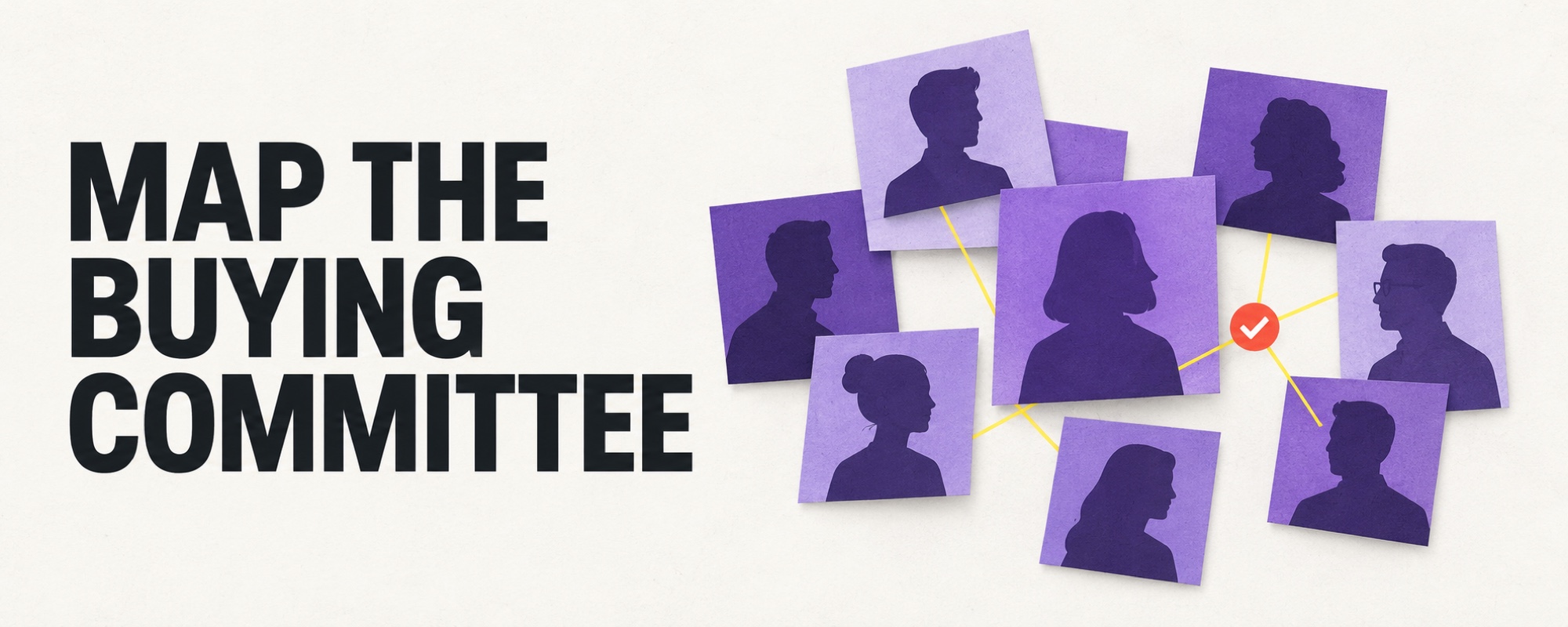
Separate the buyer's journey from your internal funnel
Your funnel answers, “Where is this record in our process?” The buyer journey answers, “What decision can this group make next, and what is still unresolved?” A discovery call can happen while an IT reviewer is only beginning research. A budget owner can reopen a comparison after a preferred vendor has been selected. Those are not exceptions to fix in the diagram; they are the work the diagram must explain.
HubSpot's B2B mapping guide distinguishes the multiple stakeholders and longer decision process from a simpler consumer path. Adobe's non-linear journey guide likewise describes buyers looping between exploration and evaluation. Neither means you need an infinitely complex canvas. It means your first map must leave room for parallel work and revisited decisions.
Choose a narrow journey before collecting touchpoints
Define the scope in one sentence: “Mid-market operations teams replacing a manual prospecting workflow, from first internal problem discussion to the first month of use,” for example. That is an illustrative scope, not a customer case. If enterprise procurement and founder-led purchases behave differently, map them separately. Combining them produces a smooth average that matches neither.
Agree on four boundaries before research:
- Segment and trigger: which account and problem start this map?
- End point: signed contract, first successful use, or renewal?
- Participants: whose decision can change the outcome?
- Evidence period: which recent deals and interviews are comparable?
If the team is still defining whom to pursue, start with the ideal customer profile. A journey map cannot repair an audience that mixes incompatible buying motions.
Interview the committee, then check the record
Use recent wins, losses, and no-decisions. Ask a buyer what first made the problem worth discussing, who joined later, which alternative almost won, what proof was missing, and when a decision was paused or repeated. Ask for the sequence in their words before showing them your proposed stages. Interviewing only the original lead turns an account decision into a single person's memory.
Then compare the account's CRM timeline, call notes, emails you are allowed to review, proposal revisions, and onboarding notes. A system trace can show that a meeting occurred; it cannot tell you whether the budget owner trusted the business case. Mark “observed,” “buyer reported,” and “inferred” separately. Unknown is a valid field, not a reason to invent intent.
Build a decision-and-handoff grid
Give each meaningful transition a row and each role a lane. You can begin in a document or spreadsheet; dedicated mapping software is optional. For each row, record:
- Buyer decision: what is the group trying to agree on?
- Roles: who initiates, influences, checks, and approves?
- Evidence: what document, conversation, trial result, or peer input matters?
- Friction: what question or dependency remains open?
- Handoff: what context must the next owner receive, and who confirms receipt?
- Confidence: direct evidence, trace, or hypothesis?
A practical sequence might be problem definition, options research, shortlist, internal validation, commercial approval, and first use. Treat these as labels for decisions, not an enforced order. A security review may start before a demo; a new sponsor may send the team back to problem definition. Keep the discovery questions tied to what the buyer has not yet resolved.
Worked example: the champion is ready, the account is not
Imagine a prospecting team champion requests a demo and likes the workflow. A generic funnel might advance the opportunity. The map asks what else must happen: the manager needs a target outcome, finance needs a cost boundary, and the data owner needs an answer about permitted inputs. None of those people is “late” merely because the champion is enthusiastic.
The useful next action is not another generic follow-up. Sales can record the champion's stated use case, identify each unresolved review, send the relevant explanation to the right person, and agree who will consolidate questions. If the account buys, the same stated outcome should pass to onboarding. If it does not, record the actual blocker rather than coding every stalled deal as “timing.” This is a hypothetical method, not a claim about Lead Scorer customers.
Turn the map into one operational change
Pick one repeated friction point backed by more than a single anecdote. It may be a missing security explanation, a vague commercial handoff, or a first-use objective that disappears after close. Assign an owner and make the change small enough to test: a revised qualification question, a shared decision brief, or a handoff field with a named recipient.
Measure the change with a relevant leading indicator, such as the share of sampled deals with an identified approver, the number of handoffs missing a stated buyer outcome, or the time spent waiting for one review. Also inspect the downstream result, but avoid claiming causality from a small before-and-after comparison. Our lead nurturing guide covers what to do when a relevant buyer is not ready; this map tells you which unresolved decision the nurture path should address.
Review the map when the buying motion changes
Revisit the map after a new segment, pricing model, approval requirement, or recurring loss reason appears. Keep the source deal links and interview dates beside each claim. Delete a lane when it no longer changes a decision. A short, evidence-backed map that a sales and marketing team actually uses is more valuable than a perfect diagram nobody updates.
Lead Scorer can help teams research and score relevant prospects and prepare reviewable outreach drafts; it does not automatically know a buying committee's private decisions. Use the map to ask better questions, keep evidence visible, and hand context to the next person. Try Lead Scorer free →
Frequently asked questions
What is a B2B customer journey map?
It is a shared view of how people at an account recognize a problem, evaluate options, approve a purchase, and adopt a solution. A useful map records each role's question, observable evidence, friction, and the team responsible for the next handoff. It describes buyer behavior, not just a vendor's campaign sequence.
How is a journey map different from a sales funnel?
A funnel groups records by your internal stages. A journey map describes the buyer's decisions across roles and touchpoints, including research you cannot observe and returns to earlier questions. Use both, but do not treat a CRM stage as proof that every committee member is ready.
Which buying committee roles should be mapped?
Start with the roles that actually appeared in recent deals: the problem owner, daily user, evaluator, budget approver, and any security, procurement, or legal reviewer. One person may hold several roles and some deals need fewer. Confirm the roster from buyer interviews and deal records rather than imposing a universal chart.
What evidence belongs in the map?
Use buyer interviews, win-loss notes, CRM timelines, sales-call notes, support or onboarding records, and relevant site or content signals. Label each observation as direct buyer evidence, a system trace, or a hypothesis. A page view alone cannot prove committee alignment or purchase intent.