Churn Rate for B2B SaaS: Calculate It Without Losing the Story
Calculate B2B SaaS customer churn rate with a consistent starting cohort, handle renewals and reactivations, and separate customer loss from revenue loss.
By Miljan @ Lead Scorer 8 min read
Churn rate answers a narrow question: of the customers you had at the start of a period, what share left? It does not explain why they left, how much recurring revenue disappeared, or whether a new customer replaced them. For a B2B SaaS team, the useful first step is a stable definition, not a supposedly universal benchmark.
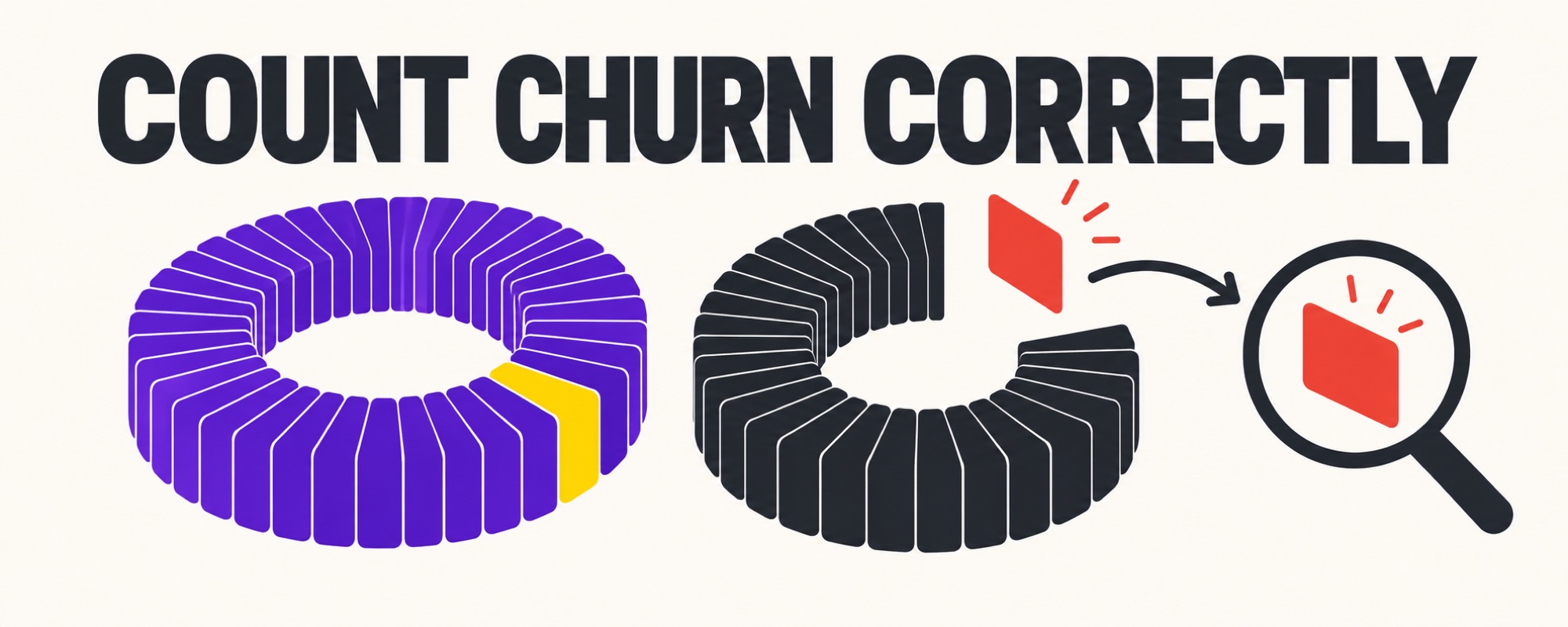
The customer churn formula
Customer churn rate = opening-cohort customers lost during the period ÷ active customers at the start of the period × 100. Suppose 200 paying accounts are active on October 1. Eight of those accounts end their subscriptions by October 31. Monthly customer churn is 8 ÷ 200 × 100 = 4%. This is an illustrative calculation, not a benchmark or Lead Scorer result. Forty new accounts acquired during October do not belong in the October opening cohort.
A customer who signs up and cancels within the same month is a real loss, but should be reported separately from this opening-cohort rate. Otherwise the numerator contains an account absent from the denominator. If one of the eight opening accounts returns before the period closes, decide whether the metric measures a cancellation event or a net lost customer. Do not silently switch definitions between months. ChartMogul's customer churn definition explicitly excludes same-period join-and-churn and churn-and-reactivation from its customer churn calculation. Your team's rule should be just as explicit.
Define a departure before opening the spreadsheet
Write down the unit of account, the observation window and the effective departure date. A person leaving a customer company is not necessarily a lost customer account. A notice to cancel is not the same as a subscription that has ended. If a renewal fails, a payment retry is pending, or a contract is temporarily paused, record the state before deciding whether that account has actually left. This avoids counting a failed payment, a cancellation request and a later expiry as three losses.
- Account: one paying organization or contract, defined consistently.
- Opening cohort: accounts active at the precise period start.
- Loss: an effective end of paid service by the period close.
- Reason: voluntary cancellation, failed renewal or payment, closure, or unknown.
- Return: reactivation recorded separately with a stable net/gross rule.
A recent B2B SaaS discussion about failed renewals illustrates the ambiguity. It is a question raised by practitioners, not evidence that every company should use one identical policy. Record an effective-end rule and keep an audit trail.
Keep customer churn and revenue churn apart
Logo churn counts customer accounts, giving each account one vote. Revenue churn looks at recurring revenue. If one large customer leaves and several small ones remain, logo churn may look modest while the revenue impact is material. Downgrades can reduce recurring revenue without losing an account at all. Expansion from surviving customers may offset lost revenue in a net measure; it must not erase the fact that an account left.
Report at least the account count and lost recurring revenue beside the percentage. If you use gross or net revenue churn, label it and state the denominator and whether expansion or contractions are included. Paddle's revenue churn guide distinguishes the revenue measure from customer loss. A single unlabeled “churn” number hides the decision it is supposed to support.
Turn the rate into a diagnostic, not an automatic rescue campaign
Start with the departure record, then inspect where in the customer lifecycle losses occur. Compare like-for-like groups: acquisition cohort, contract length, plan, customer size and first-use status. A monthly rate from self-serve subscriptions should not be compared casually with a rate from annual enterprise contracts. For early losses, review whether the customer reached the first useful result described in our B2B customer onboarding guide. For a concentrated segment, examine whether acquisition promises and the real use case matched, using the distinctions in our customer segmentation guide.
Collect cancellation reasons without treating a dropdown as the whole explanation. A price objection, an unresolved defect, lack of adoption and a failed payment imply different next steps. A recent customer-success discussion makes that practical distinction: offering a discount to a customer reporting a repeated bug can miss the problem. This is practitioner commentary, not a controlled outcome study.
- Check the account and billing record so the event is classified correctly.
- Ask which promised result was reached, blocked or no longer needed.
- Assign the issue to an owner who can change the underlying condition.
- Record the next action and review whether similar cases recur in the same cohort.
Use one page for the next monthly review
Put the opening count, lost opening accounts, end count, new customers, reactivations, loss reasons and lost recurring revenue on one page. State the effective-date rule and separate unknown reasons. Inspect a few actual account histories before changing the definition or launching a retention intervention. The rate tells you where to look; those histories help reveal what can be fixed.
If the issue begins before a customer receives value, use the onboarding checklist to review the promise, owner and first-result milestone. Lead Scorer supports prospecting and qualification; this article does not claim that it measures subscription churn or automates customer-success decisions.
Frequently asked questions
What is customer churn rate?
It is the percentage of customers active at the beginning of a defined period who have left by the end of it. State what counts as an active customer and a departure before calculating.
How do you calculate monthly churn rate?
Divide the number of opening-cohort customers who left during the month by the number of active customers at its start, then multiply by 100. Exclude customers acquired during that month from the opening cohort.
Do failed renewals count as churn?
Count them once the contract or paid subscription has actually ended under your written definition. Keep failed payments or administrative lapses in a separate reason category so they are not mistaken for voluntary cancellations.
Is logo churn the same as revenue churn?
No. Logo churn counts lost customer accounts. Revenue churn measures lost recurring revenue and can include downgrades. A large and a small account count equally in logo churn but not in revenue churn.
What is a good SaaS churn rate?
There is no universal target. Compare consistently defined periods and similar customer segments, contract terms and account sizes before interpreting a benchmark.