The First 100 Customers Course #36: CommandBar Won Its Next 10 With Custom Demos
A sourced course on CommandBar's first ten YC customers and the buyer-specific demos that helped win its next ten outside the batch.
By Lead Scorer 19 min read The First 100 Customers Course · Lesson #36
TL;DR
CommandBar's first ten customers came from its Y Combinator batch and paid roughly $50–$100 a month, co-founder James Evans says. The next ten, outside that warm circle, came after the team sent around 200 cold emails with a custom video showing the product inside each prospect's own software. Evans recalls a 20–30% reply rate. Those are founder-reported figures, not a verified funnel or a promise that custom video produces that result elsewhere. The full SaaS Club interview is unusually useful because it separates the two groups. Its short summary does not.
The mechanism was buyer-specific proof before a sales call. Evans entered each target product, found three awkward user flows, used a Chrome extension to mock CommandBar inside the app, and recorded a Loom of those flows becoming easier. At his fastest, one video still took about 45 minutes. The heavy work made a novel product understandable and made setup feel credible. A good reply then led to a prepared trial, not merely a calendar link.
This course helps you build a smaller version of that motion: ten narrowly selected products, one observable user problem per product, a truthful demonstration, and a decision gate before expanding. It does not tell you to buy 200 email addresses or create a browser extension. It asks whether the buyer can see the value of your product in their own context before they spend time interpreting a pitch.
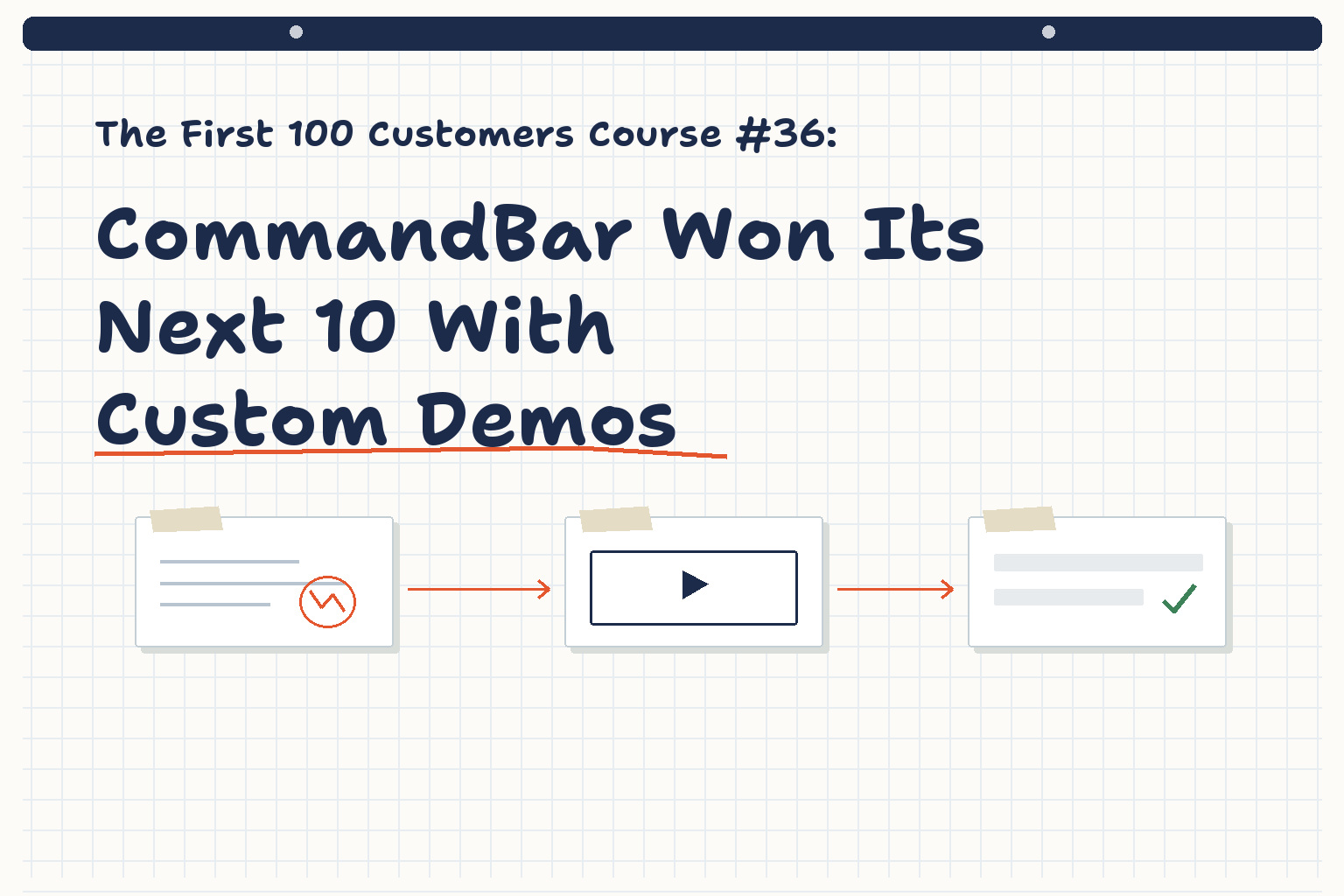
What you will build
You will leave with a ten-account proof sprint. It contains an account list, a friction log, one honest mock demonstration per account, a brief first message, a prepared trial path, and a scorecard. The output is a decision about a buyer and problem, not a claim that every personalized email works. You can run the sprint with screenshots, a sandbox, a prototype, or a screen recording. Use only material you can legally and accurately show.
This suits a B2B product with a visible workflow, an identifiable buyer, and a result that can be demonstrated before integration. It is especially useful when prospects reply, “I don't understand what this would do for us.” It fits less well when value requires months of proprietary data, clinical or financial approval, an unsafe browser modification, or a buyer who cannot evaluate the product from a mock. If you cannot make an honest demonstration without access you do not have, build a small consented sandbox first.
Case snapshot: two groups, two jobs
| Stage | Buyer and channel | What Evans reports | What the number does not prove |
|---|---|---|---|
| Before YC | Four companies said they would use it | One actually tried it and paid nothing | A commitment was not a customer |
| YC Summer 2020 | Other software founders in the batch | First ten customers; roughly $50–$100 per month | It does not prove that cold email won the first ten |
| After the batch | Founders at other software products reached by bespoke email and Loom | About 200 videos/emails, roughly 20–30% replies, next ten outside the batch | A reply is not a trial or a sale; exact cohort accounting is absent |
| Later | Word of mouth, inbound, wider product positioning | Founder describes bigger inbound accounts and later shorter explanation time | The later repositioning did not cause the original YC wins |
The YC company profile confirms the Summer 2020 batch and founder identity. A 2021 TechCrunch report independently describes the early embeddable search product and quotes Evans on how hard it was to explain by phone. Neither source audits the ten-customer or response-rate figures. An Amplitude announcement confirms the eventual acquisition in 2024; it is later context, not a validation of the early conversion math.
The model: make the buyer's own product the demo surface
CommandBar began as an embedded search bar for software products. A product manager did not wake up with a budget line for “natural-language search bar as a service,” Evans says. A standard email had to introduce an unfamiliar category, convince the buyer the problem mattered, explain integration, and ask for a meeting. That is too much conceptual work for one cold message. The founder's team moved much of that work into a visible proof artifact.
The loop was: choose a software product → use it like a new customer → record three concrete moments of friction → stage a possible improvement → show the staged result in a personal video → invite a quick trial → preconfigure enough value for the trial to be used. The Chrome extension was an internal demonstration device. It did not install CommandBar for the prospect's real users. Say that plainly when you copy the idea. If the recipient mistakes a mock for a live integration, your proof becomes a trust problem.
There are two different uncertainties in this loop. The first is whether the buyer sees the friction as costly enough to address. The second is whether the product can deliver the shown improvement after real implementation. A video can test the first. A real trial must test the second. A positive reply alone closes neither question.
Step 1: define one buyer and one visible job
The YC batch supplied CommandBar with founders of software companies. That was a useful first pool because many had an actual product to inspect and could decide quickly. It was also an unusually warm pool, so the next ten outside it mattered. When the team moved to cold outreach, it still aimed at founders whose products displayed the kind of navigation friction the search bar could address. It did not mail “all SaaS.”
Start your own worksheet with four fields: buyer role, product type, user task, and observable friction. For example: “product lead at a complex B2B app; new users cannot locate a high-value action in the first session.” The phrase is a hypothesis until you inspect real products and hear the buyer confirm it. Exclude accounts where the problem is invisible, the product cannot solve it, or a realistic trial needs access you will not get.
Create a list of ten accounts. For each, record the public product URL, why it belongs in the buyer group, who owns the workflow, and what evidence you can inspect. Mark the source of every observation. A support forum complaint can be a signal; it is not proof that the company will buy. Pass this step when eight of ten accounts share the same job and you can identify one relevant person per account. If you cannot, narrow the segment before recording videos.
Step 2: diagnose before you create
Evans signed up for each prospect's product, learned the interface, and identified three ways it could be easier to use. Three was his demonstration format, not a universal optimum. The important move was to speak about a specific workflow inside the buyer's own app. At his best speed, the research, mock and video still consumed about 45 minutes per target. That is substantial founder time. Treat it as an evidence investment.
Use a friction log: task attempted, steps taken, exact point of confusion, evidence source, user consequence, and confidence. If you have not completed the workflow yourself, label the observation “suspected.” If the product is private or regulated, ask for permission and work in a sandbox. Do not fabricate user complaints or imply that one test session represents all users. One credible issue is better than three invented ones.
The pass condition is not “I found something annoying.” It is “I can state the task and show the moment a plausible user would lose time or abandon it.” Ask whether your product actually changes that moment. If it only makes a prettier screenshot, stop. If two or three accounts show the same pain, you have the beginning of a repeatable segment. If each account requires a different product promise, return to Step 1.
Step 3: show a truthful before-and-after
CommandBar's extension inserted a local version of its search bar into the page the founder was viewing. The recipient saw a video of CommandBar in a familiar environment, which helped them judge both the job and the apparent ease of setup. Evans describes this as a way to make a claim about speed more believable than saying “integration takes a day.” That is a founder interpretation, not a measured experiment.
Build the smallest artifact that lets a buyer evaluate the change. A screenshot with annotation may be enough. A recorded click-through is better when the job depends on sequence. A prototype is useful if the interaction itself is the proof. State what is mocked, what works today, and what still needs real implementation. Do not copy the target's confidential interface into public material, claim a partnership, or use their brand in an advertisement without permission. Send the private demonstration only to the relevant contact.
Keep the video short enough to show the task, the interruption and the possible improvement without a product tour. In the original case Evans looked for three friction points. For your ten-account test, one primary job and up to two supporting examples are sufficient. End with the real next step: “If this is a priority, we can set up a small trial around this workflow.” The pass condition is that a colleague can watch the video and describe the buyer's problem before naming your feature.
Step 4: make the email a pointer to proof
The message's job is to get the right person to inspect a specific observation. It does not need to explain a new product category in a paragraph. Evans says the team sent about 200 one-off emails and received roughly 20–30% replies. His later AMA repeats the personalized Loom method and approximate reply range. It does not provide the underlying send log, a control group, or a paid-conversion denominator.
Use this template as a structure, then rewrite it from the actual evidence: “I tried [task] in [product]. At [step], I could not tell how to [desired action]. I made a short private demo of one way [outcome] could work in your app. Here is the video. Is this a problem your team is already trying to solve?” One observation, one link, one question. If the task is not genuinely hard, do not send the message.
Log sent, delivered if observable, reply, qualified reply, meeting, trial started, activated, and paid. Do not turn a reply rate into a customer rate. For the first ten sends, a practical checkpoint is whether recipients confirm the problem in their own words. That checkpoint is a test rule for your sprint, not a CommandBar benchmark. If no one confirms it, review account fit and the diagnosed job before increasing volume.
Step 5: prepare the trial before the meeting
Evans says some early trials never got used, even after a prospect expressed interest. The lesson is that interest is easy to lose when setup demands more work from the buyer. His team used integrations, imported material and curated flows so the recipient could experience an initial result quickly. The founder described the meeting pitch as trying the product after much of the preparation was already done. That is service work inside sales.
For your offer, define one activation event: a buyer completes the exact task shown in the video with their own data or approved sandbox. Write a setup checklist with owner and time required for each action. Prepare examples and permissions before the trial starts. Do not tell the prospect the integration is complete if it is a mock. Confirm security and approval requirements before requesting access.
Pass when the buyer can reach a first useful result in the first working session and agrees to a specific review date. Stop when the result depends on an unapproved data transfer or an integration your team cannot safely deliver. Follow up with the outcome of the user's task, not a generic “checking in.” A trial that was never used is neither proof of demand nor proof of product failure; diagnose the activation barrier.
Step 6: know when to change the explanation
The bespoke videos helped CommandBar find customers outside the warm batch, but the team later found that every sales conversation still required long category education. Evans says discovery calls could spend 20–25 minutes of 30 explaining what the product was. Prospects repeatedly compared it with digital adoption tools. The team eventually accepted that reference point and, in his estimate, reduced the explanation portion to around four minutes. This happened later, mainly through 2023, and should not be retroactively credited for the first-ten acquisition.
Keep an “explanation tax” field in your call notes: minutes before the buyer can state what job your product does. Also log the comparison they volunteer. If several qualified buyers use the same existing category, test a truthful sentence that starts with the shared job and then describes the difference. Do not manufacture a novel category when your buyers already have a useful frame. If calls are already clear but trials are idle, positioning is probably not the immediate bottleneck; go back to Step 5.
What failed, and what the record cannot say
Before YC, four reported commitments produced one user and no payment. Early cold messages that described a novel search bar did not do enough explanatory work. Some trials went unused. A few short content experiments did not give the team a clear acquisition channel. Those are different failures: commitment quality, message clarity, activation, and channel timing. They need different repairs. Evans also credits early word of mouth and inbound, but says he does not know how much was luck. Do not turn that into a repeatable referral engine without evidence.
There is a source conflict worth preserving. The SaaS Club summary says the personalized emails brought the “first ten”; the verbatim says the first ten were from YC and the emails brought the next ten beyond that batch. We follow the direct statement in the full interview. Neither the podcast nor the AMA publishes invoices or the complete outreach ledger. TechCrunch's early reporting supports the product description and difficulty of explaining it but does not verify the conversion percentages. The lesson is a sequence to test, not a historical funnel to copy numerically.
A seven-day proof sprint
Day 1: write one buyer-job sentence and reject accounts outside it. Day 2: find ten products and document the source for each. Day 3: use three products, record one real friction moment per product, and check whether the pattern repeats. Day 4: create one private mock or sandbox demonstration and have a colleague review what is real versus staged. Day 5: make up to three prospect-specific versions and send them only to the relevant people. Day 6: record replies and objections exactly, and prepare one trial path for anyone who confirms the problem. Day 7: decide whether to continue, narrow, or stop.
The decision sheet has four lines: accounts inspected, videos sent, buyers who independently confirmed the problem, and buyers who started and used a trial. A “yes” to the problem with no trial calls for an activation review. No problem confirmation calls for a buyer or job revision. Trials used without a measurable outcome call for a clearer success event. These are diagnostic gates, not universal pass rates. Keep the small denominator visible so you do not mistake one polite reply for distribution.
Lead Scorer implementation: research, score, draft, review
This motion fits Lead Scorer when you can define a narrow ICP and verify observable signals before spending enrichment credits or writing outreach. It does not make Lead Scorer a video recorder or browser-extension builder. The demonstration remains founder work or an approved creative workflow. Lead Scorer can organize the account research, qualify the keepers, draft individualized messages, and preserve human review before sending.
Start by storing the buyer-job statement and exclusion rules with the ICP and offer context skill. Create a source list for the ten software products and their relevant operators. Separate a “friction observed” list from a “buyer confirmed pain” list, because those are different evidence states. Use the signal-research dossier workflow to collect dated product or support signals, with URLs. Score each account against the ICP before enrichment. A low-fit company should not receive an expensive contact-discovery call merely because its UI looks awkward in a video.
For the keepers, use contact discovery only when you are ready to contact them. Build a draft campaign using the verified observation and a link to the private demo. The cold-email first-touch skill helps keep one ask under 150 words; the outreach QA audit should reject messages that invent the prospect's pain, imply a live integration, or reuse a generic line. Keep campaign status as draft. A human must review the recipient, evidence, video permission, subject, wording, and send decision. Do not schedule or activate outreach on the strength of an automated score.
One copyable research prompt is: “For these ten software accounts, identify the product owner and a public, dated signal that users struggle with [job]. Save source URLs. Mark unverified guesses. Exclude companies without a relevant buyer.” A qualification prompt is: “Score only the accounts with a verified job signal against this ICP. Explain each keep or reject; do not enrich rejected accounts.” A drafting prompt is: “For each approved contact, write one under-150-word email tied to the exact observed workflow and this private demo URL. State that the demo is a mock. Leave every message as a draft for review.”
After replies, classify objections before writing another message. Put repeated buyer language into Content Studio as a sourced note and, if useful, a narrow article or demo explanation. A person who engaged with that content can become a new signal audience, but must be requalified; a click is not an ICP match. This closes the loop from prospect observation to message to objection to sharper problem definition without pretending the software can replace the founder's judgment.
Saveable checklist
- One buyer role and one product job, with exclusions.
- Ten sourced accounts, each with a relevant operator.
- A friction log that separates observed behavior from guesses.
- A private demonstration that labels mock and working parts.
- One specific email question; no invented pain or fake integration.
- Separate counters for replies, qualified replies, trials, activation and paid customers.
- A first-session success event and a review date for each trial.
- A call note field for explanation time and buyer comparisons.
- A stop or narrow decision after the first small batch.
Sources and limits
The primary source is James Evans's full SaaS Club interview, read end to end. His Reddit AMA separately describes the personalized-video method. The YC profile confirms cohort identity, and TechCrunch's 2021 report provides an independent account of the early product and sales-explanation problem. Amplitude confirms later acquisition context. Customer counts, prices, emails, reply rates and video time are founder-reported; no public first-party transaction or campaign export was found. The source summary compresses two ten-customer cohorts, so this course uses the direct transcript wording. Run the proof sprint as a test, not as a forecast of twenty customers.
Frequently asked questions
How did CommandBar get its first ten customers?
James Evans says its first ten customers came from the Y Combinator Summer 2020 batch and paid roughly $50–$100 per month. The personalized video emails brought the next ten outside that warm cohort.
Did 200 custom videos produce a 30% customer conversion rate?
No. Evans recalls roughly 200 custom emails and a 20–30% reply rate. The public sources do not give an exact paid conversion rate, send log or controlled comparison.
Was the demo a live integration in the prospect's app?
No. CommandBar used a local Chrome extension to stage how its product could look in the app. A real installation and value test still had to follow.
What can a small B2B SaaS founder copy?
Inspect a narrow set of prospect products, document a real user task, make a truthful private demonstration, ask whether the buyer owns that problem, and prepare a first useful trial. Measure each stage separately.