Email A/B Testing for Small B2B Lists: A Decision Framework
Plan email A/B testing for small B2B lists: choose one metric, randomize accounts, define a review rule and allow an inconclusive result.
By Miljan @ Lead Scorer 8 min read
Email A/B testing compares two versions of an email by assigning eligible recipients to different groups and measuring a predefined outcome. For a small B2B list, the difficult part is deciding what the evidence can support. A dashboard can display a leading variant long before you have a reliable reason to change the campaign.
Use the workflow below to test one question, preserve a fair comparison and allow an inconclusive result. It is an editorial framework for sales teams, not a claim that any specific message has been experimentally validated.
What two podcast examples teach about small tests
In The SaaS Podcast, episode 234, Torii co-founder Uri Haramati explains that his enterprise B2B business lacked the customer flow for conclusive A/B tests. He describes bounded tests that provided direction. This is a historical founder account, not evidence that a particular email variant won.
In Startups For the Rest of Us, episode 838, Rob Walling suggests hiding a troublesome entry pricing plan and observing subsequent weeks. That practical probe is not a concurrent randomized comparison. Applying these lessons to email means distinguishing a useful clue from a measured causal effect.
1. Choose one decision and one outcome
Write the decision before writing the variants. For example: should a first-touch email offer a short diagnostic checklist or ask for a meeting? That is a test of the ask. Keep the audience, offer description, subject line and follow-up treatment stable. If you rewrite everything, you can compare two message packages, but cannot attribute a difference to the CTA alone.
For outbound, define a positive qualified reply in observable terms: the intended buyer confirms the relevant problem and agrees to a next action. A polite refusal, automatic reply and request to unsubscribe belong in separate categories. Apply the same classification to both groups, ideally without showing the reviewer the variant.
Choose a primary rate such as accounts producing that reply divided by all eligible accounts assigned to the variant. Report delivery failures separately. A secondary delivered-email rate can diagnose execution, but changing the denominator after seeing results weakens the comparison. Our sales conversion rate guide explains why event and population definitions belong together.
2. Make the groups comparable before sending
Start with a verified, deduplicated segment. For a simple pilot, select one relevant contact per account and randomly allocate accounts to A or B. If several contacts at one company participate, keep the company in one arm and analyze at account level. Otherwise, colleagues can receive conflicting treatments and their outcomes are not independent.
Avoid assigning warm referrals to A and cold prospects to B. Do not send A only on Monday and B only on Friday when the message is the question. Spread both variants across the same sending periods and sender conditions. If a major factor such as market or company size matters, randomize within a few planned groups and retain those group labels for analysis.
The NIST guidance on randomized blocks explains the principle of controlling known nuisance factors while randomizing others. The account-level setup here is our application of that principle to B2B outreach, not a design tested in either podcast.
3. Plan the evidence requirement and review date
There is no universal minimum list size for email A/B testing. The needed volume depends on the underlying response rate, the smallest worthwhile change, the desired power and the uncertainty you accept. A rare outcome and a small improvement can demand far more accounts than your campaign can responsibly reach.
The NIST sample-size discussion for proportions illustrates these planning inputs. Its one-population formula is not a ready-made two-arm email calculator. Use a method appropriate to two independent groups, or clustered accounts if applicable, before launching a formal comparison. Record the assumptions so another person can review them.
Specify the sample target, enrollment period, equal response window after each send and analysis method in advance. Daily operational checks can catch failures, but repeatedly declaring victory whenever one line moves ahead is a different statistical procedure. A valid sequential design needs its own stopping rules. Do not improvise one by refreshing the dashboard.
4. Run a test you can reconstruct
Keep a compact experiment record with the exact A and B messages, hypothesis, audience criteria, assignment method, primary metric and review rule. Add the send and delivery logs, reply categories and any deviations. Preserve the original assignment even when a contact bounces or never responds.
Check factual accuracy and message quality before randomization. Our cold email examples help with copy; the deliverability guide addresses sending conditions. An experiment does not justify relaxing recipient eligibility or sending more unwanted mail to fill a sample.
For the CTA example, A might end with “Would a short call help you assess this?” and B with “May I send the diagnostic checklist?” These are fictional variants, not winning templates. Keep the rest coherent and unchanged. If follow-ups occur before the outcome window closes, specify an identical policy for both arms so the comparison remains interpretable.
5. Keep counts beside percentages
Imagine a fictional test with 100 assigned accounts per arm. A produces four qualified replies and B produces six. The observed rates are 4% and 6%: a two-percentage-point difference, also expressible as a 50% relative increase. Those descriptions use the same ten replies. The larger relative number does not supply additional evidence.
Do not select a winner from those counts alone. Examine the uncertainty using the planned method, check comparable exposure and inspect delivery failures or misclassified replies. With sparse outcomes, use an analysis suitable for small counts rather than assuming a large-sample approximation will behave well. A non-significant comparison does not demonstrate equality.
6. Make three outcomes available
- Adopt provisionally: the planned analysis supports a commercially useful improvement, execution was sound and the result applies to this audience. Keep the scope narrow and verify it in subsequent use.
- Keep the current version: the alternative creates harm, fails a practical requirement or lacks enough benefit to justify switching. Separate that operational choice from a claim of statistical equivalence.
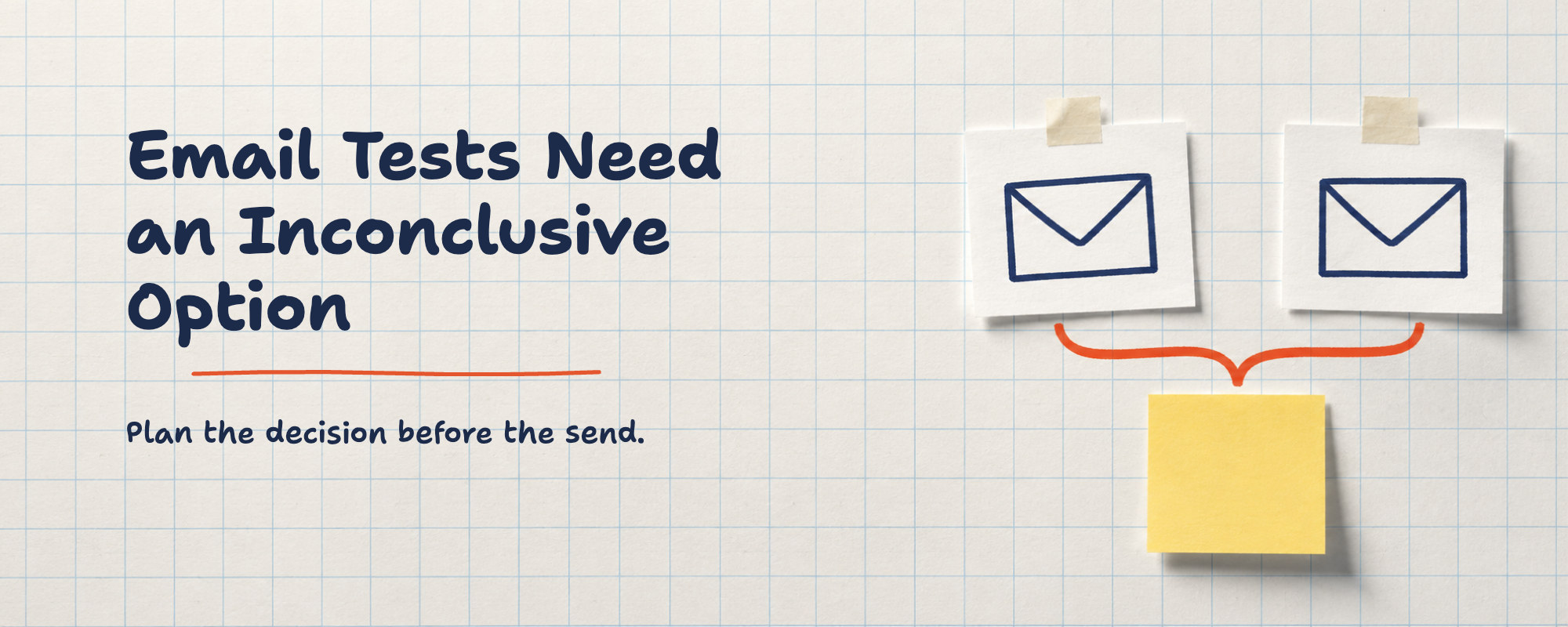
- Record inconclusive: the test cannot resolve the decision with the available evidence. Preserve the estimate, uncertainty and next question rather than relabeling the leading variant a winner.
When the required sample is unattainable, run a clearly labeled learning pilot instead. Review replies for misunderstanding, interview relevant buyers and test whether the proposed resource is useful. That can guide the next message without estimating a reliable uplift. A before/after pilot also changes time; it cannot isolate copy from a different audience mix or sending conditions.
Why opens should not decide a sales test
Apple documents that Mail Privacy Protection prevents senders from knowing whether a protected message was opened. An open count is therefore not a clean record of human attention. It is also several steps away from the buyer action that matters to a sales team.Use opens, where available, as a limited diagnostic. Review positive replies, objections, opt-outs and actual next actions. Lead Scorer can help organize audience evidence and reviewed campaign drafts; this guide does not claim it supplies random assignment, power calculations or a validated experimentation engine. Keep the experimental record wherever you can audit it.
The useful output is a defensible decision: change, retain or learn more. A small list can teach you something without proving a winner.
Frequently asked questions
What is email A/B testing?
It compares email variants assigned to different groups against an outcome chosen in advance. A useful design keeps the population, treatment and analysis rules explicit.
How many contacts do I need for an email A/B test?
There is no universal minimum. The baseline rate, meaningful effect, power, uncertainty and assignment unit determine the need. Plan a method suitable for two groups before launching.
Should I choose the email with the highest open rate?
Not automatically. Opens can be affected by privacy protection and do not establish a qualified sales conversation. Use the outcome that matches the decision and preserve its denominator.
Can I test emails with a small B2B list?
You can run a bounded learning pilot, but it may not resolve a statistical comparison. Inspect buyer understanding and objections without presenting the leading variant as a proven winner.
Does an inconclusive A/B test mean the emails perform equally?
No. It means that this test did not resolve the comparison with the evidence and method available. Establishing equivalence requires its own design and criteria.