Active Listening in Sales: A 5-Step Call Method
Use active listening in sales to turn buyer answers into verified understanding, sharper follow-up questions, and evidence-based next steps.
Active listening in sales is the discipline of turning an answer into verified understanding before turning it into a pitch. A seller hears the buyer's words, asks for a concrete example, reflects what the answer appears to mean, invites correction, and agrees on the next step that the evidence supports. The skill is visible in what the seller does after the buyer speaks.
Asking good questions is only the beginning. A rep can use an excellent discovery checklist and still miss the problem by returning to the script, completing the buyer's thought, or recording an interpretation as a fact. This guide gives B2B teams a five-step listening loop, a worked example, and a coaching scorecard for making every important answer testable.
What active listening means in a sales conversation
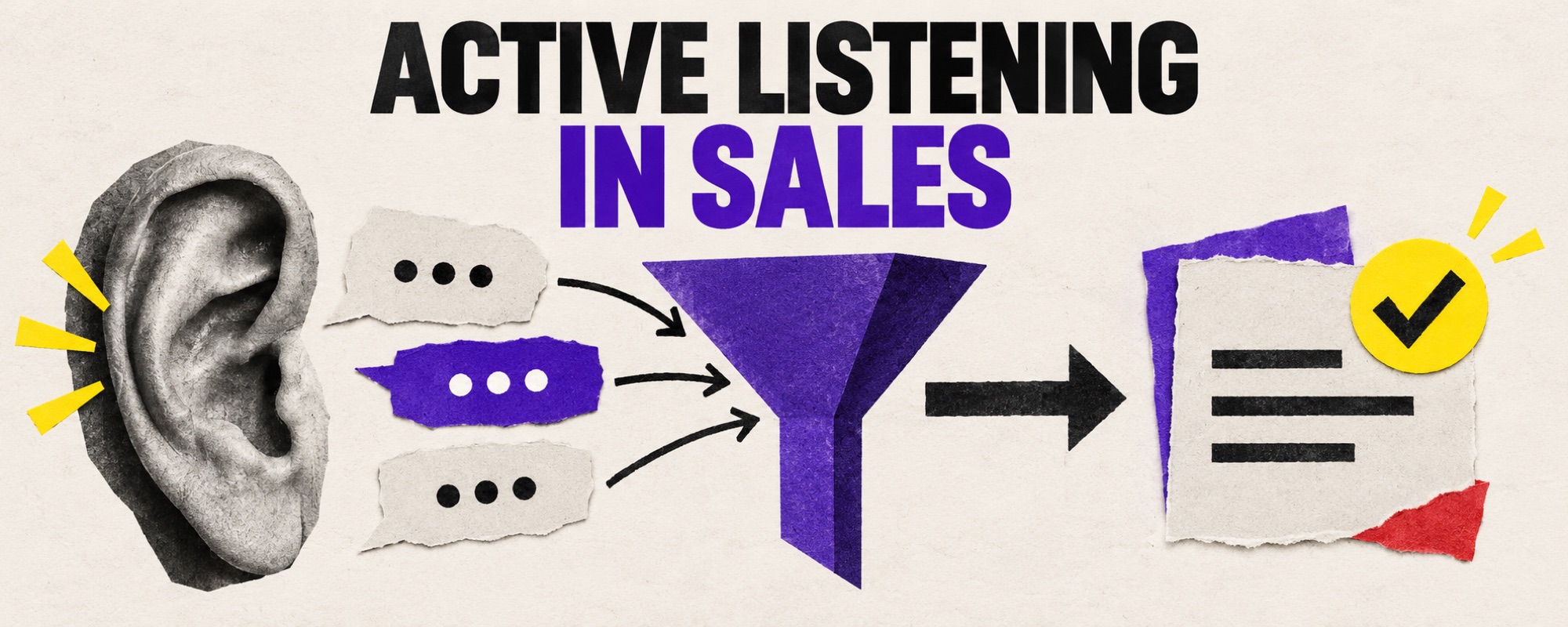
Active listening is not silence, friendliness, or repeating the last three words of every answer. It is a controlled loop between evidence and interpretation. The buyer owns the experience. The seller helps make the experience precise enough to examine without pretending to know it already.
A useful sales listening loop produces five artifacts:
- the buyer's claim in their own language;
- a recent example that anchors the claim in a real process;
- the seller's interpretation, clearly labeled as an interpretation;
- the buyer's correction or confirmation;
- a next action connected to an agreed fact, gap, or decision.
This makes active listening narrower than the full consultative selling method. Consultative selling covers research, diagnosis, recommendation, and proof across the opportunity. Active listening is the in-call mechanism that keeps the shared diagnosis accurate as new information appears.
What two sales operators reveal about listening
In an August 2026 episode of Sales Talk for CEOs, Becc Holland argues that sellers need knowledge of the buyer's work, not only product knowledge. That preparation enables finite diagnostic questions. The revealing moment comes after the answer: curiosity should create a conversation rather than a march through a fixed set of questions. She also frames sales as a helping profession, which raises the standard for how a seller interprets what the buyer says. Listen to the episode.
Carlo Girasoli gives the method an operational edge in a September 2026 episode of Higgle: The B2B Sales Club. He describes researching the company and person, using AI to assemble context and expose gaps, and then asking questions to understand the business. His tailored response in a later procurement process was based on what the buyer had told him. He also recommends closing the feedback loop on every deal, won or lost, so the next decision uses evidence rather than habit. Listen to the episode.
These are practitioner accounts, not controlled performance studies. They support the workflow in this article: prepare enough to notice meaning, follow the answer, preserve human judgment, and learn from the buyer's correction. They do not establish a universal conversion lift.
A five-step active listening method for sales calls
1. Prepare hypotheses without scripting the answer
Before the call, write down what you observed, what it might mean, and what would disprove that interpretation. A hiring announcement, a new market, or repeated account-level visits to a page can guide a question. None identifies a person's intent, budget, or priority. Enter the call ready to abandon the hypothesis.
Keep the plan short enough that you can listen. The 15-minute pre-call planning template separates verified facts from assumptions and unknowns. During the call, display only the few questions needed to test the riskiest assumption. A long checklist makes completion compete with attention.
2. Capture the claim before interpreting it
When the buyer says, “Our reps miss warm accounts,” capture the phrase and resist translating it immediately into “they need lead scoring.” Ask what warm means in their team, which accounts were missed, who noticed, and what happened next. A claim becomes useful when the people, event, sequence, and consequence are visible.
Listen for changes in language. “Usually,” “sometimes,” and “last week” describe different levels of evidence. “We think” may signal a hypothesis. “The RevOps report shows” points to a source that can be inspected. Preserve those distinctions in the notes.
3. Follow the answer with one evidence question
Choose the next question from the answer you just heard. Useful prompts include: “Can you walk me through the most recent case?”, “What happened immediately before that?”, “Who had to resolve it?”, and “What would I see in the system if that explanation is right?” The purpose is not interrogation. It is to move from an abstract judgment to an observable process.
Do not stack three questions. Ask one, allow the buyer to think, and notice whether the response confirms the original claim or opens a different path. The better question is often the one that tests the seller's favorite explanation.
4. Reflect meaning and uncertainty
Summarize the current understanding in a form the buyer can reject: “It sounds as though the issue is not the number of signals. It is that ownership is unclear when a signal arrives. I am basing that on the two examples you gave. What am I missing?” This reflection contains the interpretation, its evidence, and an invitation to correct it.
Avoid polished paraphrases that quietly add causality. “Your team is losing revenue because the process is manual” is a claim unless the buyer has shown the link. A safer reflection is: “The assignment took two days in those cases. We have not yet established whether that delay affected a deal.” Precision builds more trust than confident mind reading.
5. Confirm the next action and its evidence
Close the loop before leaving the topic. Agree on what is established, what remains unknown, who owns the missing evidence, and what decision the next step will enable. The next action may be a targeted demo, a sample audit, a conversation with another stakeholder, a measurement task, or no action at all.
Record the buyer's language, the source of each important fact, your interpretation, the correction, and the agreed next step separately. This gives a manager something coachable and prevents the CRM from hardening a plausible summary into false certainty.
A worked B2B active listening example
A growth leader says, “We need to know who visits our pricing page.” A weak response promises visitor identification. An active listener first clarifies the statement: “When you say who, do you need the company, the individual, or both? What decision would that information change?”
The buyer explains that SDRs already receive account-level signals but cannot decide which accounts deserve research. The seller asks for the most recent case. The buyer describes a known company that returned several times, yet no one acted because the account owner and buying role were unclear. The seller reflects: “The company signal existed. The gap appears to be the review and assignment step, not proof of a named visitor. Is that accurate?” The buyer corrects one detail: assignment was clear, but the team lacked a standard for prioritization.
The next step becomes a bounded audit of recent account signals and the decisions that followed. It is not a demo built around identifying a named person. The listening loop changed the diagnosis from identity to prioritization and protected the buyer from an unsupported promise. Our guide to website visitor identification explains the account-versus-person boundary in detail.
How AI can support active listening without replacing it
With appropriate consent and data handling, AI can support the administrative layer:
- transcribe the call and retain timestamps for review;
- separate buyer statements, seller interpretations, and unresolved questions;
- retrieve a contradiction between the current call and an approved CRM note;
- draft a follow-up that lists decisions, owners, and open evidence;
- surface moments where the rep asked a new scripted question instead of following the answer.
A transcript does not resolve meaning by itself. It may miss tone, speaker identity, negation, or context. Human review is essential before a summary becomes a CRM fact or customer communication. The commercial judgment remains with the people in the conversation.
An active listening scorecard for sales coaching
| Behavior | Evidence in the call | Coaching question |
|---|---|---|
| Follows the answer | Next question refers to the buyer's last statement | What phrase should the rep have explored? |
| Requests an example | A recent event, people, and sequence become visible | Which claim still lacks an observable case? |
| Labels uncertainty | Facts and interpretations remain separate | Where did the rep add causality? |
| Invites correction | The buyer can amend the summary | Was the reflection rejectable? |
| Closes the loop | Next action answers a defined unknown or decision | What will the next step prove? |
Score a short, consequential excerpt rather than the whole call. Pick one behavior below standard, rehearse a better response, and review the same behavior on the next call. The broader sales coaching framework turns this observation into a repeatable manager cadence.
Active listening earns its place in sales when it changes the quality of the decision. Prepare a hypothesis, capture the claim, ask for evidence, reflect the meaning and uncertainty, then close the loop. The result is not simply a buyer who feels heard. It is a buyer and seller working from a more accurate account of what should happen next.
Frequently asked questions
What is active listening in sales?
Active listening in sales is a verification loop: hear the buyer's claim, ask for a concrete example, reflect the meaning and uncertainty, let the buyer correct your interpretation, then agree on a next step supported by the conversation. It is more rigorous than waiting quietly for a chance to speak.
Why is active listening important in a sales call?
It prevents a seller from turning a vague symptom into a convenient diagnosis. By checking meaning, consequences, owners, and evidence, the seller can distinguish a material problem from a preference, a temporary event, or an incorrect hypothesis. The buyer also gets a clearer account of the decision.
What are five active listening techniques for sales?
Prepare hypotheses without scripting the answer, capture the buyer's exact claim, ask for a recent example, reflect both meaning and uncertainty, and confirm the next action plus the evidence behind it. These five moves form one loop and can be repeated whenever a new claim changes the diagnosis.
How do you practice active listening with a sales team?
Review short call excerpts and score whether the rep followed the buyer's last answer, requested an example, separated fact from interpretation, invited correction, and recorded an evidence-based next step. Coach one missing behavior at a time, then repeat the exercise on the next call.
Can AI improve active listening in sales?
AI can transcribe calls, organize notes, retrieve earlier statements, and flag unanswered questions. It cannot reliably decide what a buyer meant or whether a statement is commercially important. The seller remains responsible for consent, verification, interpretation, and the next question.