Sales Coaching: A Weekly System for Better Buyer Diagnosis
Run sales coaching as a weekly evidence loop: inspect real work, diagnose one buyer-facing behavior, practice it, and verify the change next week.
Most sales coaching sessions are disguised pipeline reviews. The manager asks which deals will close, the rep explains the forecast, and both leave with a longer task list. They discussed outcomes, but they did not improve the behavior that produces them.
A useful coaching session starts with evidence from the seller's work: an account brief, outbound message, call excerpt, discovery note, or next-step email. The rep diagnoses the work first. The manager then helps identify one buyer-facing behavior to practice and one observable test for the following week.
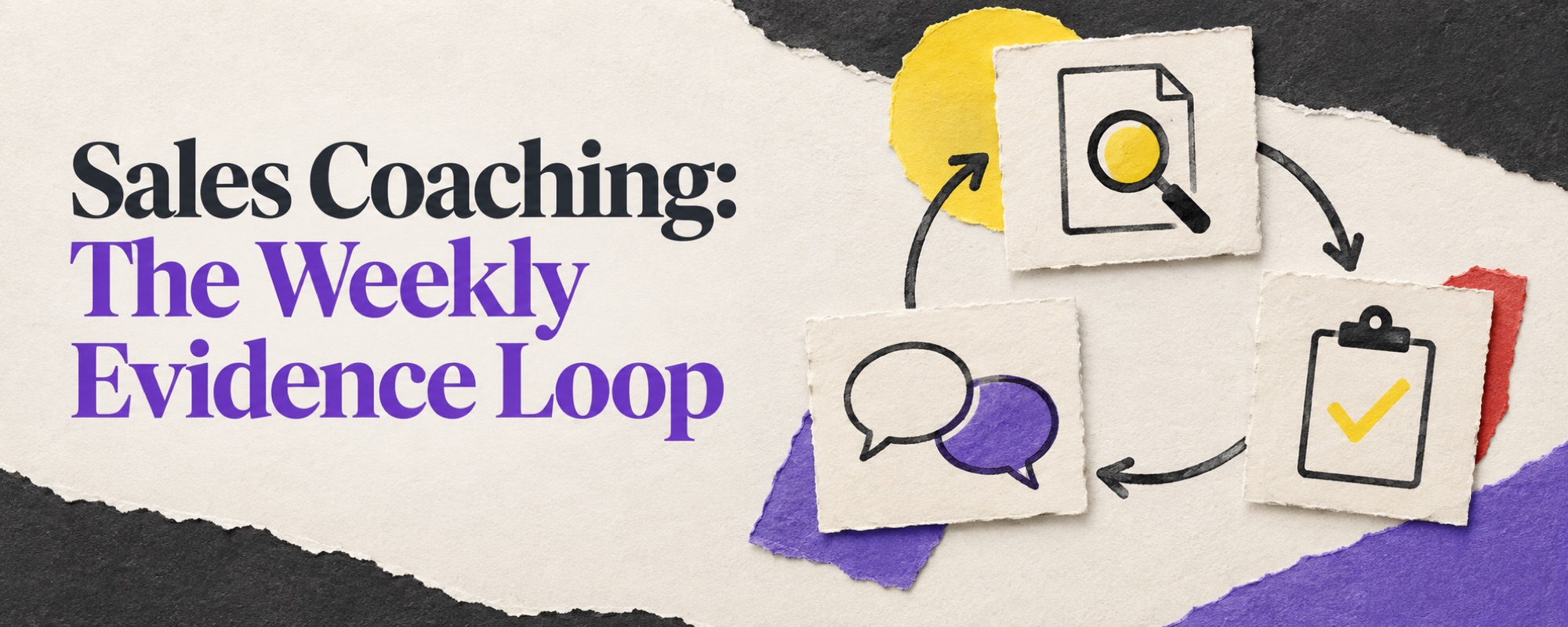
Sales coaching is a behavior loop, not a forecast meeting
Training transfers a method. Onboarding sequences what a new rep must learn. Coaching examines how one seller applies the method to current work and helps them make the next attempt better. That distinction keeps three useful formats separate:
| Format | Primary question | Evidence of progress |
|---|---|---|
| Training | Does the team understand the method? | Applied exercise |
| Onboarding | Can this new rep work safely and independently? | Capability gate |
| Coaching | Which behavior should this rep improve next? | Change in real work |
| Pipeline review | What is happening in active opportunities? | Accurate deal state |
Keep a pipeline review if the team needs one. Do not call it coaching. A forecast can reveal where to look, but the coaching work begins when the manager and rep inspect the decision that created the current state.
The buyer-knowledge gap managers should coach
In an August 2026 episode of Sales Talk for CEOs, sales practitioner Becc Holland argued that founders often carry detailed buyer knowledge that never reaches the sales team. They know the buyer's work, indicators, and recurring problems, then equip sellers mainly with product knowledge. The rep can present the solution but cannot reliably diagnose the situation. Listen to the episode.
Holland's advice to “learn about your buyer 15 minutes a day” is useful as a habit, not a performance benchmark. Coaching should turn that habit into observable work. A seller studies a buyer indicator, uses it to form a cautious hypothesis, asks a question that could disprove it, and records what the buyer actually said.
This gives the manager something better to coach than confidence or charisma. They can inspect whether the rep understood the buyer's process, separated a fact from an assumption, and chose a relevant next question.
The five-part weekly sales coaching system
1. Bring one piece of real work
Choose one artifact before the session. It should be small enough to inspect and important enough to teach something. Useful options include:
- an account brief written before outreach;
- a first email and the evidence used to write it;
- a five-minute call excerpt with its transcript;
- a discovery summary and the questions that produced it;
- an objection response or a follow-up message;
- an opportunity note that explains the next decision.
Avoid starting with a dashboard average. An average can locate a pattern, but the rep needs a concrete example to understand what to change.
2. Let the rep diagnose the work first
Ask the seller to reconstruct the moment without defending it. Good coaching questions include:
- What did you know about the buyer before this interaction?
- Which part was a sourced fact, and which part was your hypothesis?
- What answer changed your understanding?
- Where did you move from diagnosis to presentation?
- What evidence would prove your conclusion wrong?
- If you repeated this tomorrow, what would you keep?
This is not a test of whether the rep can guess the manager's preferred answer. The purpose is to reveal the reasoning that produced the work. A manager cannot coach an invisible decision.
3. Compare the decision with buyer evidence
Rebuild the chain together: signal, hypothesis, question, answer, consequence, and next step. Mark missing links rather than filling them with confidence. For example, a company hiring SDRs is an account-level signal. It does not prove that a named VP wants new software. The rep can use the hiring pattern to ask about ramp or process, but should not present inferred intent as fact.
This boundary also applies to website activity. Account identification can suggest which company is active. It rarely identifies the person or their motive. Coaching should preserve that distinction before it appears in customer-facing copy.
4. Practice one behavior, not the entire call
Select the smallest behavior that could improve the next attempt. If the rep pitched too early, practice two follow-up questions after a vague answer. If the email overclaimed, rewrite the claim as a sourced fact plus a question. If the next step was weak, practice summarizing the buyer's decision and asking who owns it.
Run the same moment three times with slightly different buyer responses. Repetition matters because the rep must adapt the behavior rather than memorize one sentence. Keep the rest of the scenario stable so the change is visible.
5. Agree on one observable test
End with a behavior that the rep can demonstrate during the next week. “Improve discovery” is not observable. Better commitments look like this:
- label facts and hypotheses in five account briefs;
- ask one disconfirming question in three discovery calls;
- summarize the buyer's current process before presenting a capability;
- remove person-level claims supported only by account signals;
- record a mutual owner and date for every opportunity next step.
The next coaching session begins with this evidence. Without follow-up, the session was advice. With follow-up, it becomes a learning loop.
A 45-minute sales coaching agenda
| Time | Activity | Output |
|---|---|---|
| 0-5 min | Review last week's observable test | Evidence checked |
| 5-12 min | Rep explains the new work sample | Decision reconstructed |
| 12-22 min | Inspect buyer evidence and missing links | One root behavior |
| 22-35 min | Practice the difficult moment three times | Adapted response |
| 35-42 min | Apply the behavior to live work | Revised artifact |
| 42-45 min | Define the next observable test | Owner and review date |
The timing is a working template. A ten-minute message review may be enough for an experienced rep. A high-stakes enterprise call may deserve a longer session. Keep the evidence loop even when the duration changes.
A buyer-diagnosis coaching scorecard
Use a small scorecard to focus attention, not to manufacture a precise performance score. Mark each dimension as demonstrated, partial, or missing and attach the supporting excerpt.
| Dimension | Question for the reviewer |
|---|---|
| Buyer context | Can the rep explain the buyer's current work? |
| Evidence discipline | Are facts, inferences, and unknowns separated? |
| Question quality | Could the questions disprove the hypothesis? |
| Listening | Did the rep follow the answer or return to the script? |
| Relevance | Was product information tied to a verified condition? |
| Decision clarity | Do both sides understand the next decision and owner? |
Store the excerpt and the agreed behavior alongside the scorecard. A row without evidence becomes a manager's impression, which is difficult for the rep to act on or challenge.
What not to coach from
Do not coach only from outcomes
A meeting booked can follow weak research. A lost deal can follow sound discovery. Inspect the decision and the available evidence before treating the outcome as proof of skill.
Do not fix five behaviors at once
A long list of corrections feels comprehensive but gives the rep no clear experiment. Select the behavior with the greatest buyer impact and return to the others later.
Do not write the answer for the rep
The manager can demonstrate once, but the rep must reconstruct and practice the choice. Otherwise the manager becomes a permanent editing layer and the seller never owns the judgment.
Do not turn surveillance into coaching
Call recordings and activity data can support review. They do not create psychological safety or explain why a decision was made. Tell reps which evidence is reviewed, for what purpose, and how a coaching note will be used.
How AI can support the loop without coaching by hallucination
AI can reduce the mechanical work around coaching. It can locate a call moment, retrieve the account sources used before outreach, compare an artifact with a scorecard, or generate practice variants from approved buyer patterns. It should show its evidence so the manager and rep can inspect the same material.
Keep four boundaries:
- do not infer a person's intent from company-level activity;
- do not invent a customer quote, benchmark, or objection;
- do not score tone or confidence as a proxy for buyer value;
- do not let a generated summary replace the source call or message.
Lead Scorer can help assemble the research and message evidence that makes this review possible. The manager still decides whether the rep understood the buyer and which behavior deserves practice.
Build the system around the assets you already have
If the team lacks a shared standard, start with our sales enablement training program. Use the sales onboarding plan to certify new reps, the discovery question workflow to coach calls, and the objection-handling process to review difficult moments.
Then choose one weekly artifact, one buyer-facing behavior, and one observable test. A modest loop that closes every week will teach more than a detailed coaching plan that disappears after the kickoff.
Frequently asked questions
What is sales coaching?
Sales coaching is a recurring manager-rep process that improves a specific behavior through evidence, reflection, practice, and follow-up. It uses real work such as an account brief, email, call, or opportunity note. Training transfers a shared method; coaching helps one seller apply and refine that method in context.
How often should sales coaching happen?
A weekly session creates a short enough feedback loop for most B2B teams. Keep the session focused on one behavior and check the agreed evidence the following week. Add brief call or message reviews between sessions when the work is high-risk or the rep is still learning the motion.
What should a sales coaching session include?
Bring one real work sample, ask the rep to diagnose it first, compare the work with buyer evidence, choose one behavior to change, practice that behavior, and agree on an observable test. The next session starts by reviewing whether the behavior changed.
What is the difference between sales coaching and sales training?
Sales training teaches a common capability to a group, often through a defined curriculum. Sales coaching is continuous, individual, and based on current work. Onboarding and enablement create the shared standard; coaching keeps that standard alive after the course ends.
How do you measure sales coaching?
Measure the behavior before the revenue outcome. Track whether account research is sourced, questions follow buyer evidence, claims stay within approved proof, next steps are mutual, and CRM notes separate facts from assumptions. Revenue can be reviewed later, but one deal does not prove that coaching caused the result.
Can AI help with sales coaching?
AI can retrieve call excerpts, group repeated issues, simulate buyer responses, and compare work with a scorecard. Require source links, keep account signals separate from person-level claims, and let the manager decide what the evidence means. AI can accelerate review without owning the coaching judgment.