Cold Email Follow-Up: 7 Examples After No Response
Write a cold email follow-up that earns a reply without nagging. Use seven stage-specific examples, a value test, and clear rules for when to stop.
A cold email follow-up fails when it repeats the same request with more pressure. “Just checking in” asks the recipient to reconsider an email that has not become more relevant. A useful follow-up does a specific job: revive the original context, add evidence, teach something, test another plausible problem, change channel, route the conversation, or close the loop.
The seven examples below form a menu rather than a mandatory blast. Use only the steps your evidence can support. A short sequence to the right account is better than seven clever messages to the wrong person.
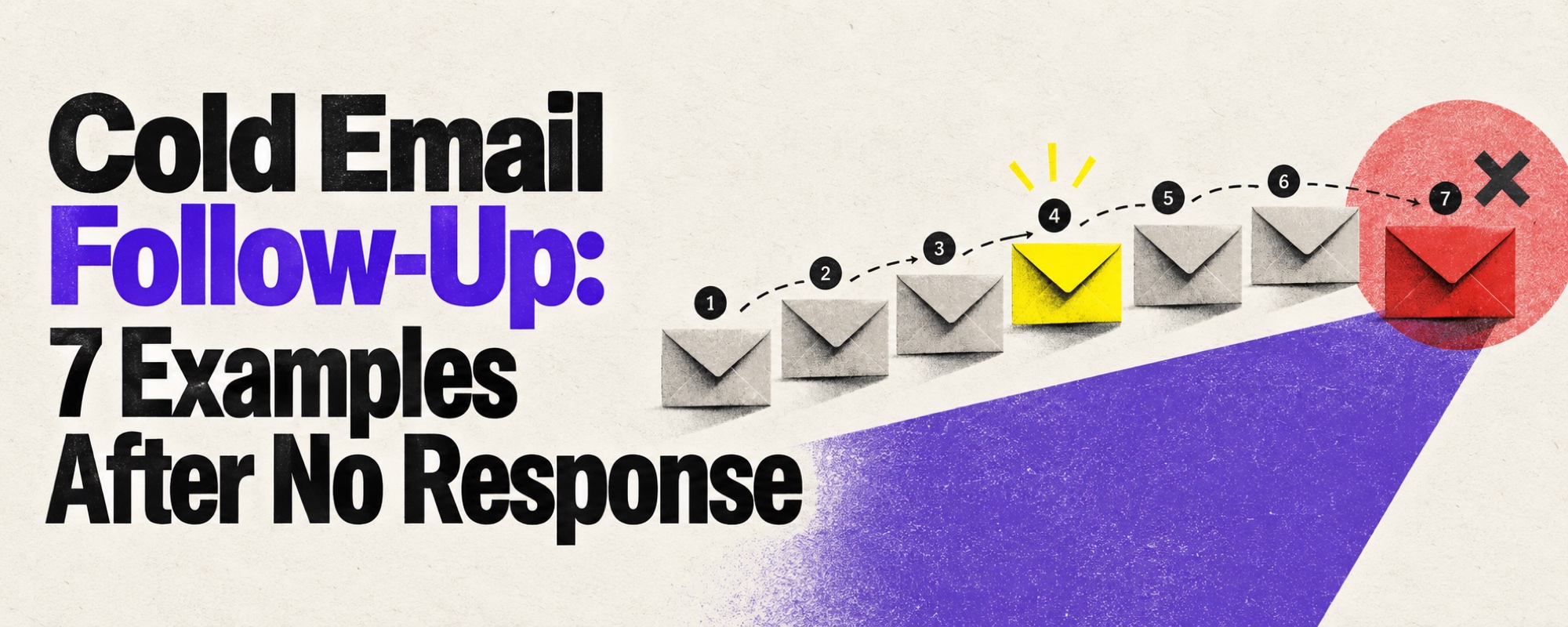
What a cold email follow-up should change
Silence is ambiguous. The buyer may be busy, unconvinced, badly matched, unable to prioritize the issue, or simply unaware of the first message. Do not pretend to know which explanation is true. Give the next email one observable purpose and measure whether it produces a useful response.
| Follow-up job | What changes | What to avoid |
|---|---|---|
| Memory jog | Returns the original message to view | Adding a second pitch |
| Evidence | Makes the claim easier to evaluate | Unverified social proof |
| Education | Gives the buyer a useful distinction | Disguising a pitch as advice |
| Reframe | Tests a different relevant problem | Listing every product feature |
| Channel change | Makes the sender recognizable elsewhere | Copying the same pitch into a DM |
| Routing | Checks ownership with a low-effort reply | Making the recipient research for you |
| Close | Stops the active sequence cleanly | Fake scarcity or guilt |
This is narrower than a complete sales cadence, which also covers channel mix, timing, ownership, and funnel math. It begins after a relevant first cold email received no answer.
Two podcast lessons that improve the sequence
In a 2026 episode of 30 Minutes to President's Club, Sam McKenna described a simple second email that adds no new information: it politely brings a heavily researched first message back to the recipient's attention. Her third email changes jobs. It teaches a related value proposition and carries no ask. She also recommends acknowledging a LinkedIn acceptance without immediately repeating the pitch. Listen to the episode.
A Help Wanted episode with sales leader Will Stein supplies the other boundary. The hosts review a sequence full of jokes, GIFs, and increasingly theatrical nudges. Stein's alternative is professional persistence: explain why the offer matters, contribute a concrete insight, and accept that the buyer's priorities differ from the seller's. He gives five contact points as a possible stop guideline while stressing that product complexity and adoption friction change the answer. Listen to the episode.
These are operator accounts, not universal benchmarks. They support a message design: one job per touch, value before pressure, and a visible stop condition. They do not prove that a particular day, number of emails, or template will perform for your market.
7 cold email follow-up examples after no response
1. The short memory jog
Use this only when the first email was researched, specific, and still current. Keep the original thread so the evidence remains visible.
Hi Maya — bringing this back to the top of your inbox in case the note below arrived at a busy time. I would still value your view on whether improving lead-routing accuracy is a priority for the revenue operations team this quarter.
Best,
Jon
The email names the subject and asks for a view. It does not claim the recipient “must have missed” anything, manufacture urgency, or paste a second product summary.
2. Add one piece of evidence
If the first email offered a hypothesis, the next can make that hypothesis easier to inspect. Use an approved customer example, a public workflow observation, or a small diagnostic. Never invent a result to fill the slot.
Maya — one detail that may help you assess the routing issue: teams usually find the largest gap by comparing assigned owner, accepted owner, and first-action time for the same lead cohort. If those fields disagree, changing the scoring model first rarely fixes the handoff.
Would that check be useful for your team?
3. Teach without asking for a meeting
A no-ask email proves that every touch is not another demand on the buyer. Share one distinction the recipient can use without purchasing anything.
A quick distinction for your routing review: match rate shows whether a rule found an owner; acceptance rate shows whether that owner agrees. Combining them can hide a clean technical rule that sends work to the wrong team.
I thought that might be useful as you review the process.
4. Test a second, adjacent problem
Do not dump the rest of the feature list. Choose one adjacent problem that the same evidence makes plausible, and label it as a question rather than a fact.
Maya — the routing rules may already be sound. A second failure point we often check is context: does the assigned rep receive the page, campaign, and account signal that caused the score to change? If not, the queue can look slow when the real issue is missing evidence.
Is that closer to the problem you are seeing?
5. Change channel without a pitch slap
A LinkedIn connection or brief voicemail can make the email sender recognizable. It should not multiply the pressure. A connection note can simply provide context:
Hi Maya — my name may look familiar from two emails about lead routing. Connecting here so you have the context. No need to reply if it is not a current priority.
If the request is accepted, “Thanks for connecting; glad to stay in touch” is enough. Do not treat acceptance as consent to restart the full pitch in direct messages.
6. Make routing easy
When the problem appears real but ownership is uncertain, ask a question that can be answered in a few words. Research the likely owner first; the recipient should not have to map the organization for you.
Maya — I may have the ownership wrong. Does lead-routing quality sit with revenue operations or sales operations at Acme? A one-word redirect is helpful; if neither team owns it, I will close the loop.
7. Close the active sequence
The final email should reduce uncertainty without pretending this is the buyer's last-ever chance. Leave the door open and stop the automated sequence.
Maya — I have not heard back, so I will close this thread rather than keep adding to your inbox. If lead-routing accuracy becomes a priority later, I am happy to share the diagnostic checklist. Either way, thank you for reading.
How to choose the next follow-up
Before sending another message, answer four questions:
- Fit: Is this still the right account and likely owner?
- Evidence: What verified fact or useful distinction makes this touch different?
- Job: Is the email jogging memory, teaching, testing, routing, or closing?
- Stop: Which response or lack of evidence ends the sequence?
If you cannot answer the evidence question, do not manufacture novelty with a meme, fake reply, compliment, or new formatting. Pause the contact and improve the account research. Our guide to cold email subject lines applies the same rule to the inbox preview: specificity must come from something true.
Timing, asks, and stop rules
Start with a testable spacing rule, such as two or three working days before the first follow-up and progressively longer gaps later. Compare cohorts rather than individual anecdotes. Weekend sends may fit some executive audiences, but the podcast account alone does not establish a general advantage.
Match the ask to the evidence. A broad relevance question belongs early. A meeting request belongs after the buyer confirms the subject matters. McKenna's warning about calendar links is useful here: a link can make the recipient do scheduling work before agreeing to the conversation. Once interest exists, offer times or let the buyer choose the scheduling method.
Stop after an explicit no or opt-out. Also stop when the account is a poor fit, the role is wrong and no responsible owner can be verified, the trigger is stale, or the sequence has exhausted its useful evidence. A silence limit should reflect deal complexity, but “we built seven steps” is not a reason to send all seven.
Measure message quality, not persistence alone
Track delivery, positive replies, negative replies, referrals, meetings, and opt-outs by step. Then review the copy qualitatively. Did each touch introduce a new reason to read? Did a referral question outperform another meeting request? Did later steps create replies but also more opt-outs?
Separate sequence performance from list quality. A polished follow-up cannot make an irrelevant account relevant. Verify the ICP and decision role before optimizing another subject line. If replies expose recurring objections, use the objection-handling framework to improve the next message without arguing with the buyer.
A safe role for AI
AI can retrieve the first email, classify the next job, summarize approved evidence, and generate a shorter draft. Require it to cite the source of every account claim and to leave unknowns unknown. Block generation when the prospect opted out, the account no longer fits, or the system cannot verify the proposed evidence.
The final check remains human: is the fact true, is the inference labeled, does the message help, and should this person still be contacted? That discipline makes a follow-up sequence feel coherent because every touch earns its place.
Frequently asked questions
How do you follow up on a cold email after no response?
Start with one short memory jog in the original thread. Later touches should earn their place with a new proof point, useful observation, alternative problem, or easy routing question. Keep each email about one idea, remove manufactured urgency, and stop when continued contact no longer creates value.
How long should you wait before following up on a cold email?
There is no universal interval. A practical starting point is two or three working days, then wider spacing for later touches. Adjust for the buyer's role, sales cycle, urgency, and channel. Timing cannot rescue an irrelevant first email, so test message quality separately from send time.
How many times should you follow up on a cold email?
Use a stop rule instead of an arbitrary maximum. Five total contact points can be a reasonable planning boundary for a low-complexity motion, but enterprise or high-adoption offers may need a longer, more varied sequence. Stop immediately after a clear no, opt-out, wrong-person confirmation without a referral, or any sign that further contact would be inappropriate.
Should every cold email follow-up include a call to action?
No. An educational follow-up can deliver one useful insight without asking for a meeting. Removing the ask can make the touch easier to consume and prove that the sequence is not only a repeated request. Use a clear question when the next decision genuinely belongs to the recipient.
Should a cold email include a calendar link?
Usually wait until the prospect has expressed interest. A calendar link in an unsolicited email can shift scheduling work to the buyer before they have agreed to meet. First ask whether the topic is relevant; once they say yes, offer a few times or a link according to their preference.
Can AI write cold email follow-ups?
AI can suggest variants, shorten copy, and retrieve approved evidence. It should not invent a trigger, personal detail, customer result, or urgency. A person should verify the account, the claim, the sequence history, and the stop condition before any message is sent.