Demand Generation vs Lead Generation: What Each One Actually Does
Demand generation creates problem awareness before buyers are ready. Lead generation captures explicit interest. Learn how to connect both without turning every signal into a lead.
The simplest difference between demand generation and lead generation is the change each one is supposed to produce. Demand generation changes what a market understands. Lead generation records who has responded.
That distinction matters because a database can grow while demand stays flat. A gated PDF may collect an email address from someone doing research. A website visit may identify a company. A list vendor may supply a valid contact. None of those events proves that a buyer recognizes a costly problem, trusts your point of view, or wants a sales conversation.
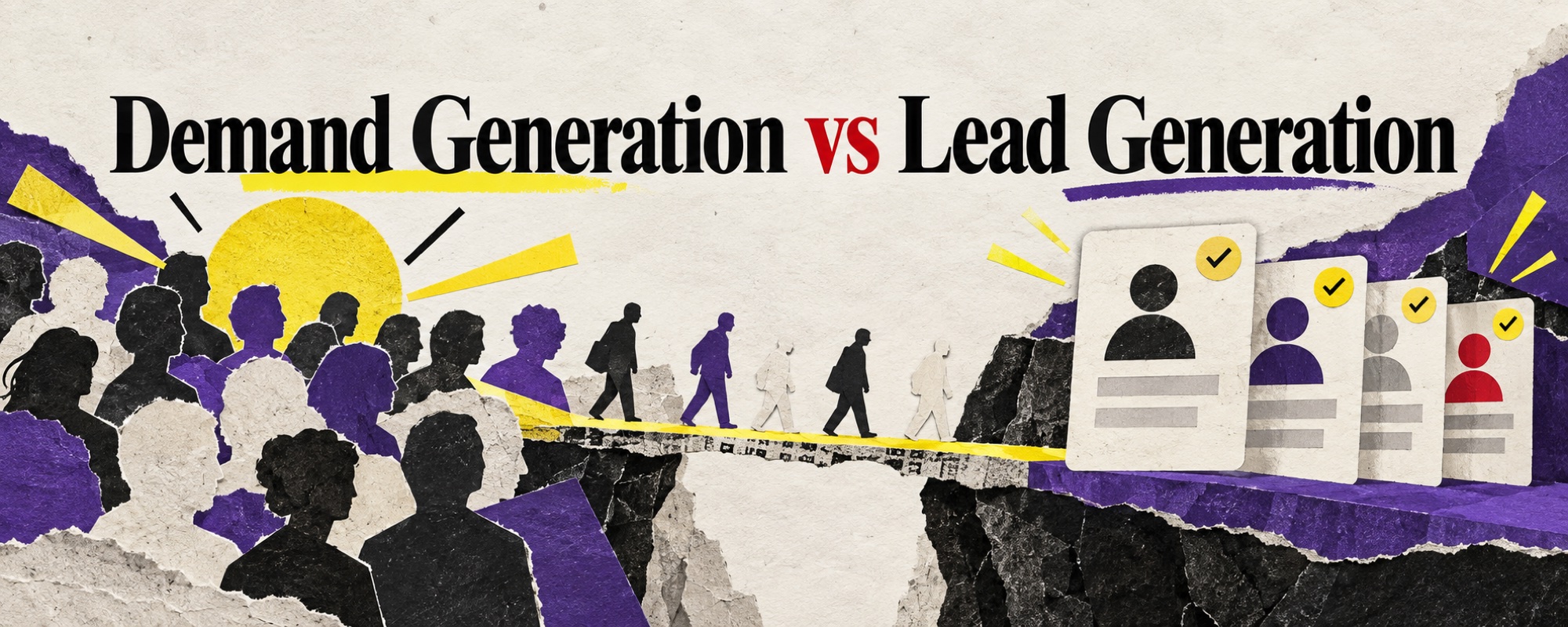
Demand generation creates relevance; lead generation captures a response
Demand generation makes a problem visible before the buyer is actively shopping. It can take the form of research, practical education, a diagnostic tool, a useful point of view, or an outbound message that helps a specific account notice a real operational risk.
Lead generation begins when the organization asks for, observes, or receives an explicit response: a registration, subscription, reply, request, referral, trial, or demo. The response is useful, but it still needs context. Someone downloading a guide is not automatically qualified. Someone from an account visiting a pricing page is not automatically the person who visited it.
| Layer | Job | Useful evidence | Common mistake |
|---|---|---|---|
| Demand generation | Create problem and category awareness | Qualified people consume, remember, and return to useful material | Calling every impression a lead |
| Demand capture | Meet buyers already researching | High-intent searches, repeat account activity, comparison behavior | Attributing an account signal to a named person |
| Lead generation | Collect an explicit hand-raise | Reply, registration, referral, trial, or demo request | Optimizing form volume without measuring fit |
| Sales conversion | Diagnose and decide together | Confirmed problem, decision path, next step, and mutual commitment | Treating contact data as purchase intent |
Why lead generation fails when the buyer has learned nothing
In a 2026 episode of Sales Talk for CEOs, sales practitioner Becc Holland makes a useful distinction between attracting existing demand and creating demand. Her argument is that outbound teams often ask whether a buyer already struggles with the problem the seller happens to solve. The buyer has not prioritized it, so the message adds no reason to act.
Holland suggests a diagnostic approach instead: learn the buyer's operating indicators, identify where those indicators tend to produce a problem, and ask a finite question that helps the buyer test whether the issue exists. The seller is not inventing pain. The seller is making a plausible, sourced risk easier to examine.
This is demand creation at the level of one conversation. A useful message does not say, “We help companies like yours improve efficiency.” It says, in effect: “Teams with this observable condition often encounter this consequence. Is that happening here, or does your process work differently?” The question leaves room for contradiction. That is what keeps education from becoming a fabricated claim.
Intent signals decide where to look, not what a person believes
Connor Heggie, co-founder and CTO of Unify, describes a complementary mechanism on the Code Story podcast: use signals such as relevant website activity, hiring, funding, or other account changes to trigger a more timely outbound workflow. The system identifies a company, finds relevant roles, enriches the account, and helps prepare outreach.
That mechanism improves prioritization. It does not remove the evidence boundary. Reverse IP can indicate that traffic may come from a company; it does not reveal which executive visited or why. Hiring can indicate a change in capacity; it does not prove that a particular leader wants your product. Our guide to website visitor identification explains that boundary in detail.
A defensible workflow therefore keeps four statements separate:
- Observed fact: what the source actually shows at account level.
- Hypothesis: the problem that fact could make more likely.
- Diagnostic question: what the buyer can confirm, reject, or refine.
- Commercial response: the next action justified by the answer.
B2B intent data becomes useful when it improves the first two lines. Demand generation still has to earn the third.
A six-part B2B demand generation system
1. Define the problem before choosing the channel
Start with one buyer role, one recurring operational condition, and one consequence. Avoid a broad objective such as “build awareness.” Write the diagnostic chain instead:
Condition → hidden problem → observable consequence → decision the buyer may need to make.
If you cannot complete that chain with sources and customer evidence, more content will amplify a weak thesis. Interview customers, review sales calls, and inspect support questions first. The purpose is to learn how the buyer describes the work, not to collect phrases for a landing page.
2. Build one ungated diagnostic asset
Create something that helps the buyer assess the problem without surrendering contact details: a benchmark explanation, calculator, checklist, teardown, short course, or evidence-backed article. The asset should answer three questions:
- What should the buyer observe?
- What can and cannot be inferred from that observation?
- What is the smallest safe action if the problem appears real?
Ungated does not mean unmeasured. Track qualified distribution, repeat visits, branded search, account engagement, and the conversations that cite the asset. The point is to remove the form from the learning step, not to abandon evidence.
3. Offer a capture point that matches the buyer's maturity
A buyer learning the category may want a newsletter or template. A team comparing approaches may want a technical guide or workshop. A buyer with a confirmed problem may request a demo. Use the smallest commitment appropriate to the stage rather than placing “Book a demo” beneath every page.
This is where demand generation connects to lead generation. Capture is useful after the buyer receives value and chooses a next step. It should not be used to manufacture a lead status from weak activity.
4. Use account signals to prioritize distribution
Distribute the diagnostic asset where the relevant buyer already works: search, communities, partner channels, events, customer conversations, and carefully researched outbound. Account-level signals can help decide which companies deserve attention now.
Keep the outreach proportional to the evidence. A verified role change can justify a message about the new remit. A company hiring ten SDRs can justify a question about ramp or quality control. A single anonymous website visit should not produce a message claiming that a named executive viewed pricing.
5. Route responses with their evidence attached
When a person replies, registers, or asks for help, pass the context with the lead: source, asset, account facts, stated question, and any assumptions that remain unverified. Sales should know why the conversation exists without pretending to know the answer.
The first call then continues the diagnostic work. Use sales discovery questions to understand the current process, consequences, alternatives, and decision. Do not repeat a generic qualification script that ignores the learning already completed.
6. Measure each layer with a different denominator
One funnel cannot explain every layer. Review demand creation, capture, qualification, and revenue separately before connecting them.
| Question | Example measure | What it cannot prove alone |
|---|---|---|
| Did the right market encounter the idea? | Qualified reach and distribution | Understanding |
| Did people engage deeply enough to learn? | Repeat visits, completion, direct feedback | Buying intent |
| Did someone choose a next step? | Replies, registrations, trials, demo requests | Fit |
| Did sales accept the conversation? | Accepted leads and held meetings | Opportunity quality |
| Did the problem enter a buying process? | Qualified opportunities and pipeline | Causation by one asset |
Three failure modes that produce “leads” without demand
Gating the definition
A short glossary page does not become more valuable because a form hides it. Gating low-value information optimizes contact collection while making problem education harder. Gate access only when the exchange itself has value, such as a tailored assessment, live workshop, or saved account.
Scoring activity as certainty
Page views, opens, and clicks can rank follow-up priorities. They should not be translated into a story about a person's budget, urgency, or internal project. A lead qualification process verifies those conditions in conversation.
Publishing without a sales learning loop
Demand generation becomes generic when marketing never hears what buyers reject, misunderstand, or repeat. Review calls, replies, losses, and customer questions every week. Feed those findings into the next diagnostic asset and use sales coaching to improve how sellers continue the conversation.
Where AI helps, and where it creates false demand
AI is useful for retrieving call passages, clustering repeated questions, mapping account facts, drafting content variants, and routing explicit responses. It can shorten the distance between a new buyer insight and a usable asset.
It creates false demand when it fills evidence gaps with plausible language. A model can turn an account signal into a confident sentence about a person, label weak activity as intent, or produce hundreds of pages that repeat a category definition without teaching anything new.
Keep human approval at three gates:
- Claim gate: does the source support the sentence?
- Identity gate: is the evidence about an account or a known person?
- Action gate: does the signal justify this level of contact?
AI can prepare the work. A human remains responsible for what the company claims and whom it contacts.
A 30-day implementation plan
- Week 1: choose one role and reconstruct ten real buyer conversations. List the conditions, unknowns, objections, and phrases buyers used.
- Week 2: publish one ungated diagnostic asset and create two stage-appropriate next steps: a low-commitment subscription and a high-intent conversation.
- Week 3: distribute through one owned channel, one trusted external channel, and one researched outbound cohort. Label account facts and hypotheses separately.
- Week 4: review engagement, explicit responses, accepted conversations, and buyer language. Keep the source and problem constant while changing only the weakest step.
Demand generation and lead generation are connected operating layers. Create a useful reason to care, make the evidence accessible, let the buyer choose a next step, and preserve the context when sales takes over. The goal is not a larger database. It is a market that understands the problem well enough to make a better decision.
Sources and further reading
Frequently asked questions
What is the difference between demand generation and lead generation?
Demand generation helps a market recognize a problem and understand a category before a buying project exists. Lead generation captures an explicit response, such as a form submission, event registration, demo request, or reply. Demand generation changes what buyers know; lead generation records who has raised a hand.
Which comes first, demand generation or lead generation?
Demand generation usually comes first because buyers need a reason to care before they will exchange information or speak with sales. The two can overlap, but lead capture without prior relevance tends to produce names rather than buying intent.
Is outbound sales part of demand generation?
It can be. Outbound creates demand when a message teaches a well-sourced problem the buyer may not have recognized. It merely captures demand when it contacts an account already showing a relevant signal. A generic pitch sent at scale does neither reliably.
How should B2B teams measure demand generation?
Measure the layer you are trying to change: qualified reach and repeat engagement for problem education, explicit hand-raises and fit for lead capture, then accepted opportunities and pipeline for commercial impact. Do not use form fills as proof that awareness or trust improved.
Can intent data replace demand generation?
No. Intent data can indicate that an account may be researching or changing, but it cannot establish a named person's intent or teach the market why a problem matters. Use signals to prioritize accounts, then earn attention with useful evidence.
Can AI automate demand generation and lead generation?
AI can cluster recurring buyer questions, retrieve source material, monitor account-level signals, draft content, and route responses. Humans should still approve claims, decide whether evidence supports a person-level conclusion, and judge when a conversation is commercially appropriate.