Customer Health Score: Build a Score You Can Explain
Build a customer health score from dated evidence, explicit rules and follow-up actions. Includes a worked calculation, missing-data checks and a practical review method.
By Lead Scorer 7 min read
A customer health score is useful when someone can explain the evidence behind it and the action it changes. A green label is much less useful when it combines old activity, an optimistic account note and a missing customer objective into one reassuring number.
This guide concerns existing B2B customers. It gives you a small evidence record, a worked scoring example and a review process. The example's weights and ratings are illustrative design choices, not benchmarks or a validated prediction of renewal.
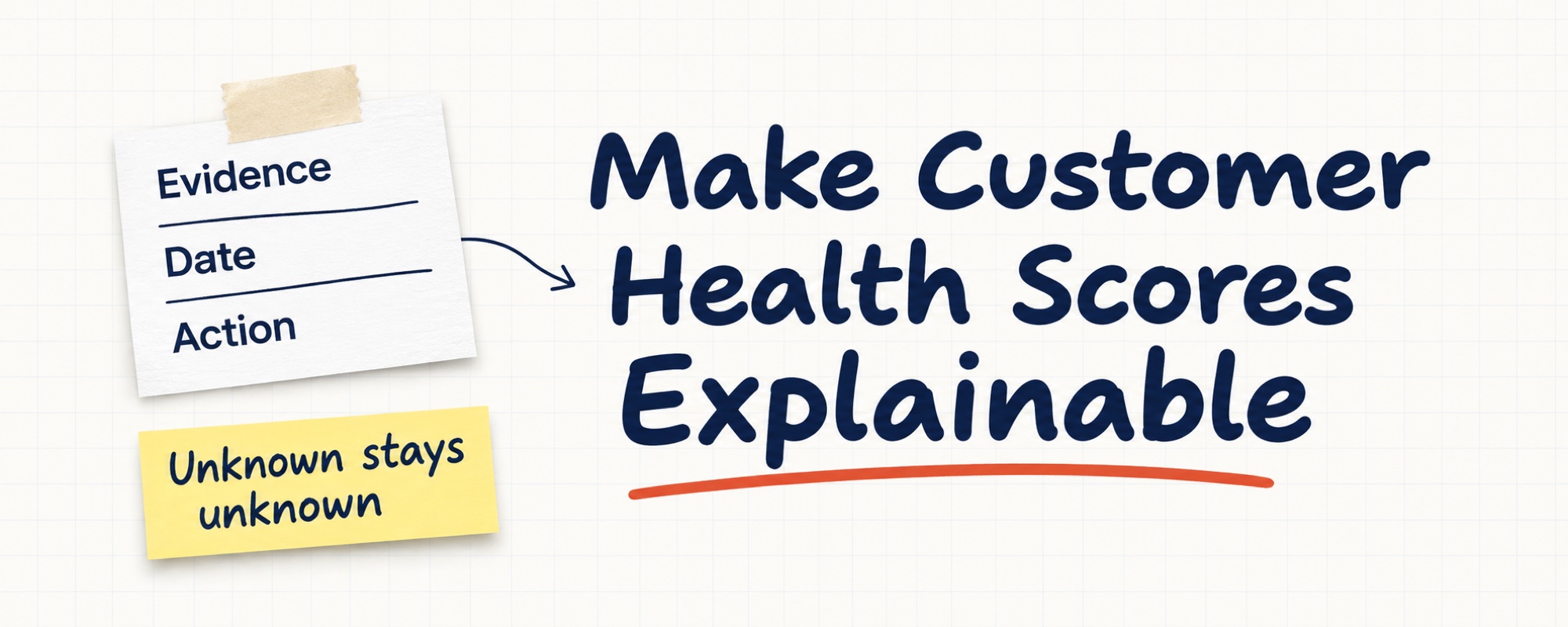
Define the decision the score should support
Start with a decision such as “Which established accounts need an outcome review?” or “Which onboarding accounts need help with a blocked milestone?” These are different populations and may need different rules. Do not rank them together simply because both are customers.
A prospect account score helps decide where to focus acquisition work. A customer health score examines the continuing relationship after purchase. Neither should silently inherit the other's variables, weights or interpretation.
Write down the account unit, lifecycle stage, review purpose and owner. An account-level score can combine observations from several people, but should preserve whose evidence it contains. One enthusiastic user does not establish that the purchasing owner sees value, and a quiet sponsor does not establish dissatisfaction.
Choose evidence that can change an action
Apivom's French health-score guide emphasizes reliable, available and actionable metrics, with models adapted to segments and reviewed over time. Those principles are useful. Its suggested weights or thresholds are not evidence that the same settings work in your business.
Consider four dimensions as a starting structure:
- Progress toward the customer's goal: a result the customer wanted, its current evidence and the customer's interpretation.
- Relevant adoption: whether the workflow needed for that result is happening, with an appropriate population and period.
- Relationship continuity: whether the people responsible for the work and decisions remain identified and involved where needed.
- Service and dependencies: unresolved obstacles, their actual effect on the work and the next agreed update.
Choose observable inputs within each dimension. “The agreed import remains blocked” is more useful than “low engagement.” More logins may show activity without demonstrating a business outcome. Fewer logins can accompany a simpler workflow. Confirm the meaning before assigning a favorable rating.
For new customers, use the agreed onboarding milestone. For established customers, use their current objective rather than a target that stopped mattering months ago.
Keep a small evidence record behind each rating
For every input, retain the observation, source, observation date, relevant period, person responsible for checking it and next action. Distinguish a customer's statement from an internal interpretation. Add a rule for when the observation needs rechecking, based on how quickly that fact can change.
For example, a completed implementation step may remain a historical fact, while responsibility for the next step can change tomorrow. A single universal expiry period would conceal that difference. Mark stale evidence separately rather than letting an old rating appear current.
Gainsight's scorecard documentation provides a concrete reason to check freshness: a measure can be marked stale and still contribute to its calculation. That is product-specific behavior, not a safeguard you should assume works identically in every tool.
Write scoring anchors before assigning numbers. Two reviewers should be able to explain why they chose different ratings from the same evidence. Reconcile that disagreement before adding more decimal places. If a dimension cannot be assessed reliably, simplify its rule or keep it as a review note.
A worked calculation, with its limits visible
Suppose a fictional reporting-service account has four fully observed input ratings on a 0–100 scale. The values below are invented to demonstrate arithmetic, not measured customer results. The weights are a provisional rubric for this example only.
| Dimension | Illustrative weight | Illustrative rating | Weighted contribution |
|---|---|---|---|
| Customer goal progress | 30% | 80 | 24 |
| Relevant adoption | 25% | 60 | 15 |
| Relationship continuity | 25% | 40 | 10 |
| Service and dependencies | 20% | 90 | 18 |
| Total | 100% | 67 / 100 |
The formula is 0.30 × 80 + 0.25 × 60 + 0.25 × 40 + 0.20 × 90 = 67.
The number says that this rubric produced 67. It does not mean a 67% chance of renewal. The relationship dimension deserves a look: suppose the current operational owner is known, but responsibility for the next account decision is unresolved. The useful next step is to confirm that responsibility, not to congratulate the team on a combined score.
Do not declare a universal green, amber or red boundary from this example. If a severe service issue is actively blocking the customer's work, show that issue prominently even when other dimensions are favorable. Averaging should not hide the action that matters.
Keep unknowns out of reassuring averages
Now suppose relationship continuity has no current evidence. Do not quietly give it 50, copy last quarter's 40 or assign zero as though missing information proved a problem. Each choice changes the meaning of the score.
For this example, leave the composite unreported as a comparable complete score. Show the three observed dimensions and 75% weighted coverage, because the missing dimension carries a quarter of the planned weight. Coverage describes the inputs available under this rubric; it is not a confidence level or proof that the account is safe.
Make “obtain current relationship evidence” the next task. If you use any partial-score calculation internally, label its method and coverage explicitly and keep it apart from complete scores. Otherwise, two identical totals may describe very different amounts of knowledge.
Attach an owner and a response to each alert
A review flag should lead to an action that can produce evidence or resolve a real obstacle. Specify the account, observation, hypothesis, owner, action and next review condition.
For the fictional reporting account, the action could be: ask the customer who owns the next scope decision and record the answer. It should not automatically become an upsell sequence. For an unresolved service dependency, the action belongs with the team that can address it.
A customer business review can help confirm goals and next decisions. A score alone does not authorize a promise, a commercial change or an outreach sequence. Review the underlying issue before choosing the contact.
Check whether the rubric is helping
Store dated snapshots and the rubric version. At the next review, check whether the flagged issue was real, whether the action happened and what the customer confirmed afterwards. Inspect apparently healthy accounts that still developed problems, as well as alerts that led nowhere.
Keep accounts with different lifecycle stages, contract exposure and workflows distinguishable. Do not use information learned after an outcome to make an earlier score appear accurate. Comparing scores with later renewal outcomes is a separate validation exercise; a weighted spreadsheet does not validate itself.
Use churn analysis for departure evidence and cohorts, and the retention guide for the relationship work itself. Start with a rubric someone can challenge, not a dashboard that turns unknowns green. Explore Lead Scorer for prospecting upstream; this customer-health method is an editorial workflow, not a claim about a product feature.
Frequently asked questions
What is a customer health score?
A customer health score combines selected observations about an existing account to help prioritize a review or action. It can include progress toward the customer's goal, relevant usage, relationship continuity and unresolved service issues. A rule-based score is not automatically a probability of renewal.
How do you calculate a customer health score?
Define the population and purpose, rate each dimension with explicit evidence rules, then apply documented weights if a composite is useful. Preserve the underlying observations, dates and model version. Weights and thresholds need validation in your own context.
How should missing customer health data be handled?
Keep missing or stale evidence visible as unknown. Show coverage separately and avoid silently turning unknowns into average, healthy or zero values. Obtain the missing information before comparing a partial composite with complete scores.