Quarterly Business Review: An Agenda for Customer Decisions
Prepare a quarterly business review with a customer evidence sheet, adaptable agenda and follow-up record. Includes a B2B example and clear proof limits.
By Lead Scorer 8 min read
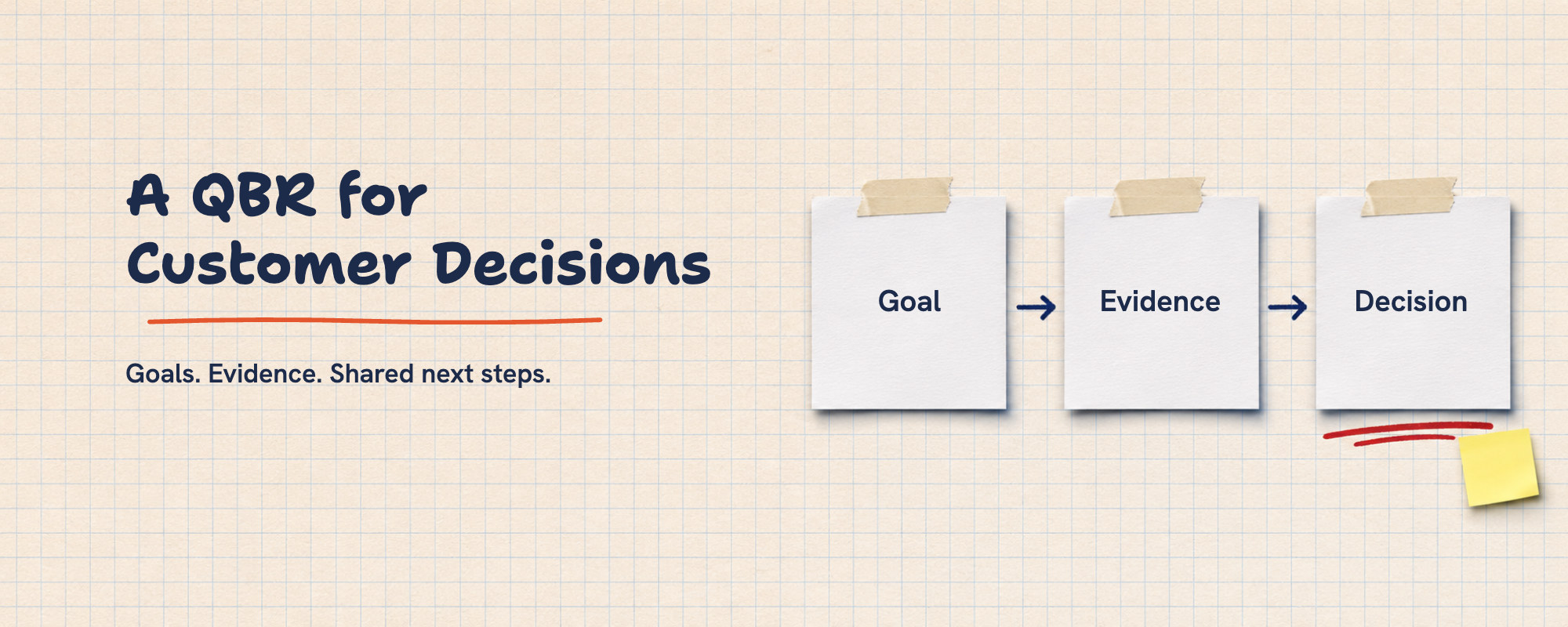
A quarterly business review is a recurring customer meeting to examine the value of a relationship and agree what should happen next. A useful QBR connects the customer's goal, evidence of progress, unresolved gaps and a shared decision. Prepare those four things before building the slides.
What is a quarterly business review?
A QBR usually brings a supplier and customer together once per quarter. Gainsight's QBR guide describes it as a customer meeting focused on business impact and shared goals. Here, we focus on that customer-facing format, rather than an internal sales performance review.
The output can be small: an agreed finding, a decision and a next step with an owner. A polished presentation with no customer correction or decision can leave the account exactly where it was before the meeting.
A QBR is also different from sales account planning. Your account plan organizes internal research, relationships and commercial priorities. The review puts a selected part of that evidence in front of the customer so both sides can challenge it. Internal assumptions do not become shared facts simply because they appear in a deck.
What the podcast accounts support
In The SaaS Podcast's interview with Rodney Robinson of TabaPay, published on September 17, 2026, Robinson describes the difficulty of keeping an infrastructure service's value visible when the product works quietly in the background. He mentions quarterly business reviews and explains the value in the customer's own terms. He also acknowledges that a high-touch service model is expensive.
A second perspective comes from Agam Vasani's MarTalks interview, published on August 3, 2026. Describing his post-sales work at LeanData, he connects renewal conversations with transparency about pricing, adoption and value achieved. He discusses executive business reviews, regular contact and relationships with more than one stakeholder.
These accounts explain why a review should start before a last-minute discount request. They do not prove that a quarterly meeting causes retention, and neither provides a controlled comparison of agendas. The worksheet and timing below are editorial proposals, not a procedure claimed to have been tested by either guest.
Decide whether a live QBR is useful
Start with a customer decision that needs a conversation. Perhaps the original goal has changed, different teams disagree about the result, an adoption gap needs a joint response, or the next phase depends on someone outside the everyday workflow.
If there is only a routine update, a short written review may be enough. If a customer is dealing with an urgent service problem, address that problem directly rather than waiting for a quarterly slot. A recurring meeting should not become a prerequisite for getting help.
For a smaller account, ask whether the value of the conversation justifies the preparation and attendance. Adapt the depth to the decision and the customer's preference. The calendar gives the review a rhythm; it does not create a reason for the customer to attend.
Prepare a one-page customer evidence sheet
Use a page that the customer can correct before the meeting. Keep internal account scoring, negotiation limits and unverified assumptions in your own account plan.
| Field | What to prepare | What the customer can challenge |
|---|---|---|
| Outcome | The result the customer originally wanted | Whether that result is still a priority |
| Evidence | Source, period, population and observation | Whether the data describes their actual workflow |
| Gap | Expected result compared with the observed result | Missing context or an alternative explanation |
| Decision | A choice that needs agreement | Whether that choice is useful now |
| Next step | An owner, date and dependency | Who can commit and what could block progress |
Separate three kinds of statement: something directly observed, something the customer has reported, and something you infer. For example, active users are an observation; a manager's estimate of time saved is a reported estimate; a claim that usage caused higher sales needs additional evidence.
Put unknowns on the page. If there was no baseline, say so. If the sample covers only one team, do not present it as the whole customer's experience. The review becomes more useful when uncertainty can change the decision.
An adaptable QBR agenda
The following 40-minute agenda is a starting point for a fictional B2B account, not a best-practice duration benchmark. Shorten or expand it around the decision.
| Time | Discussion | Intended output |
|---|---|---|
| 5 minutes | Confirm the customer's current priority | One goal both sides still recognize |
| 10 minutes | Read the evidence together | Confirmed observations and disputed items |
| 10 minutes | Examine the most important gap | A problem worth addressing and its limits |
| 10 minutes | Choose the next action or decide to wait | A decision with explicit dependencies |
| 5 minutes | Read back commitments and the follow-up trigger | Owners, dates and unresolved questions |
1. Reconfirm the goal in the customer's words
Open with the outcome the customer bought, then ask what has changed. A vendor goal such as increasing licensed seats is not a substitute for the customer's goal. If the priority has shifted, update the review rather than using the previous quarter's plan as a fixed script.
A useful opening is: “The original goal was to prepare weekly schedules without rebuilding spreadsheets. Is that still the problem this review should address?” This is an illustrative prompt, not a quote from either podcast.
2. Present evidence that can be checked
Show the period, the source and what was actually counted. Product adoption can help explain what happened, but it is not automatically a business outcome. Where evidence comes from customer interviews, name the role and date with the customer's agreement, rather than presenting an estimate as an audited result.
Invite correction before interpreting the numbers. A change in team size, workflow or sample can explain an apparent improvement. A comparison becomes less useful if the definitions changed between periods without anyone noticing.
3. Spend time on the gap that changes the next decision
Do not turn the review into a tour of every support ticket or dashboard. Select the gap that matters to the agreed goal and explain what remains unresolved. An urgent incident still belongs in its own active response process.
Ask what evidence would distinguish an adoption problem from a product limitation or a changed customer priority. Avoid assigning a cause merely because it fits your preferred commercial next step.
4. Agree a next step without manufacturing an upsell
The next decision might be to repair an existing workflow, gather a missing baseline, run a small trial, revise an expectation or stop an activity. An expansion belongs in the conversation only when it addresses a customer-confirmed need; the B2B upselling guide covers that separate qualification.
Name the person who can accept the action, the dependency and the evidence to inspect next time. A proposal to send another deck is not yet a customer commitment.
A fictional account example
A maintenance scheduling software provider holds a QBR with an operations manager. The original goal was to let team leaders prepare weekly schedules without assembling spreadsheets. Three of four teams now use the shared template. The provider has no reliable before-and-after measure of preparation time.
The review records adoption as observed and the time-saving claim as unverified. The operations manager explains that the fourth team uses a different shift pattern. Together they decide to test the template with that team after checking whether it fits the workflow.
The manager will identify a team leader, the provider will inspect the missing scheduling requirement, and both will review the next two completed scheduling cycles. Those cycles are an illustrative follow-up trigger, not a universal measurement period. Nobody claims an ROI figure or offers extra seats before understanding the gap.
Invite people who can explain and decide
Include enough customer context to interpret the evidence and enough authority to accept the next action. That may mean a day-to-day user and an accountable manager. It does not mean inviting every executive to every review.
Vasani's account warns against relying on only one contact, but it does not justify approaching other people behind that contact's back. Agree on the participants and the purpose. Explain why a different perspective would help the customer resolve the question.
An executive business review and a QBR can overlap in practice. Define the audience, decision and preparation expected rather than arguing about the label or assuming a senior audience guarantees a better meeting.
Send a record the customer can correct
Follow with a short written note: goal confirmed; evidence accepted or disputed; decision; owner; date or event; unresolved dependency. Keep proposed actions separate from accepted commitments. The sales meeting notes guide explains that distinction in more detail.
Ask the customer to correct the record. At the next agreed event, inspect what happened instead of counting the previous meeting as success by itself. Attendance and completed actions describe the process. Retention, expansion and realized customer value require their own evidence and cannot be attributed to the QBR alone.
Lead Scorer can help keep account research and relationship context organized before outreach. The evidence for a customer review must still come from the relevant customer records and conversations. Public account signals or an internal score do not establish adoption, value achieved or a person's intent to renew.
Frequently asked questions
What is a quarterly business review?
A recurring meeting with a customer to examine the relationship’s business value, discuss progress and gaps, and agree what should happen next. Define whether the session is customer-facing or an internal business review.
What should a QBR agenda include?
Confirm the customer’s goal, examine evidence and its limits, discuss the gap that matters, agree a decision and read back owners and follow-up triggers. Adapt the proposed agenda to the customer and the decision.
How long should a quarterly business review last?
There is no universal duration appropriate to every account. This guide proposes a 40-minute illustrative agenda. The decision, preparation and participants should determine how much time is useful.
What is the difference between a QBR and an EBR?
Organizations use the labels differently. An executive business review often emphasizes senior stakeholders and strategic decisions; a QBR names a quarterly rhythm. Specify the audience and intended decision rather than assuming a universal format.