Sales Pitch Examples: Start With the Buyer's Problem
Build a B2B sales pitch from a confirmed problem, relevant outcome, credible proof, and a useful next step. Includes adaptable examples and a review checklist.
A sales pitch should help a buyer decide whether a problem is worth solving together. It is not a compressed feature tour. The best version changes as the conversation moves from a cold introduction to discovery, evaluation, and a decision.
The rule is simple: do not claim to know a buyer's pain before they confirm it. Start with an observable reason for the conversation, ask a useful question, and only then connect one relevant capability to an outcome and a verifiable proof point.
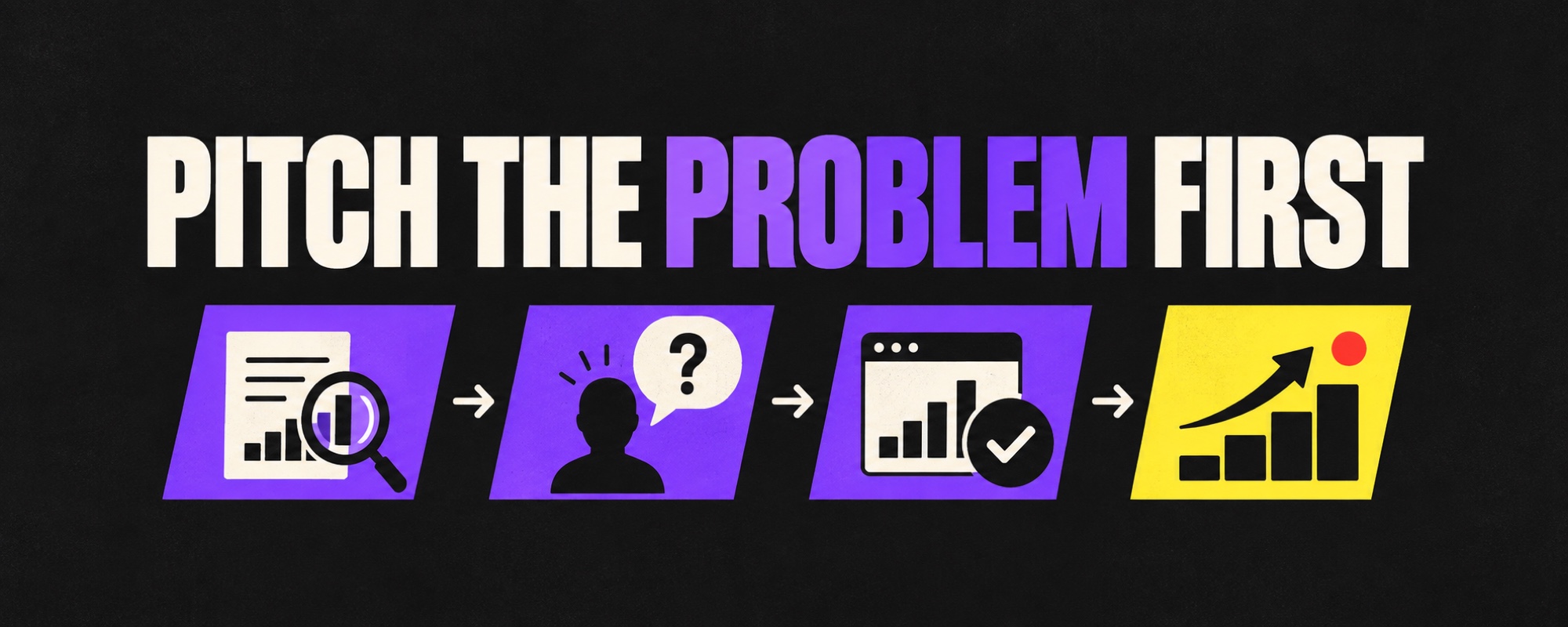
What a sales pitch does, and what it does not
A pitch is a short decision aid. It connects a buyer's situation to a possible change and makes the claim testable. A discovery conversation finds out whether that situation exists. A demo shows the relevant workflow. A proposal sets out scope, economics, and commitments. These are related activities, but a pitch cannot replace any of them.
Salesforce's sales pitch guide emphasizes researching context and asking questions before mapping an offer to the buyer's needs. HubSpot's pitch examples similarly organize the message around relevance, value, evidence, and conversation. The operational implication is to prepare a flexible argument, not a speech to recite.
Our discovery questions guide covers the questions that precede a substantive pitch. If the problem is still hypothetical, return to discovery rather than pushing ahead.
Build the pitch from five pieces of evidence
- Observed context. State only what you can verify: a published hiring announcement, a public product change, or a buyer's own description. A company-level website signal is not proof that a named person visited.
- Confirmed problem. Ask what the buyer is trying to improve and what happens today. A plausible problem is still a hypothesis until they confirm it.
- Desired change. Use the buyer's terms for the result. “Faster” or “more efficient” is too vague unless you can name the workflow and a measure.
- Relevant proof. Choose one product demonstration, documented capability, customer-approved example, or bounded calculation. Say “we do not yet have proof” when that is true. Never invent a customer or outcome.
- Next decision. Ask what would help the buyer judge fit: review a current workflow, include an owner, test a limited use case, or compare alternatives.
Turn the five pieces into a working sentence: “You described [confirmed workflow problem]. That affects [buyer-named consequence]. We can show [relevant approach], with [available proof]. Would it be useful to [specific next step]?” The brackets are prompts for facts, not permission to fill gaps with guesses.
Three B2B sales pitch examples, adapted to the stage
The examples below are fictional teaching examples. They show structure, not actual Lead Scorer customer results or a claim that any particular product solves the stated problem.
1. First contact: invite diagnosis
A company publicly announces that it is adding regional sales teams. The signal may make ownership rules worth discussing, but it does not prove they are broken.
“I saw the announcement about the new regional teams. When account ownership changes, some teams revisit who receives inbound requests and how handoffs are recorded. Is that something you are already working through, or is your current process holding up?”
The message names the source of relevance and leaves the prospect free to reject the hypothesis. It does not claim insider knowledge, push a demo, or confuse hiring with buying intent. For signal selection, see our B2B buying signals guide.
2. After discovery: connect one capability to one problem
Imagine the buyer has confirmed that salespeople manually inspect several sources before deciding which accounts to contact. They want to reduce repeated research, but they have not agreed on an acceptable quality threshold.
“You said the team repeats the same account research before every first contact, and that consistency matters more than raw activity. I would focus our next session on one segment: compare your current research checklist with a proposed workflow, check the source evidence, and decide which steps still need human judgment. If that comparison does not save meaningful work at your quality bar, we should stop there.”
This is not a performance promise. It proposes a test whose outcome the buyer can assess. A tailored product demo can follow, but only when the workflow and success criterion are clear.
3. Evaluation: make the internal decision easier
A stakeholder may like the workflow but still need IT, finance, or sales operations to assess it. The pitch should change from “why meet us?” to “what decision needs evidence?”
“We have confirmed the workflow gap and the proposed pilot scope. The remaining questions appear to be data access, review ownership, and the measure that would justify a wider rollout. Could we put those three questions in a one-page decision note and review it with the people who own them?”
This example does not treat agreement from one contact as organizational approval. It surfaces the actual decision path. If an objection arises, our objection-handling guide separates a missing proof point from a real misfit.
Choose proof that matches the claim
Evidence fails when it answers a different question. A product screenshot can show that a field exists, but not that a team's conversion rate improved. A customer quote can describe one experience, but not a universal result. A hypothetical calculator can show a method, but it is not measured savings.
- Capability claim: show the actual workflow or documented feature.
- Outcome claim: use a measured, permissioned result with its context.
- Fit claim: compare the buyer's requirements to what the product can and cannot do.
- Economic claim: expose assumptions, inputs, and who supplied them.
If you cannot support a claim, narrow it. “We can inspect whether this reduces manual review” is honest. “We will halve your research time” is not, without evidence specific to that workflow.
How to end a sales pitch without forcing a close
End with a decision the buyer can actually make. “Book a demo” is often too large for a first contact and too vague after discovery. Ask to inspect a process, test one scenario, compare a documented alternative, or bring in the owner of a blocked requirement.
Also give the buyer a clean exit. “If this is already solved, I will not keep pushing” is not a trick; it is a boundary that makes the question credible. A pitch that only permits “yes” does not reveal fit.
Review checklist before you send or deliver it
- Can I name the source of every fact about this buyer?
- Have they confirmed the problem, or am I still testing a hypothesis?
- Does each product claim answer a buyer question?
- Can I show the proof, including its limits?
- Is the next step specific, useful, and proportionate to the stage?
- Would the message still be truthful if the buyer says “not a priority”?
Use the checklist with one real account before turning it into a team-wide script. Then revise it from observed buyer responses, not from which wording sounded most persuasive internally. If you need to decide which accounts deserve that work first, begin with lead qualification.
Frequently asked questions
What is a sales pitch?
A sales pitch is a concise explanation of why a specific buyer might care about an offer, supported by relevant evidence and a proposed next step. In B2B, it should respond to a problem the buyer has confirmed, not assume pain from a company signal.
What should a B2B sales pitch include?
Include the buyer's confirmed situation, the consequence they care about, one relevant capability or approach, a proof item you can verify, and a concrete question or next step. Leave out features that do not help this buyer decide.
How long should a sales pitch be?
Long enough to make one relevant claim understandable and short enough to invite correction. A first-call opening may be a few sentences; a later proposal needs more detail. Length follows the buying decision and channel, not a universal stopwatch.
How do you pitch before discovery?
Treat an observed signal as a hypothesis, explain why it prompted contact, and ask whether the issue is relevant. Do not present an unverified problem as a fact or imply that you know who visited a website.
How do you end a sales pitch?
Ask for the smallest useful next step: confirm the problem, inspect a workflow, compare an alternative, or include the relevant stakeholder. If the fit is absent, close the conversation honestly rather than forcing a demo.