Win-Loss Analysis: A Buyer Interview Guide for Closed Deals
Investigate why B2B deals were won, lost or ended without a purchase. Use a decision timeline, neutral interview questions and a source-linked review template.
By Lead Scorer 7 min read
A closed-lost reason is a starting point for win-loss analysis. “Price” records a label; it does not tell you which budget was unavailable, which alternative looked safer, or whether the buyer made any purchase at all. Those distinctions lead to different decisions about your offer.
Use the guide below to reconstruct a completed buying decision, interview the people involved and turn the evidence into one reviewable action. The template and examples are editorial proposals. They do not establish a revenue lift or an optimal research sample.
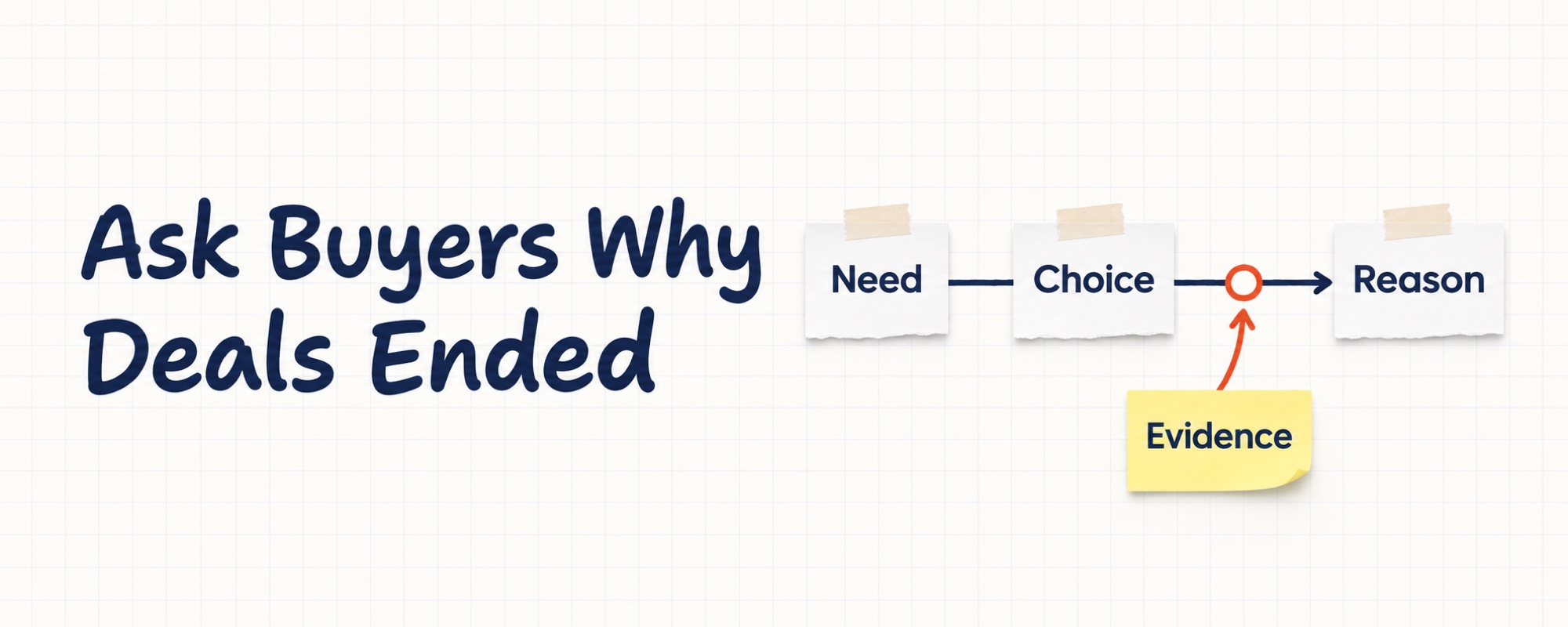
What win-loss analysis should explain
Win-loss analysis studies why buyers selected your offer, selected another approach or decided against a purchase. Pragmatic Institute recommends consistent questions across won and lost customers and an interviewer who can hear criticism without defending the sale.
The research object is a buying decision. A voice-of-customer analysis may inform a broader message; this review asks how one evaluation unfolded and which criteria actually mattered. Your conversion rate describes outcomes in a defined cohort. Interviews help investigate those outcomes but do not replace that denominator.
1. Choose a decision your team can change
Write the question before choosing interviewees. “Why do we lose?” is too broad. A narrower question could be: “Why did qualified regional operators reject our implementation approach after a successful technical evaluation?” That question has a segment, a stage and a decision your team might improve.
Define the product, market, close-date window and eligibility rule. Separate new purchases from renewals. Include wins as well as losses so the review can test why the same concern was acceptable to one buyer and decisive for another. Use your B2B segmentation to keep fundamentally different buying situations apart.
Keep confirmed no-purchase decisions visible. A buyer saying the project was cancelled is evidence of that outcome. Silence after a proposal is an unknown outcome, even if your CRM requires a closed-lost status. Preserve both the operational status and the research uncertainty.
2. Build the decision timeline before the interview
Read the permitted deal record and create a short chronology: initial trigger, evaluation, people consulted, proposal, turning points and final known outcome. Mark each entry with its date and source. A rep's recollection and a buyer's email are different forms of evidence.
Use a compact record for each account:
- Scope: segment, offer, evaluation period and outcome, including whether it is confirmed.
- People: participant role and what part of the decision they observed.
- Seller explanation: original CRM reason, author and date, preserved unchanged.
- Buyer account: the participant's explanation, supporting passage and date.
- Decision criteria: requirements, trade-offs and which ones were described as decisive.
- Unresolved points: contradictions, missing participants and unverified alternatives.
- Proposed action: one change, owner, next check and review date.
Do not prepare a prosecution brief against the salesperson. The timeline reduces repeated factual questions and makes gaps visible; it should not decide the explanation in advance.
3. Invite buyers without reopening the deal
Ask someone with direct knowledge of the evaluation to participate. A procurement contact may explain approval rules but know little about daily use. A user may understand adoption concerns without seeing the final commercial negotiation. When useful, seek another perspective and retain disagreements.
Explain the learning purpose, expected effort and how notes will be used. Make it easy to decline. Arrange recording only with appropriate permission; otherwise take agreed notes. Use information your team is authorized to process and share findings at the level needed for the decision.
A suitable invitation might be: “We are reviewing how teams evaluated the implementation work. Would you be open to a short research conversation about the decision? This is feedback research, rather than another sales presentation.” This is fictional wording to adapt, not a tested response-rate formula.
4. Ask about events before asking for explanations
The Product Marketing Alliance question bank follows the buying journey from awareness through consideration to decision. Adapt that sequence to the evaluation you are investigating:
- What first made the team consider a change?
- Which approaches were seriously considered, including keeping the existing process?
- How did the team decide what to test or compare?
- Who joined the decision, and what did each person need to approve?
- When did your preferred approach become clearer? What happened then?
- Which trade-off was hardest to accept?
- What was finally chosen, and what made that choice workable?
- What remains uncertain about the decision from your perspective?
Follow the participant's account rather than reading every question mechanically. Ask for a concrete incident or example when an answer stays abstract. Avoid leading with your CRM label: “Was our price too high?” can narrow the answer before the buyer describes the evaluation.
5. Investigate price without explaining it away
If the buyer raises price, ask what they were comparing, which costs were included and how the commitment was assessed. Price may mean a genuinely unaffordable offer. It may also refer to implementation cost, uncertain adoption or a different scope. Research should preserve that distinction, not automatically reinterpret every price objection as a messaging problem.
Consider a fictional software evaluation. The CRM says “lost on price.” The operations lead reports that rollout required an internal coordinator the business could not spare. The selected provider also cost less. Both observations matter: the interview does not prove that staffing was the sole cause or that a price reduction would have won.
The defensible next step is to test whether a clearer staffing plan changes understanding in comparable evaluations. It is not to publish a competitor weakness or promise an implementation service your team cannot deliver.
6. Review patterns and keep the missing cases
Track eligible accounts, invitations, respondents and nonrespondents separately. Count distinct accounts rather than every mention of the same concern. People willing to discuss a purchase may differ from those who decline; a selected sample cannot establish how common a reason is across the market.
Keep the original loss code alongside the researched interpretation. Record multiple contributing factors when the evidence supports them. A decision to prioritize one action does not require claiming that only one cause existed. Neither a first-mentioned reason nor an automated summary establishes causality.
Close the review with a statement another colleague can inspect: “These accounts described this obstacle; these cases differed; this source supports the proposed change; these questions remain open.” Update a sales battlecard only when the finding supports a specific, verifiable response.
Assign an owner and a check that can fail. For example, ask buyers in the next comparable evaluations to explain the staffing plan in their own words. If comprehension improves, that supports the wording change; it still does not isolate its effect on win rate. Changes in deal mix, product and seller behavior remain possible explanations.
Start with one bounded research question and a traceable account record. Explore Lead Scorer for the broader prospecting workflow; keep buyer decision research grounded in the evidence your team actually holds.
Frequently asked questions
What is win-loss analysis?
Win-loss analysis investigates completed buying decisions using outcome records and buyer feedback. It explains the context and criteria behind a purchase, a competing choice or a confirmed decision to do nothing.
What questions should a win-loss interview include?
Ask about the original trigger, alternatives, evaluation criteria, people involved, turning points and final decision. Explore what a price comment meant before treating it as a request for a discount.
How many win-loss interviews are enough?
There is no universal count that makes a selected interview sample representative. Define the research question, cover relevant outcomes, report invitations and responses, and treat small recurring themes as hypotheses to investigate.