Thought Leadership Strategy: A Point of View Buyers Can Test
Build a B2B thought leadership strategy from a buyer decision, evidence and a clear boundary. Includes a point-of-view worksheet and a fictional example.
By Lead Scorer 8 min read
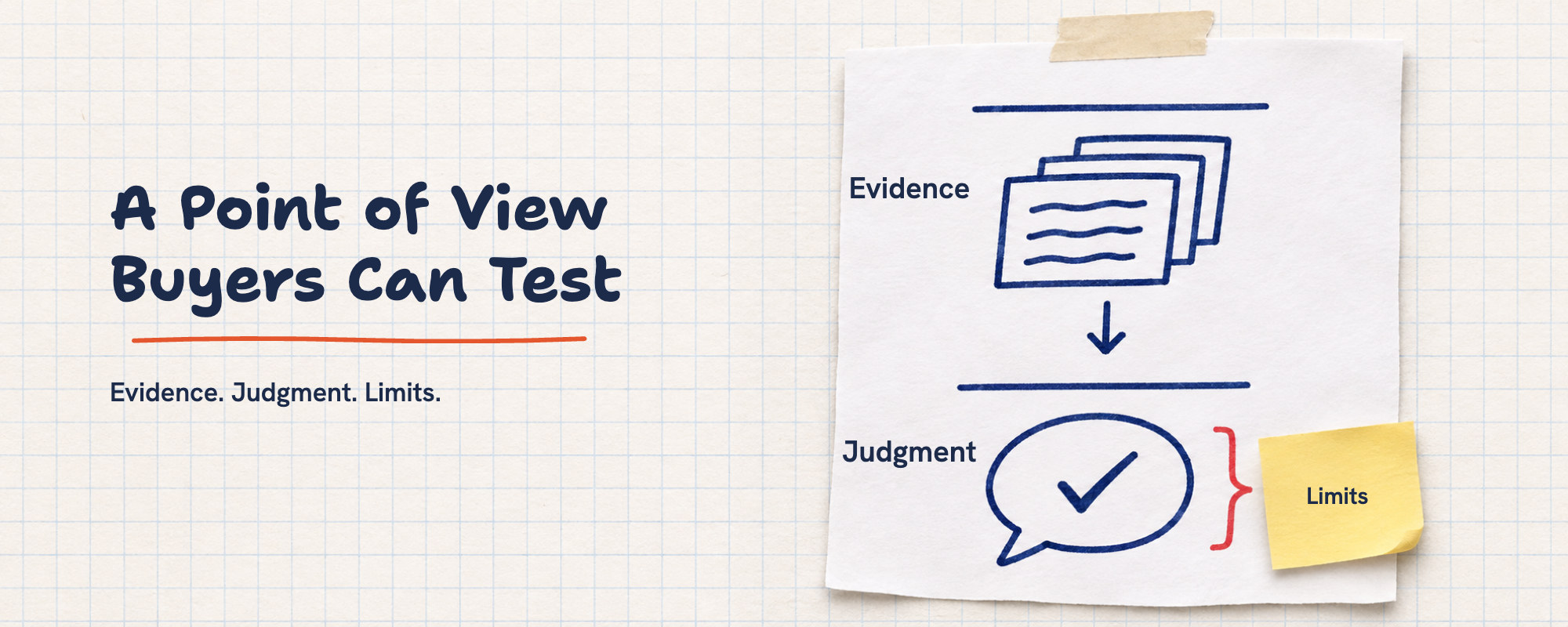
A thought leadership strategy gives a defined audience a useful way to judge a problem, then makes that point of view available where the audience needs it. Start with a decision you understand, evidence you can explain and a recommendation with visible limits. A publishing schedule comes after that work. More formats cannot supply the missing judgment.
What thought leadership means for a B2B team
For this guide, thought leadership means sharing a reasoned perspective that helps buyers interpret a situation or make a decision. It might challenge an accepted practice, explain when a familiar rule breaks down, or make a difficult trade-off easier to discuss. Being provocative is optional. Having something useful and defensible to say is the starting requirement.
Consider three different statements. “Our team is innovative” is a claim about the seller. “Five reporting trends” names a content topic. “Choose who will act on a metric before commissioning another dashboard” proposes a decision rule. The third statement gives the reader something to examine, including reasons it might not apply.
The boundary matters for sales. A perspective can help a buyer understand your judgment before a conversation. Reading or sharing it does not establish purchase intent, budget or agreement. Keep the evidence standards of consultative selling when the conversation becomes commercial.
The podcast lesson: judgment precedes the format
In Consulting Rainmakers, Maliha Aqeel describes thought leadership as positioning grounded in a point of view. She discusses using AI to challenge and edit her thinking. These are her practices, not measured sales results.
The practical worksheet below is our editorial proposal. It turns that distinction into a reviewable process; it is not a framework Aqeel claims to have tested. There are no attributed conversion rates or promises that publishing a perspective will generate leads.
1. Choose one decision your audience faces
Begin with a buyer situation rather than a broad industry theme. “The future of analytics” leaves the reader's job unclear. “Whether to add a dashboard when nobody owns the action behind the metric” defines a choice, an audience and a consequence.
Write the situation in ordinary language. Identify who encounters it, what they are deciding and what makes the choice hard. A finance lead and an operations manager may use the same report for different purposes. Do not turn their separate questions into a universal claim about all B2B buyers.
Check whether you have relevant experience or a documented evidence base. If the subject lies outside your expertise, narrow the claim, involve an appropriate reviewer or choose another topic. An interesting headline does not repair an unsupported recommendation.
Use voice of customer analysis to preserve the context behind repeated phrases. A buyer's frustration can suggest a question. It does not prove that every similar account has the same problem.
2. Separate observations from interpretations
Create a small evidence file before drafting. For each useful observation, keep its source, date, context and what it actually establishes. Mark whether it comes from an interview, a delivery record, a direct test or a published source. Do not remove inconvenient examples just because they weaken the headline.
A repeated anecdote is still different from a representative study. Several colleagues retelling one customer story are not several independent cases. If a client name or detail cannot be shared, use an authorized account, a sufficiently general description or an explicitly fictional example. Never fabricate a testimonial to make an argument feel concrete.
Keep interpretation in a separate field. “The team did not identify an owner during the workshop” is an observation. “Ownership might be a prerequisite for this reporting project” is an inference. “Every dashboard without an owner fails” goes well beyond the evidence.
3. Write the point of view on one page
A useful first version fits in five fields:
| Field | What to write | Review question |
|---|---|---|
| Situation | The buyer decision and its conditions | Can the reader recognize when this applies? |
| Observation | What the available sources establish | Can another person inspect the basis? |
| Judgment | What you recommend, and why | Is this more useful than a slogan? |
| Boundary | Exceptions, uncertainty and competing explanations | What would make the recommendation inappropriate? |
| Action | One proportionate next step | Can the reader use this without buying from you? |
The goal is not to claim an idea nobody has ever expressed. Make your reasoning specific enough that a reader can understand your contribution. A familiar recommendation can become useful when its conditions, costs and exceptions are explained clearly.
Remove claims of inevitability unless the evidence supports them. Words such as always, never and guaranteed often hide a missing boundary. A strong point of view can make a clear recommendation while acknowledging that another decision fits another situation.
A fictional B2B thought leadership example
Imagine a reporting consultancy reviewing a proposed dashboard project. Everything in this example is invented. It is not an Aqeel case study, a Lead Scorer customer story or a measured industry pattern.
The fictional team has workshop notes showing that participants disagree about who should respond when a metric changes. It also has a reporting requirement that must be delivered regardless of whether an operational action follows. Those are two different jobs.
Its initial headline says: “Stop building dashboards.” That overstates the observation and ignores the reporting requirement. A better point of view says: “For operational dashboards, agree who will act on each decision signal before adding another screen.” The scope is visible, and the reader can challenge it.
The proposed action is a short review of one metric: who uses it, which change matters, what action follows and who can authorize that action. If the purpose is a required periodic report, a different evaluation may be appropriate. The exception strengthens the explanation because the recommendation no longer pretends to solve every reporting task.
Notice that the exercise does not claim a revenue lift or time saving. Those outcomes would require separate measurement. The perspective earns attention by clarifying a decision, not by attaching a fabricated result.
4. Challenge the reasoning before polishing the copy
Ask a knowledgeable reviewer to look for the strongest alternative explanation. Could the issue be a temporary handoff, an unclear price, a product limitation or a requirement you have misunderstood? Record what the reviewer changes rather than collecting approval for a finished headline.
A helpful challenge is: “Describe a plausible situation where following this recommendation would make the buyer worse off.” If you cannot answer, examine whether the claim is too broad or whether you have considered too few cases. The answer may become an exception, a narrower audience or a reason to abandon the piece.
AI can support this proposed review workflow by organizing supplied notes, identifying unsupported transitions and suggesting counterexamples. Ask it to distinguish what is in the source material from what it is proposing. A person must verify the sources and decide which judgment to publish. Generated confidence is not additional evidence.
5. Choose a format that carries the reasoning
Once the one-page argument is stable, choose the smallest format that helps the audience use it. A comparison may suit an article. A difficult decision may benefit from a workshop. A short checklist may work as a post or a sales conversation aid. None of those choices requires a claim about an algorithm's preferred format.
Keep the same evidence boundary in each derivative. A short post should not turn a qualified observation into a universal rule because the explanation was cut. A sales slide should not transform an illustrative example into a customer result.
A demand generation system covers the broader distribution and response process. This thought leadership strategy supplies one reasoned idea for that system. The two jobs are related, but they need different review questions.
6. Review understanding separately from commercial response
Before wide distribution, ask a few relevant readers to explain the recommendation in their own words and identify where they would use it. Record how those readers were selected. This is a comprehension check, not proof of a representative market preference.
Then keep actual observations separate: questions received, corrections made, requests for more evidence and relevant conversations. If a person asks for a meeting, qualify that request on its own merits. Do not attribute an opportunity to the article merely because someone on the account saw it.
Lead Scorer can support the account research and reviewed outreach around a defined buyer situation. It cannot supply your professional experience or certify that a generated opinion is yours. Start the next piece with a decision worth explaining, then keep its reasoning and limits intact as it travels.
Frequently asked questions
What is a thought leadership strategy?
In this guide, it is a plan for developing and sharing a reasoned perspective that helps a defined audience interpret a problem or make a decision. The point of view, evidence and limits come before the choice of formats.
How does thought leadership differ from content marketing?
They overlap. This guide treats thought leadership as the judgment a team wants to make useful, while content marketing includes the broader production and distribution of material. Publishing frequently does not by itself establish a defensible perspective.
What should a B2B thought leadership plan include?
Define one buyer decision, preserve the supporting observations, state the recommendation, identify exceptions and propose a usable next action. Then choose a format, review the reasoning and check whether relevant readers understand it.
Can AI help with thought leadership?
AI can help organize supplied notes and propose objections or edits in a reviewed workflow. The author remains responsible for verifying sources, choosing the judgment and ensuring that generated suggestions are not presented as observed evidence.