Voice of Customer Analysis for B2B: Words, Context, Action
Run voice of customer analysis for B2B messaging: connect statements to behavior, separate accounts from mentions and preserve conflicting evidence.
By Miljan @ Lead Scorer 8 min read
Voice of customer analysis turns customer language into a decision you can explain: which problem to describe, for which buyers, and what evidence supports that message. Collecting quotations is only the beginning. A useful analysis connects what people say with what they do and preserves the cases that disagree.
For a B2B sales or marketing team, the output can be a small decision record rather than a new software platform. This guide provides a workflow, a fictional worked example and a review checklist. The goal is a defensible message to test, not a claim that feedback alone proves demand or predicts revenue.
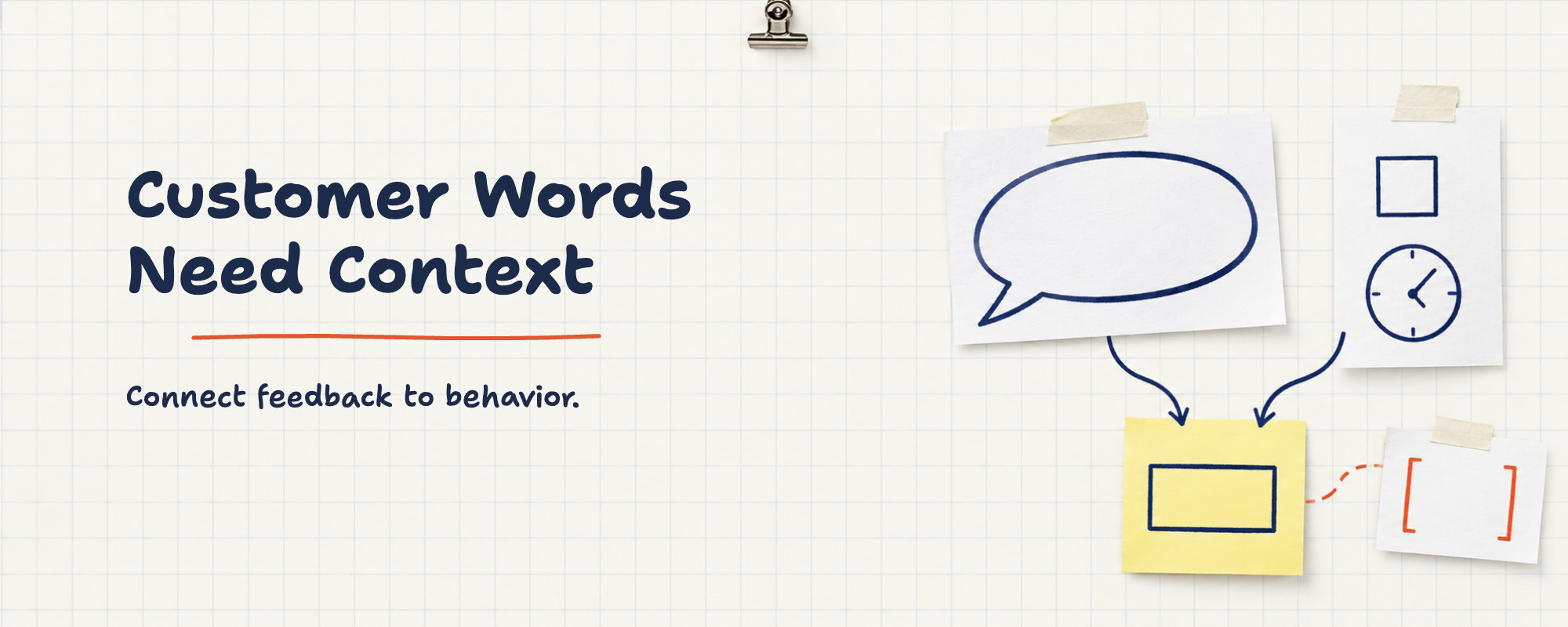
What voice of customer analysis should produce
Voice of customer, often shortened to VoC, includes expressed needs, expectations and experiences. Analysis organizes those inputs around a question and turns them into an action. A satisfaction score, a transcript archive and a collection of positive comments each reveal something, but none automatically explains what to change in a sales message.
Start with a decision such as: “Which problem should our first email describe to operations managers who coordinate work across several branches?” That question defines the audience, the situation and the intended use of the research. “Understand our customers” leaves too many possible outputs.
A completed record should contain the proposed message, the segment it applies to, source references, supporting behavior, contradictory evidence, unresolved questions and the person responsible for the next check. Someone outside the original interviews should be able to reconstruct the reasoning.
What two founders actually describe
In his Product Market Fit Show interview, Within cofounder Andrew Antos describes joining customer conversations to usage, support and sales progression. Between 32:17 and 38:49, he explains how the team examines repeated language by segment and changes the way it describes the problem. He also distinguishes an encouraging first meeting from a relationship that progresses.
Antos gives a concrete language example: customers described the product as a “company brain,” making its role easier to explain internally. That is his account of messaging development, not evidence that the phrase will work for another company. His preference for feedback from active customers also deserves scrutiny: learning from buyers who did not progress may expose a targeting or product problem.
In The SaaS Podcast interview with Rick Knudtson, the Workshop cofounder explains at 28:03–29:03 how conversations informed content. Repeated complaints about planning in spreadsheets helped the team create a useful calendar. The lesson concerns a connection between observed work and a specific output; it does not establish a universal content-to-revenue effect.
The workflow below is our synthesis of those experiences. Neither guest presents this exact worksheet or a controlled test of its performance. The broader Within distribution case explains the company's whole growth motion; this guide concentrates on the analysis between a source statement and a message decision.
1. Bound the question and the evidence set
Choose one audience and one decision before collecting material. Record the role, company situation, buying stage and period covered. Keep current customers, stalled prospects and lost opportunities distinguishable. They can all contribute, but they answer different questions.
List the sources you can legitimately use: interview notes, relevant support exchanges, account progression and permitted product observations. Include how the sample arose. A set of calls booked through a founder's network cannot automatically describe the entire market. Missing accounts and missing answers belong in the limitations.
For French operations, review the CNIL guidance on purpose and data minimisation before reusing personal data. Define the permitted use and keep shared extracts limited to what that use requires. An available recording is not, by itself, authorization to reuse it for every purpose.
2. Separate the statement from its interpretation
Create one evidence row per relevant observation, linked to its original passage. Preserve the customer's words where needed, but keep your interpretation in another field. “We need better visibility” could refer to ownership, deadlines, financial exposure or access permissions. Those are different problems despite a shared phrase.
A practical row includes:
- Source and date, with a passage reference that a reviewer can reopen.
- Account, respondent role and relationship stage, using controlled access where needed.
- Situation, task, obstacle and current workaround.
- Observed behavior or commercial next step, including “unknown.”
- Analyst interpretation, competing explanation and question still to verify.
The active listening method helps establish meaning within a conversation. VoC analysis adds the next layer: compare statements across accounts without losing the context that made each one meaningful.
3. Group problems while preserving differences
Build a small set of themes from the observations. For each theme, write a definition and a boundary. “Handover ownership” could include uncertainty about who accepts a task, while excluding complaints solely about report loading time. Revise the theme when a new case does not fit; do not force every sentence into an existing label.
Count distinct accounts separately from mentions. Ten tickets from one customer are evidence of repeated friction for that customer, not ten independent customers. Retain the number of accounts reviewed and how many supplied usable evidence for the question. Frequency in a convenience sample does not establish market prevalence.
Compare within a segment before combining segments. A branch manager and a central operations director might use the same word for different decisions. Record uncertainty instead of creating a single confident theme that hides both needs.
4. Connect language to behavior and contradiction
Look for behavior relevant to the question: a manual workaround, a requested example, a completed evaluation or a decision to stop. Positive sentiment can coexist with no reason to change. Conversely, a stalled deal can contain a real problem that your offer failed to solve.
Avoid a universal weighting formula. An active customer's experience may inform delivery improvements, while an unsuccessful evaluation may matter more when diagnosing barriers to adoption. State why an observation is relevant to this decision. Keep contradictory cases visible rather than treating them as inconvenient exceptions.
A fictional example: one phrase, two different messages
Suppose a team reviews permitted notes from six accounts evaluating a coordination tool. Four accounts use the word “visibility.” Within that group, two branch operators describe losing ownership during handovers, one director wants a consolidated weekly report, and another account never explains the term. These numbers are illustrative, not a study or a recommended sample size.
The analyst initially proposes “Get complete visibility across your operations.” The evidence does not support that broad promise. One handover account maintains a manual owner checklist and asks to test task acceptance. The other reports a similar problem but has not agreed to an evaluation. Neither observation establishes a measurable business result.
The team narrows the hypothesis to “Check who owns the next handover before work moves on.” It records the two relevant accounts, the observed workaround, the difference in progression and the reporting case as outside this message's scope. It also keeps the unexplained fourth case open. This is a proposed formulation to test for understanding, not a new product capability or a quotation from either founder.
The next check is specific: ask a relevant buyer to explain the message in their own words and connect it to a recent task. If the buyer describes reporting rather than ownership, revise the interpretation before increasing outreach volume.
5. Close the analysis with an owned decision
Publish a compact internal record: decision, audience, supporting sources, counterevidence, uncertainty, next check, owner and review date. Keep changes versioned. A later objection should be able to challenge the message without erasing the evidence that originally supported it.
Use the B2B value proposition examples to connect the chosen problem to an offer you can deliver. If the next step is an experiment, the email A/B testing framework explains why a small test may remain inconclusive. Customer understanding and a measured conversion improvement are different outcomes.
Before approving a message, verify that every claim has a source, every count has a clear unit, every segment has a boundary and every unknown remains visible. A useful VoC analysis earns its place when another colleague can inspect the evidence and understand why the team chose this message for this audience.
Frequently asked questions
What is voice of customer analysis?
It organizes customer statements and their context around a decision, then connects the findings to an owned action. In B2B messaging, the output can be a record of the audience, proposed wording, sources, behavior, contradictions and next check.
Which sources can a B2B team use for VoC analysis?
Relevant interview notes, support exchanges, account progression and permitted usage observations can contribute. Keep the source, date, respondent role, selection method and relationship stage visible rather than treating every input as interchangeable.
How do I count repeated customer feedback?
Track distinct accounts separately from mentions. Repeated tickets from one customer show repetition within that account, not multiple independent customers or market prevalence.
Should I ignore feedback from prospects who did not buy?
No. A stalled or lost evaluation may reveal an adoption barrier or a mismatch in targeting. Decide why each observation matters to the question instead of applying a universal weighting rule.
Can AI choose the sales message from customer transcripts?
Use any automated summary as a draft to verify against the source passages. Preserve unknowns and conflicting cases, and keep a person responsible for the interpretation and next decision.