Sales Meeting Agenda: A Decision-First Team Template
Use a sales meeting agenda that separates written updates from decisions, selects deals needing help, and ends with owners, actions and dates.
By Miljan @ Lead Scorer 9 min read
A sales meeting agenda should name what the team will decide, not list everything that happened last week. If the same update can be read in a CRM or short note, it usually does not need a round-robin presentation. Reserve shared time for blocked buyer decisions, ownership conflicts, and changes to the team's next actions.
Below is a reusable weekly agenda, a filter for what belongs in the room, and a fictional example. It is for an internal B2B sales team meeting, not a discovery agenda with a prospect or an individual coaching session.
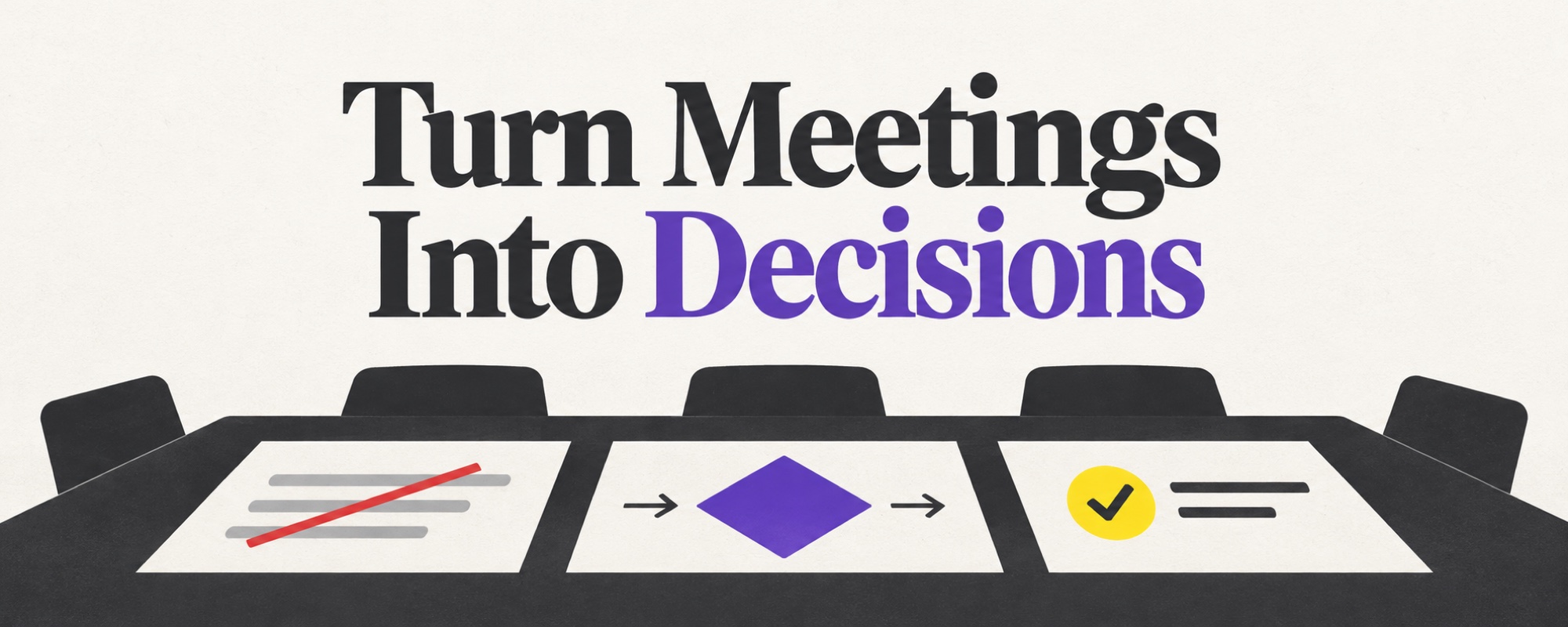
Decide whether a meeting is needed
Ask each proposed agenda owner to complete one sentence: “We need the group to decide what, using which evidence, by when.” If there is no decision or useful joint work, send a written update. If only a manager and one rep can resolve it, use a one-to-one conversation. If the answer depends on marketing, delivery, or leadership, invite that person for the relevant item rather than filling the whole meeting with observers.
A sales dashboard is useful pre-reading for changes in pipeline and activity; it is not the meeting script. Our separate sales coaching guide covers individual practice. This agenda is for the decisions that need the team together.
Prepare a decision queue before the call
Give the team a short pre-read with the agenda, relevant account links, the last decision log, and only the metrics that changed the question. Each proposed deal discussion should state the buyer-confirmed fact, the seller's hypothesis, the current obstacle, and the decision needed. Mark unknown information as unknown; a stale CRM stage is not evidence of buyer progress.
- Written update: completed activity, routine metric, or a fact with no decision attached.
- One-to-one: a rep-specific skill or deal question that does not need the group.
- Team decision: a shared resource, ownership rule, priority, or blocker several people can resolve.
- Escalation: a decision whose real owner is outside the sales team.
This filter prevents the meeting from becoming a substitute for updating records. Salesforce's pipeline review guidance emphasizes preparation, a clear agenda, deal obstacles, and who will tackle them. A team meeting needs the same discipline without turning every opportunity into a public review.
A sales meeting agenda you can copy
The following 35-minute allocation is an illustrative template, not a performance benchmark. Shorten it when there are fewer decisions and extend a complex issue in a separate working session rather than overrunning everyone else's calendar.
- 0–5 minutes, close the previous loop: check only actions due since the last meeting. Mark done, blocked, or explicitly replaced. Do not replay the entire history.
- 5–10 minutes, name the changed signal: show one or two material changes in qualified pipeline or buyer behavior and state why they alter a team decision. The full dashboard stays in the pre-read.
- 10–25 minutes, resolve selected blockers: discuss at most the issues that require this group's judgment. For each, ask what the buyer has confirmed, what is unknown, what options exist, and who can remove the obstacle.
- 25–30 minutes, adjust the shared plan: choose any account ownership, outreach, handoff, or resource change that follows from the discussion. State the tradeoff and who approves it.
- 30–35 minutes, read back decisions: record the decision, evidence or assumption, action, single owner, due date, and where the update will be visible. Name unresolved questions separately.
A general Asana meeting agenda similarly uses a purpose, discussion owners, time limits, and action items. The sales-specific addition here is to require buyer evidence before an opportunity becomes a group discussion.
Example: replace a status update with a decision
Imagine a fictional software company whose CRM says “proposal sent.” The account owner has not confirmed whether the buying team received it, who reviews security, or when a decision might be made. This is not a real Lead Scorer customer or a measured outcome.
A weak agenda item is “Update on Acme proposal.” A useful one is: “Decide whether the account owner should request a joint scope-and-security review before forecasting this opportunity for the month.” The evidence is the sent proposal and the buyer's last confirmed reply. The open questions are receipt, reviewer, and approval sequence. The group can decide who requests that conversation and whether the forecast assumption must change. It cannot vote a buyer approval into existence.
End with a decision log, not a transcript
Write one compact line for each decision: decision → evidence → action → owner → due date → review point. Use a second line for unresolved questions. A note that says “follow up with customer” lacks a clear owner and outcome; “Maya asks the buyer to name the security reviewer by Thursday, then updates the opportunity with the response” can be checked. Atlassian's action-item guidance likewise recommends a named owner, concrete task, context and target date.
At the next meeting, review only the actions that were due or became blocked. If nothing needs a shared decision, cancel or replace the meeting with a note. The value of an agenda is not the number of topics it fits; it is whether the team leaves knowing which buyer-facing action it chose and why.
Keep account facts, assumptions and next actions clear before the meeting. Explore Lead Scorer if you want to organize that groundwork; the meeting decision remains a human responsibility.
Frequently asked questions
What should a sales meeting agenda include?
Include the decisions required, the evidence for each item, the people who can decide or remove a blocker, a time limit, and a closing action log with one owner and a due date per action. Move routine status updates to a written pre-read.
How is a sales team meeting different from a pipeline review?
A team meeting handles shared priorities and decisions that require several people. A pipeline review can focus on a rep's specific opportunities and obstacles. Neither needs to repeat every CRM field aloud.
How long should a weekly sales meeting be?
Choose a length based on the decisions and people involved, not a universal benchmark. A 35-minute example can be a starting template, but end early when no issue needs group discussion.