Sales Proposal Template: Give Buyers a Decision, Not a Brochure
Use a practical B2B sales proposal template with a confirmed problem, bounded scope, transparent price, evidence, and an explicit decision path.
A useful sales proposal template does more than make a document look polished. It lets a buyer answer five questions: What problem did we agree on? What exactly will happen? What will it cost? Why should we believe this approach? Who decides what happens next?
If any answer is missing, the proposal may be a brochure, a quote with extra pages, or a set of untested assumptions. This guide provides a copyable structure, a fictional B2B example, and a pre-send review that keeps the offer tied to the buying conversation.
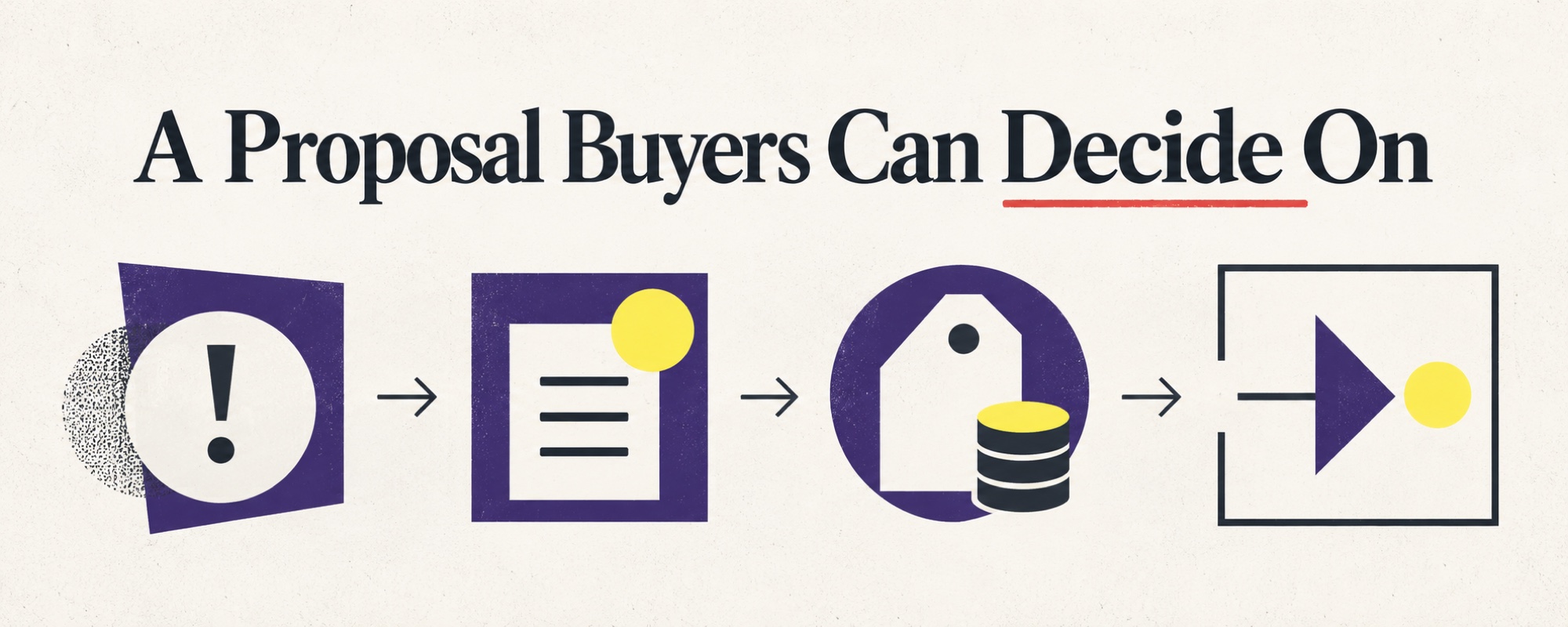
Check whether the proposal is ready to write
A request for a document is not proof that the buyer has agreed on a project. Before writing, verify the situation with the person who asked and, when possible, with the people who will use, approve, and pay for the solution. Our sales discovery questions can help separate a confirmed need from a seller's hypothesis.
- Problem: What is happening now, and which part has the buyer confirmed?
- Outcome: What change would make the project worthwhile to them?
- Scope: Which team, process, users, locations, or systems are included?
- Decision: Who reviews the offer and what questions must they answer?
- Commercial fit: Has the buyer discussed a budget range or buying constraint?
If the buyer cannot yet define the scope or decision path, send a short discovery recap with open questions. If pricing depends on unknown volume or integration work, state a conditional estimate and the information needed to finalize it. Do not turn a guess into a firm promise.
The sales proposal template
Use these blocks in this order. Keep the main document easy to scan; attach detail only when the buyer needs it.
- Decision summary: name the buyer, the confirmed problem, the proposed result, the total commercial ask, and the decision requested. A reviewer should understand the offer without reading a company history first.
- Current situation and success condition: distinguish buyer-confirmed facts from assumptions. Say how the buyer will judge whether the work succeeded, and who will validate that condition.
- Recommended approach: explain the work or service in buyer language. Map each important element to a stated need rather than listing every available feature.
- Scope and boundaries: list deliverables, who does what, dependencies, what is excluded, and what would require a change. This is where a broad promise becomes an executable offer.
- Schedule and commercial terms: show milestones, price components, billing assumptions, optional items, and the conditions under which dates or price change. Keep tax and legal treatment accurate for the actual transaction; do not copy generic terms without review.
- Evidence and risk: add only approved, relevant evidence. A comparable project, a demonstrated workflow, or a clearly labeled test can support a claim. A logo, statistic, or customer quote without permission and context cannot.
- Decision path: name the review meeting or approval step, the people involved, the remaining questions, and the date by which the parties aim to resolve them. A proposed date is not a fabricated commitment.
This is an editorial operating template, not a contract. Salesforce's sales proposal guide likewise identifies buyer needs, solution, price, timeline, evidence, terms, and next steps as core components. HubSpot's business proposal guide provides a problem–solution–price–timeline structure. Our addition is to mark what is confirmed, conditional, or still undecided in every block.
A fictional B2B example
Imagine a small services firm proposing to improve inbound lead qualification for a hypothetical software company. The buyer confirmed that multiple teams review the same new inquiries and that ownership is sometimes unclear. The example is illustrative; it is not a Lead Scorer customer story or a measured result.
- Problem: two teams may contact the same inquiry. The buyer wants one accountable owner and a reviewable reason for assignment.
- Scope: define qualification criteria, clean one agreed list of current inquiries, document the routing rule, and test it with the buyer's team. Historical data migration and outbound campaigns are excluded.
- Responsibilities: the buyer supplies a sample, names an approver, and validates edge cases; the services firm documents and tests the proposed process.
- Price: insert the actual fixed fee or rate and state what volume and revisions it covers. Do not use an invented figure copied from a template.
- Decision: the buyer confirms the scope and owners, raises unresolved security or procurement questions, and then approves or revises the offer.
Notice what this example does not promise: more pipeline, a shorter sales cycle, or automated routing by a particular product. Those outcomes and capabilities need separate evidence. The proposal first makes the work and decision legible.
Keep price, scope, and proof together
A single number without its assumptions is hard to approve. A long feature list without a price is hard to compare. For each priced option, show its included work, limits, buyer responsibilities, and decision tradeoff. If you offer two options, explain which circumstance makes each sensible. Avoid a decorative three-tier table when there is only one credible path.
Proof should answer a buying risk, not decorate the page. If a reference or testimonial is available and approved, specify what it actually demonstrates. Our guide to useful client testimonials covers that distinction. If you have no comparable evidence, describe a small verification step instead of inventing certainty.
Run a pre-send decision test
Ask someone outside the deal to read only the first page and answer:
- Which buyer problem has been confirmed, and by whom?
- What is included, excluded, and dependent on buyer input?
- What price or pricing rule is being approved?
- Which claims have evidence, and which are assumptions?
- What exactly is the buyer being asked to decide next?
If they cannot answer, revise the proposal before sending it. After delivery, follow the agreed decision process rather than treating silence as a request for repeated reminders. Post-send follow-up is a separate job; it cannot repair an unclear offer.
A proposal is strongest when it faithfully records a decision the buyer can actually make. Before drafting one, keep the underlying account facts, assumptions, and next actions clear. Explore Lead Scorer if you need a place to begin organizing that work.
Frequently asked questions
What should a B2B sales proposal include?
Include the buyer's confirmed problem and desired outcome, the proposed scope and exclusions, deliverables or service, responsibilities, timeline, transparent price and assumptions, relevant evidence, decision criteria, and a named next step. Put legal terms in the appropriate agreement or appendix.
When should you send a sales proposal?
Send it after you have checked the buyer's problem, scope, decision participants, timing, and a plausible budget range. If those are unknown, use a discovery recap or a scoped estimate instead of presenting assumptions as an agreed offer.
Is a sales proposal the same as a quote?
A quote states what will be supplied and at what price. A proposal also explains the buyer problem, the recommended approach, the boundaries and assumptions, the evidence behind it, and the decision process. A formal contract or order form may still be needed.
How long should a sales proposal be?
Make the decision view as short as the purchase allows and move detailed specifications, legal terms, or supporting proof to appendices. Complexity and procurement requirements determine the final length; a fixed page count is not a quality test.