Sales and Marketing Alignment: Close the Buyer Feedback Loop
Align sales and marketing around buyer evidence. Use a working agreement, a feedback record and a decision review that sends a useful answer back to sales.
By Lead Scorer 8 min read
Sales and marketing alignment means agreeing on the buyers you serve, the outcomes you pursue and the work each team owes the other. A shared CRM helps, but alignment becomes observable when a seller's buyer evidence produces a decision and the seller hears what happened next.
That last return is easy to miss. Marketing receives a comment such as “the leads are not ready,” sales receives another asset, and neither team can tell whether anything changed. Start with one segment and one complete feedback loop before building a larger program.
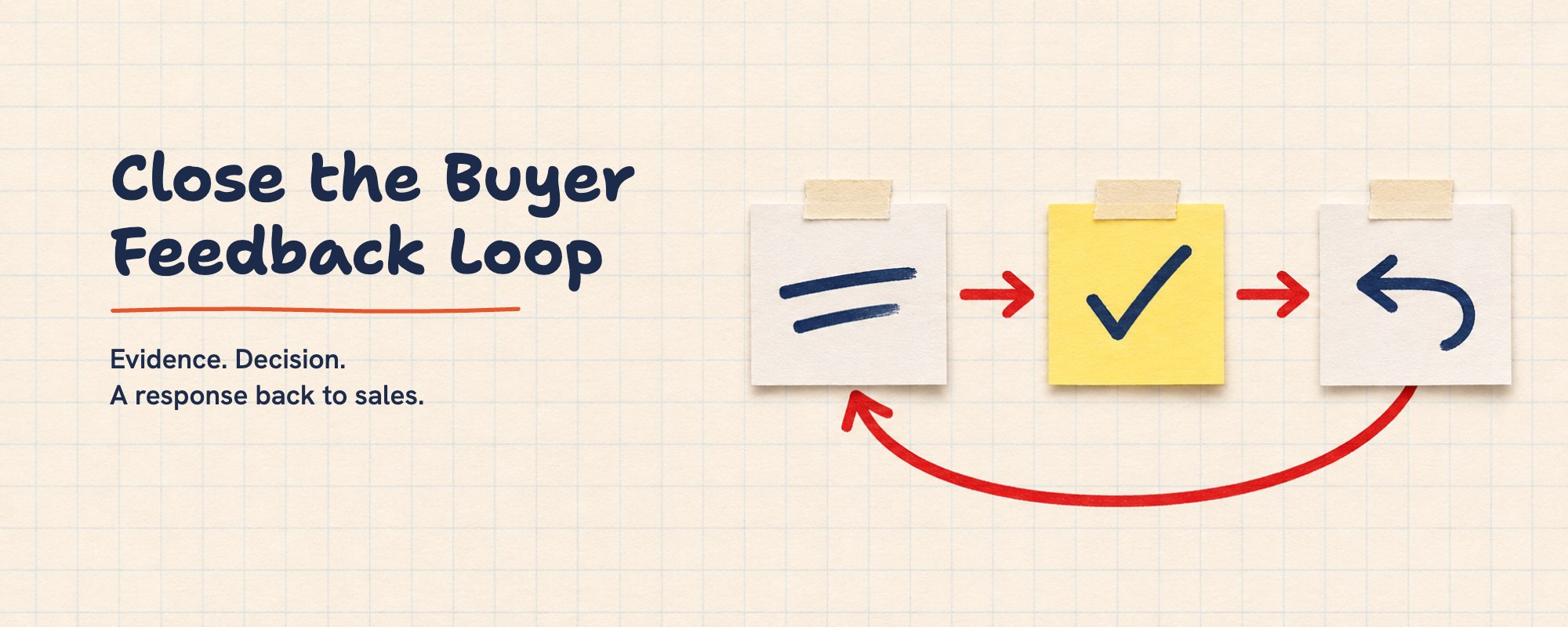
What alignment needs beyond a shared target
A useful agreement answers four questions: which buyers are in scope, what counts as progress, what information crosses the team boundary, and who decides what to do with it.
This is often called smarketing, combining sales and marketing. It overlaps with revenue operations, which covers a broader system of processes, data and tools. Here the job is narrower: make evidence from buyer conversations usable by the people choosing campaigns, messages and content.
For example, a seller may learn that a company has a real problem but cannot reconsider its supplier until a contract review. Marketing can use that distinction to prepare material for the review rather than treat the account as an immediate meeting target. This is an illustrative situation, not a reported customer result.
A shared revenue target alone does not settle these choices. The two teams also need compatible definitions and a way to resolve conflicting evidence. Our MQL versus SQL guide examines that qualification boundary in more detail.
What the podcast actually supports
In a Closed Circuit Selling conversation with Jake Rivera, the discussion turns from prospecting to what happens to account knowledge after the call. The hosts describe useful information staying with front-line sellers instead of reaching marketing or product. Later, they ask where account information should live and how different teams should receive it.
Keep the attributions separate. Rivera describes profiling accounts to understand their situation and buying window. The hosts extend the discussion to information moving through the organization and into customer success. Rivera also acknowledges that he would need better data collection to support a precise improvement claim.
The conversation supports a practical problem: collecting information and making it available are different jobs. It does not establish a measured revenue lift from the workflow below. The record and review method in this article are an editorial adaptation, not Rivera's named methodology.
HubSpot's Getting Started with Smarketing guide also recommends recurring cross-team reviews and using sales feedback in content work. That is operating guidance, not independent proof that a particular meeting cadence will increase revenue.
Write a small working agreement
Choose one customer segment or campaign where both teams can inspect the same evidence. Write down:
- Shared outcome: the buyer action both teams want to support, such as a relevant evaluation conversation.
- Handoff definition: what has to be known before an account or contact changes owner.
- Sales contribution: a short, contextualized account observation rather than a general complaint.
- Marketing contribution: a decision, the reason for it and any material the seller can use.
- Owner and review rule: who resolves the item and when the team checks its status.
Set review timing from actual capacity. “Every Tuesday” can be a local starting choice; it is not a proven universal interval. If the team cannot respond to every suggestion, define which items warrant a decision first.
Keep commercial stages separate from research findings. A useful conversation can improve market understanding without creating a qualified opportunity. Recording the former as the latter makes the pipeline less trustworthy.
Use a feedback record that survives the handoff
A note such as “buyers dislike the integration” leaves too much work for the next team. The record should preserve enough context to make the statement inspectable.
| Field | What to record |
|---|---|
| Context | Segment, account situation, role and date |
| Evidence | The buyer's statement or observed behavior, with a source |
| Interpretation | What the seller thinks it might mean, labeled as a hypothesis |
| Decision needed | The specific question marketing, sales or product must resolve |
| Ownership | One responsible person and the next review point |
| Response | Decision, reason, asset or action, and confirmation that sales received it |
Use the minimum identifying information needed for the work and follow your organization's access rules. A team learning record does not need to copy every private detail from a conversation.
Do not turn an account-level observation into a claim about a particular person's intent. A company hiring a new team may justify research; it does not establish that a named buyer wants your product.
For the wider discipline of grouping and interpreting customer evidence, see our voice of customer analysis guide.
A worked example: fix the question before the asset
The following example is fictional.
A seller reports: “The buyer needs a security pack.” Marketing could immediately commission a new brochure. A more complete record says that an operations lead asked who reviews supplier access before a pilot, while the seller inferred that a general security pack was required.
Those are different requests. The shared review produces a smaller decision: confirm the review owner and the information required before choosing an asset. Sales asks the buyer that question. The answer shows that the buyer needs a named internal sponsor and an access summary for one workflow.
Marketing and the relevant specialist then decide whether an approved existing document covers the request. The seller receives that decision, its limits and the next question. If the document does not fit, the gap is recorded without inventing an assurance.
Nothing here proves that the deal will close. The gain is a clearer decision and less chance of producing content for an assumption that nobody checked.
Review decisions, then return an answer
Use an existing cross-team meeting if one already has the right owners. The point is to move an item through a decision, not create another standing meeting by default. Our sales meeting agenda offers a structure for separating written updates from decisions.
For each item, ask:
- Is the evidence clear enough to interpret?
- Does it change a message, asset, targeting choice or handoff rule?
- Who can make that decision?
- What will the original seller receive?
- What further observation would make the team reconsider?
“Do nothing yet” is a valid decision when accompanied by a reason. So is “ask two more relevant accounts,” provided the team does not present that small sample as market prevalence.
Close the item only after returning the answer. A document uploaded to a folder may still leave the seller unaware of the decision. Record whether they received it and whether they found it usable.
Measure the process without claiming causation
Start with measures the workflow can directly support: feedback items with a source, items assigned to an owner, decisions returned to sales and unresolved items by reason. Write the denominator and review period before comparing percentages.
Then look at commercial outcomes separately: accepted evaluation conversations, opportunities and revenue within comparable segments and time windows. A change in those outcomes can also reflect account selection, seasonality, product changes or sales capacity.
Avoid scoring teams on the number of feedback notes alone. That rewards volume without requiring evidence. Avoid counting every rejected lead as marketing failure; timing, fit and routing can require different actions.
A small team can begin with a shared document and named owners. Add automation when the definitions work: retrieve the original observation, flag missing context and remind the owner. A person should approve interpretations and commercial claims.
The first useful test is simple: take one buyer observation, follow it to a decision, and check that a usable response reaches the seller. That gives sales and marketing alignment a visible unit of work.
Frequently asked questions
What is sales and marketing alignment?
It is an agreement on the buyers, goals, definitions and responsibilities that sales and marketing share. It needs a two-way process so that buyer conversations can change marketing decisions and those decisions return to the sellers who supplied the evidence.
Is smarketing the same as revenue operations?
Smarketing focuses on collaboration between sales and marketing. Revenue operations has a broader remit across revenue processes, data, systems and often customer success. A feedback agreement can be one part of that broader operating model.
What should a sales and marketing agreement include?
Start with one segment, a shared outcome, definitions for handoffs, the evidence each team provides, an owner for decisions and a review rule. Avoid promising a fixed lead volume or response deadline before checking capacity.
How can a small team measure alignment?
Track whether relevant buyer feedback reaches an owner, receives a decision and returns to sales. Separate these process measures from qualified pipeline and revenue, which take longer and have many other causes.