The First 100 Customers Course #32: How Autoklose Turned a 2,400-Person Waitlist Into Its First 20 Customers
A source-backed course for building a qualified pre-launch buyer room, converting interest into scheduled actions, and turning the first paid cohort into product evidence.
TL;DR
Autoklose did not turn a waitlist directly into one thousand customers. Co-founder Shawn Finder says the company spent eight months involving prospects through surveys, questionnaires, and product previews. By launch, the list held 2,400 people and produced nearly 1,000 booked demos. The supported customer milestone came next: the first 20 people paid something, after Finder asked what the product was worth to them.
The transferable mechanism is not “grow a huge waitlist.” It is seed a qualified buyer room → ask decision-grade questions → return visible product proof → schedule a concentrated action → staff the manual bottleneck → charge a bounded evidence cohort → raise price when the evidence changes. Autoklose also had an important advantage: existing customers from Finder's Exchange Leads business helped fill the room. A builder starting from zero should copy the cadence, not the absolute list size.
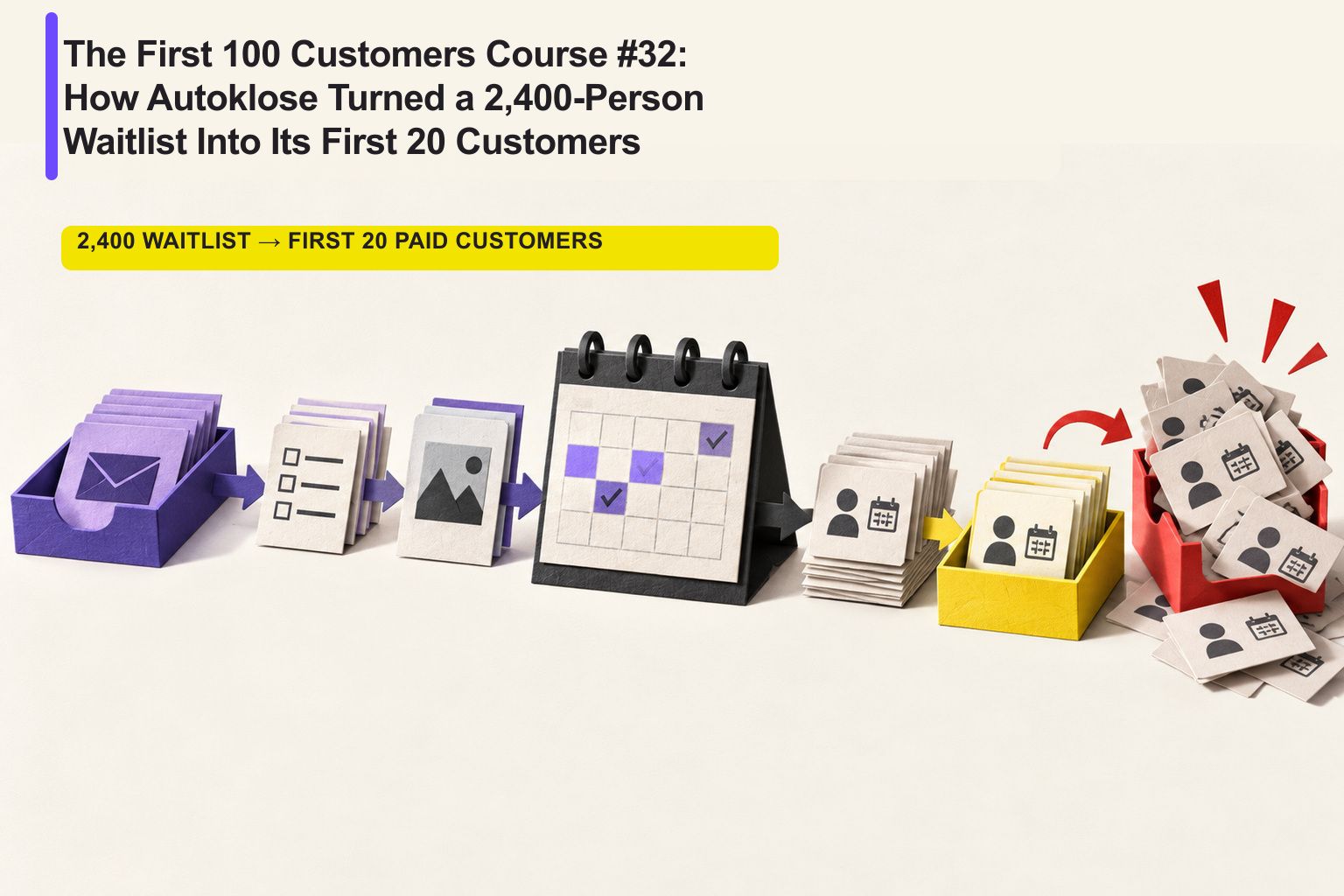
What you will build
You will build a seven-gate pre-launch buyer room for one narrow B2B product. The finished system contains a seed-account list, a research cadence, a visible change log, a launch action, a capacity plan, a paid-cohort contract, and a price-evidence ladder. Every gate has an output, a pass condition, and a stop condition.
This is for a founder with a specific buyer, a credible prototype, and enough access to recruit 15 to 30 relevant people. It is not for a broad consumer idea, a product whose buyer cannot be named, or a founder using “waitlist” as another word for an unqualified email giveaway. The room exists to improve a purchase decision, not to produce a vanity number.
Case snapshot
| Stage | What the evidence supports | Evidence limit |
|---|---|---|
| Seed | Existing Exchange Leads customers, LinkedIn, and content fed one landing page | Not a cold-start launch |
| Participation | Eight months of surveys, questionnaires, and product-video previews | No public response-rate ledger |
| Waitlist | 2,400 people before launch | Founder-reported; qualification mix is unknown |
| Launch action | Nearly 1,000 demos booked on launch day | A later interview recalls about 800 in 48 hours |
| Capacity | Three friends joined Finder for demos after one weekend of training | No show rate or completion count is public |
| First customers | The first 20 named a price and paid something | No public customer list, invoices, or retention cohort |
| Price ladder | $19.99 public start, increases every three months, then $49.99 | Plan composition may also have changed |
| Later outcome | More than $1M annual revenue around 18 months; acquired in 2020 | Does not prove the early mechanism caused the whole outcome |
The model: a waitlist becomes useful only when it changes the decision
Most pre-launch lists are passive. A visitor leaves an email, receives one generic update, and forgets why the product mattered. Autoklose treated the list as a room. Finder says subscribers received surveys and questionnaires. When roughly 20% of the product existed, they saw a video. The product came back to them with visible progress, so launch was a continuation rather than a new introduction.
That creates a causal loop. Buyer input changes a concrete decision. The founder returns proof of that change. Proof increases the cost of disengaging because the buyer now recognizes part of the result. A scheduled launch action converts interest into behavior. Payment converts behavior into evidence. The loop fails if feedback never changes anything, if updates are only marketing, or if launch day offers no specific next step.
Step 1: define one buyer and one expensive repeated problem
Autoklose came from an adjacent product. Exchange Leads sold B2B data, and its customers needed a place to send and follow up. The new product combined the database with sales engagement for small and medium-sized teams. This was not a brainstorm detached from a buyer. It was a repeated request inside an existing workflow.
Write a one-sentence hypothesis: “When this buyer performs this repeated job, the current stack creates this measurable cost.” Interview ten people around the last real occurrence. Ask what they used, what broke, who approved the workaround, and what happened next. Do not show your roadmap first.
Output: one repeated problem with an owner, frequency, and cost.
Pass: five buyers describe the same event before you name it.
Stop: interest appears only after you explain the product category.
Step 2: recruit a qualified seed room
Finder disclosed the advantage plainly: Exchange Leads customers already knew and trusted the team. LinkedIn activity and blog content added more people, but the incumbent customer base gave the landing page a head start. That matters because a list of 2,400 existing buyers is not comparable to 2,400 anonymous giveaway entries.
Start smaller. Recruit 25 accounts that match the same buyer, problem, and buying context. Record why each account belongs. Split them into existing relationships, referred buyers, and cold prospects. Never blend those sources in the final conversion rate.
Metric: qualified participants, not raw emails.
Pass: at least 15 people agree to review two or more product decisions.
Stop: the incentive attracts people who cannot buy or use the product.
Step 3: ask questions that can change the product
“Would you use this?” produces politeness. A buyer room needs questions with competing answers: which data source comes first, which workflow must survive migration, which result earns a meeting, and which risk blocks payment. Every question should map to a decision you can change within one cycle.
Use a decision log with five fields: question, options, evidence, decision, and product change. Do not count a response unless it contains an example or tradeoff. After each cycle, tell participants what changed and what did not. Explain why.
Pass: one cycle changes onboarding, scope, positioning, or price.
Stop: three updates collect opinions but change no decision.
Step 4: return visible proof on a fixed cadence
Autoklose sent product videos as the build advanced. The useful detail is not the video format. It is the proof cadence. Participants could see that the product existed and that the team kept moving. Choose one proof unit: a 90-second workflow recording, a before-and-after result, a tested migration, or a short live teardown.
Keep each update to one decision, one change, and one requested action. Do not send a changelog. If a participant must read ten features to understand why the update matters, the room is already becoming an audience rather than a research system.
Metric: repeat participation across consecutive updates.
Pass: half of the active room takes the requested action twice.
Stop: opens remain high but decision-grade replies disappear.
Step 5: convert launch interest into a scheduled action
A launch email is not an outcome. Autoklose used a webinar and demos, so interest had somewhere to go. Finder recalls nearly 1,000 demos booked on launch day. A later Mixergy interview recalls roughly 800 in the first 48 hours. The discrepancy is a reason to avoid theatrical funnel math, not a reason to discard the lesson.
Pick one launch action that proves buying intent: a scheduled implementation review, a paid setup, a data import, or a scoped trial with a decision date. Define capacity before you invite anyone. Track invitees, registrations, attendees, qualified opportunities, completed actions, and payments separately.
Pass: the action exposes a real adoption constraint.
Stop: the only conversion is another email signup.
Step 6: staff the manual bottleneck before launch
Finder faced a simple operations problem: one founder could not run the booked demos. He recruited three friends, trained them over a weekend, and created a temporary four-person demo team. Two later joined the company. The improvisation worked, but relying on emergency friends is not a capacity plan.
Calculate slots per operator, preparation time, call time, notes, follow-up, and no-show recovery. Write one demo rubric and run five rehearsals. If demand exceeds capacity, open another date or qualify harder. Do not preserve a launch-day screenshot at the cost of a poor buyer experience.
Pass: every qualified booking has an owner and follow-up window.
Stop: the queue grows faster than the team can close evidence loops.
Step 7: turn the first 20 into a paid evidence cohort
Finder says he asked early prospects what the product was worth. One might say $20, another $30, another $5. He accepted a payment rather than creating a free cohort. The company then started public pricing at $19.99 and raised it every three months until $49.99. Cheap early buyers also reported bugs that the internal team had missed.
Copy the bounded experiment, not permanent bespoke pricing. Define the first cohort size, minimum payment, support period, evidence obligations, and conversion date. Ask every buyer the same willingness-to-pay question before revealing a number. Record their reasoning, not only the amount. Then publish one standard price for the next cohort.
Output: a paid cohort contract and an evidence ledger.
Pass: payment, activation, and repeated use point in the same direction.
Stop: low price attracts testers who cannot become the target customer.
What failed, and what no longer transfers
Autoklose defined its buyer persona too late. Messaging first focused on VPs of Sales, while Finder later found that CEOs of smaller companies often made faster decisions. Cheap pricing also damaged credibility with larger prospects. At the prior company, Finder felt acquisition had received too much attention while product improvement lagged. These are three different failures: targeting, value signaling, and resource allocation.
One historical tactic should not be copied. Finder describes a virtual assistant sending up to 100 personalized LinkedIn requests per day. LinkedIn now says all members face invitation limits and that third-party automation or scraping is prohibited. Use the historical example only as evidence that founder participation mattered. Use compliant, human-reviewed activity now.
Your seven-day implementation plan
- Day 1: write the buyer, repeated problem, current workaround, and exclusion list.
- Day 2: build 25 qualified accounts across warm, referred, and cold sources.
- Day 3: run three event-based interviews and log one product decision.
- Day 4: publish one proof update and ask one decision-grade question.
- Day 5: define the launch action, funnel fields, and operator capacity.
- Day 6: rehearse the action five times and prepare the paid-cohort contract.
- Day 7: invite the room. Continue only if payment and activation can be measured separately.
Run the buyer room with Lead Scorer
Lead Scorer can reproduce the research, qualification, and drafting loop without pretending to create trust automatically. Start with the ICP and offer context skill. Store the buyer, problem event, exclusions, permitted proof, launch action, and paid-cohort boundary. The output is one reusable context record, not a broad market description.
Next, create three lists: buyer-room candidates, active participants, and paid evidence cohort. Never use one status field for all three. Discover 25 accounts and score them before contact enrichment. Use a minimum 7/10 fit threshold and require a visible reason the workflow matters now. Reserve paid contact discovery for keepers only.
Run signal research dossier on approved people. Require two dated sources per lead when public evidence exists. If there is no usable signal, skip the lead honestly. Create a draft campaign with one request: participation in a specific product decision. Keep every message under one idea and leave the campaign in draft.
For each approved lead, name one verified workflow signal, ask one decision-grade question, and invite them to a two-update buyer room. Do not claim exclusivity, mention list size, or pitch the full product. Leave every message in draft for review.
Run outreach QA audit before human approval. Reject a draft if the signal is generic, the ask cannot change a product decision, or the message implies a relationship that does not exist. The operator decides whether to send. Lead Scorer must not automate LinkedIn activity outside platform rules or activate a campaign without approval.
After each response, update the participant list and write the evidence into Content Studio. A product update should cite the decision it addresses. Objections become the next research question or a useful content brief. When someone completes the launch action, move them into the paid cohort only after a reviewed payment and activation plan. The pass condition is not a large list. It is a short, auditable chain from signal to decision to proof to payment.
Checklist
- One narrow buyer and one repeated expensive problem
- A 25-account seed list with source types kept separate
- Questions tied to decisions the team can change
- A visible proof update on a fixed cadence
- One scheduled launch action, not another signup
- Capacity calculated before invitations go out
- A bounded paid cohort with a minimum price
- Activation and retention tracked separately from demos
- Current platform rules checked before outreach
- Human approval before contact enrichment or sending
Sources and limits
- SaaS Club episode 216 and full transcript
- Finder's contemporaneous alpha and beta announcement
- VanillaSoft acquisition release
- Built to Sell interview
- Mixergy interview
- LinkedIn invitation limits
- LinkedIn automated activity policy
The 2,400-person list, launch-demo count, first-20 pricing, price ladder, and early revenue are founder-reported. No public customer list, invitation log, response-rate ledger, invoices, demo attendance report, activation cohort, CAC, or retention data exists. The later demo recollection is lower than the original interview. This course therefore treats the first 20 paid customers as the supported milestone and treats every larger number as context with an explicit limit.
Frequently asked questions
Did Autoklose get 1,000 customers on launch day?
No. Shawn Finder says Autoklose booked nearly 1,000 demos on launch day. The supported early customer milestone is the first 20 paid customers, who were asked what the product was worth to them.
Was Autoklose a cold-start launch?
No. Existing Exchange Leads customers helped seed the pre-launch list, alongside LinkedIn and content. A founder without that advantage should begin with a smaller qualified room and judge participation quality, not list size.
Should founders let every early customer choose any price?
Only as a bounded evidence exercise. Define the cohort size, minimum payment, evidence you need, support period, and date when standard pricing begins. Otherwise flexible pricing becomes permanent ambiguity.
Can founders still copy Autoklose's LinkedIn automation tactic?
No. LinkedIn now imposes invitation limits and prohibits third-party tools that automate activity or scrape the site. Use compliant research, fewer relevant invitations, and human-reviewed outreach.