Client Testimonials: Collect Evidence Buyers Can Use
Collect B2B client testimonials that answer buyer questions: interview prompts, evidence checks, approved examples, reference calls, and clear limits.
Client testimonials are attributed accounts of a customer's experience with a product or service. In a B2B sale, the useful question is what that experience helps a prospective buyer verify. “Great team” conveys satisfaction. It does not explain the original problem, the work required, or whether the result applies to another organization.
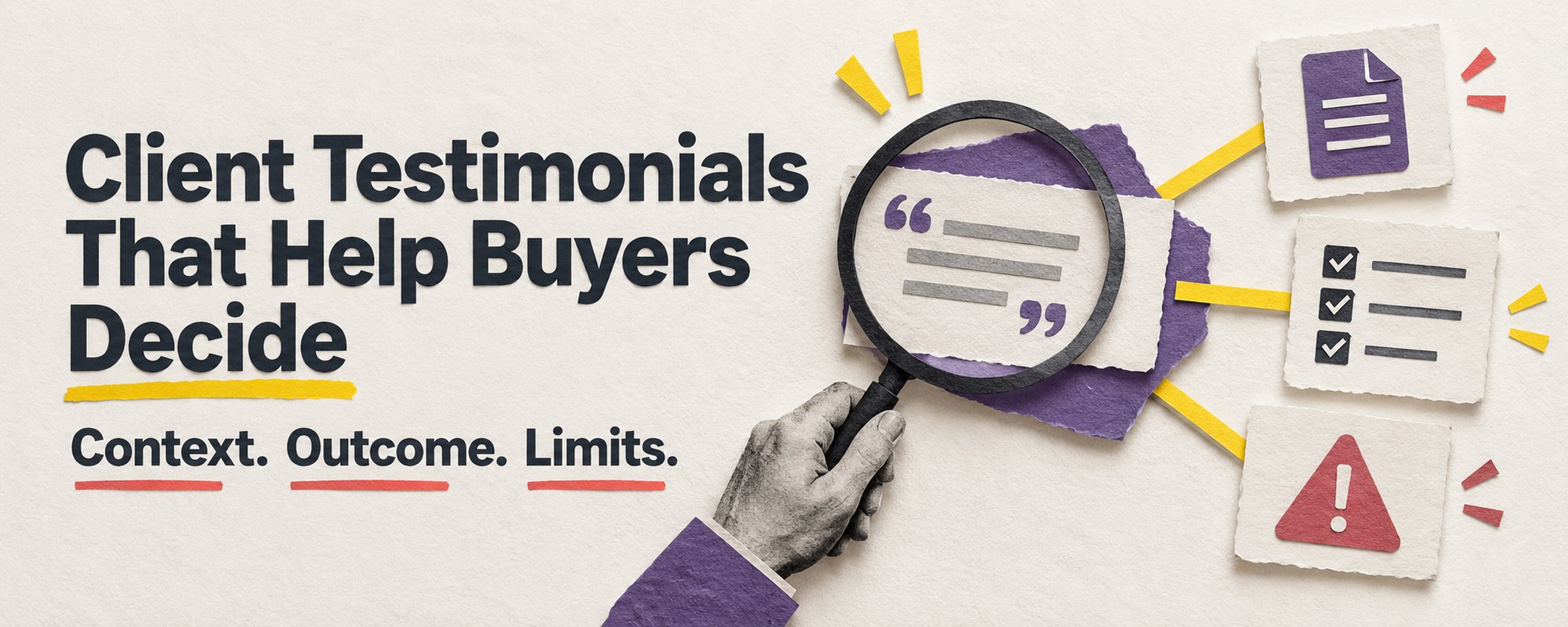
A useful testimonial preserves three things: context, an observed outcome, and its limits. This guide shows how to collect that information, turn it into a short approved account, and decide when a written quote should become a customer reference conversation. The aim is a better informed buying decision, without promising that one customer's result is repeatable everywhere.
What two sales practitioners actually say
In The SaaS Podcast, Felix Hoffmann describes how 7Learnings found early customers through its network and events. At roughly 18:33–19:23, he distinguishes customer referrals from customers being willing to speak with a prospective buyer. A customer can support a sale without generating a new introduction. That distinction matters: a reference answers questions inside an existing opportunity; a referral creates access to a new one.
In Sales Talk for CEOs, Becc Holland argues that the objective should be a customer who succeeds using what was sold. She connects that success with customers being willing to recommend the company or make introductions. Her surrounding discussion includes the work of change, the role of customer success and subject experts, and helping the buyer after the decision.
These are practitioner perspectives, not a controlled study of testimonial conversion. Neither episode supplies the exact interview process below. Our editorial synthesis is to collect evidence about actual use before requesting an endorsement, and to choose the form of advocacy according to the buyer's unresolved question.
A testimonial, a case study, and a reference do different jobs
A short testimonial conveys one customer's account in a small space. A case study can describe the starting situation, implementation, observations and limitations in more detail. A reference call lets an interested buyer ask a customer about a relevant experience. A referral is an introduction to another potential buyer. Keep those permissions and activities separate.
Choose a short quote when one verified point answers the question. Choose a case study when the dependencies matter. Offer a reference conversation when the buyer needs to examine a comparable operational situation. A video is a delivery format, not an automatic increase in evidence quality. A recognizable logo also cannot establish which product was used or what happened after purchase.
Our relationship selling guide covers earning access and trust before a meeting. This process starts with a customer experience you can document. The Judi Health case explores a founder's path upmarket through references; the method here is for collecting and editing an individual testimonial.
Start with the buyer's unresolved risk
Write down the question the account should help answer. “Will this fit our current workflow?” is different from “How much internal work will deployment require?” or “What happened when support was needed?” Select an interviewee with first-hand knowledge of that question. A senior sponsor may understand the decision but have little direct knowledge of daily use.
Check with the delivery team whether the customer has reached a meaningful usage milestone. A signed contract establishes a commercial relationship. It does not establish that implementation succeeded. If the customer is still waiting for the agreed outcome, request feedback about that stage instead of asking them to endorse a result they have not experienced.
Do not ask for a positive response as a condition of support. Make the request easy to decline, explain the intended use, and agree on who needs to review the eventual account. An interview invitation and publication approval are different steps.
Eight testimonial interview questions
Use these as prompts, not a script for putting words into the customer's mouth. Follow an answer with a request for a concrete example rather than suggesting the result you want.
- What problem were you trying to solve, and how did you handle it before?
- What made you decide to change at that point?
- What did your team actually use, and which part of the offer was outside the scope?
- What did implementation require from your people, data and existing tools?
- What changed in the work, and what observation supports that account?
- Over what period did you observe the change, and what else changed at the same time?
- What did not work as expected, or still needs attention?
- Which other organization would be a reasonable comparison, and which would not?
The last two questions protect the usefulness of the story. A buyer needs to see dependencies and limits, not only praise. Ask separately which facts, wording, name, role, logo or image the customer is comfortable sharing. Preserve an unanswered question as an unknown.
Turn the interview into an evidence sheet
Keep five fields before drafting: starting context; actual use; observed outcome; supporting source and period; limitations. For a quantitative statement, preserve its definition, baseline, population and calculation. A report of fewer manual steps is not evidence of increased revenue. A customer's estimate should remain an estimate.
Keep the original notes or approved recording in the team's authorized storage, with access appropriate to the information. Store the proposed public wording separately. This makes it possible to check whether an edit removed a condition or changed the meaning. It also lets sales colleagues retrieve the relevant story without exposing private operational detail.
For US advertising, the FTC's endorsement guidance emphasizes truthful, non-misleading accounts and disclosure of unexpected material connections. A customer's sincere statement does not by itself substantiate every implied claim. Review the applicable context rather than treating a customer approval as blanket clearance.
Example: replace broad praise with a bounded account
The following is a fictional editing exercise, not an actual customer's quote. A customer initially says the project made the sales team more organized. An interview then establishes that one team used a shared checklist for preparing calls, that a manager reviewed its use, and that several missing handover fields were noticed earlier. No financial result was measured.
An accurate summary could explain those facts and state that the observation applies to that team and workflow. It should not become “the platform increased sales” or “every team became more productive.” Those claims add an outcome or a population the interview did not establish. If a concise account cannot preserve the important boundary, use a longer case study.
Treat the draft as a proposal for review, not a quote until the customer confirms the exact wording and attribution. Ask them to correct it. If the customer cannot confirm an important detail, remove the detail or label the uncertainty; do not reconstruct it from your preferred narrative.
Match the story to the sales conversation
Link each approved asset to its use case, role, starting conditions, evidence, limitations and review date. Then select it against the buyer's stated concern. An account from a large enterprise may be poorly matched to a small company without a dedicated implementation team. Similarity of problem and operating constraints can matter more than similarity of logo prestige.
Use the sales discovery questions to establish the concern before choosing the story. Send a short explanation of why this account is relevant and what it cannot establish. If questions remain, request a separate, voluntary reference conversation from the customer and agree on topics and availability. Do not circulate their contact details as if publication permission included unlimited calls.
Maintain the account and measure its usefulness
Revisit a testimonial when the product, customer role, implementation or measured situation changes. Keep a responsible owner and retire an account that no longer describes the experience accurately. AI can organize notes and suggest a shorter draft; a person must compare every statement with the source, and the customer must review the proposed public account.
Measure collection completion, approval status, relevance to the intended buyer question, and the questions left unanswered. If you compare opportunities with and without a testimonial, recognize that sales teams may choose testimonials for already different deals. That comparison alone cannot prove a causal lift in conversion.
The practical test is whether a buyer can identify what happened, under what conditions, and what still needs verification. If the only information is enthusiasm, the testimonial needs a better interview before it needs a better design.
Frequently asked questions
What is a client testimonial?
A client testimonial is an attributed account of an experience with a product or service. In B2B, useful accounts identify the original problem, actual use, observed outcome and important limitations. Satisfaction alone does not establish a measurable business result.
What questions should you ask for a testimonial?
Ask about the original problem, trigger for change, scope used, implementation work, observed outcome, evidence and period, limitations, and comparable organizations. Request concrete examples without suggesting a positive answer.
How do testimonials differ from customer references?
A testimonial presents an approved account. A reference conversation lets a prospective buyer ask an existing customer questions. A referral introduces a new potential buyer. Publication, contact sharing and participation in calls require separate agreements.
Can AI write a customer testimonial?
AI can organize authorized notes and propose edits to a genuine account. It should not invent a customer, quote, result or endorsement. Compare each proposed statement with its source and obtain customer review of the final wording.
Do testimonials prove a higher conversion rate?
An individual testimonial does not prove a general or causal conversion improvement. Customers and deals selected for testimonials may differ from others. Measure usefulness and unresolved questions, and distinguish those observations from causal impact.