Sales Territory Planning: A Practical Capacity-First Template
Build sales territories around account potential, rep capacity, ownership rules, and review triggers—not just equal-sized maps. Includes a reusable planning template.
Equal-sized territories are rarely equal opportunities. One rep may inherit many low-fit accounts; another may own a small set of complex buyers that consumes the entire week. A useful sales territory plan balances the potential of the accounts with the work needed to cover them, then makes ownership unambiguous.
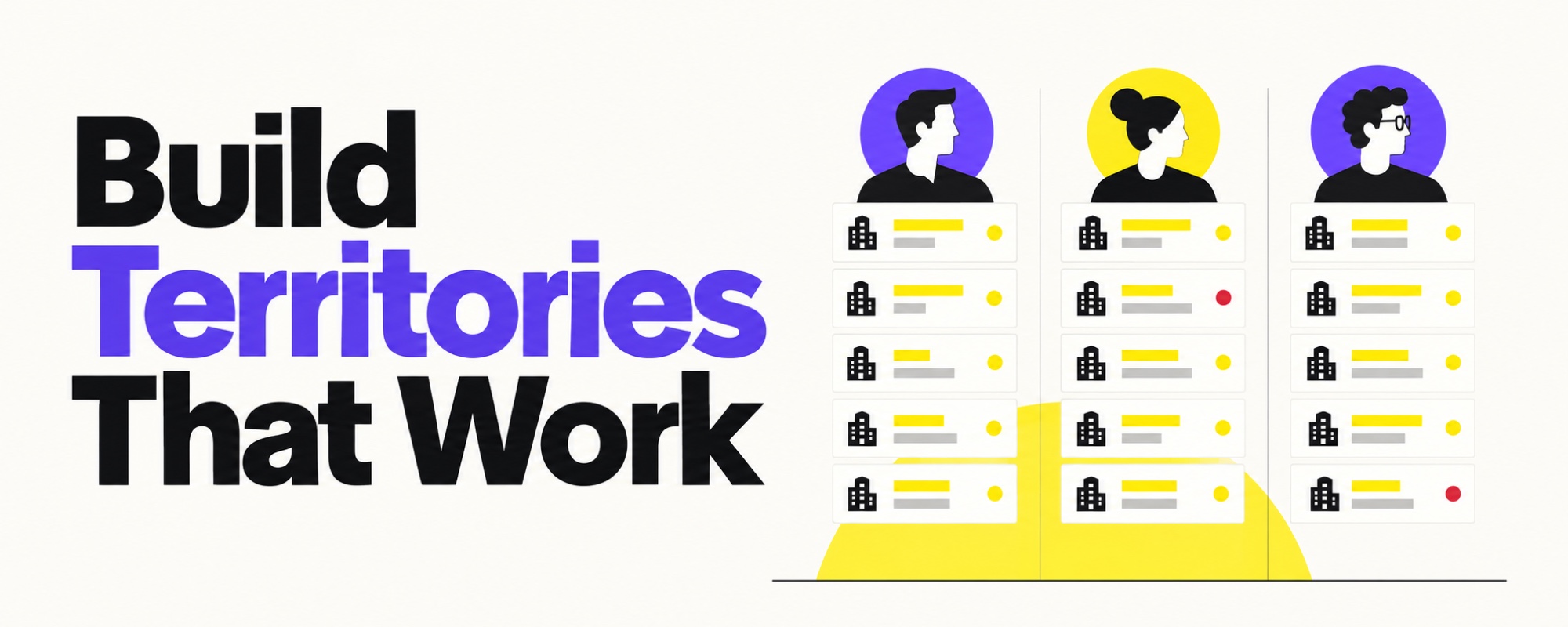
This guide gives you a territory-design sequence and a one-page template. It works for a small remote B2B team as well as a field team, provided you treat travel as a real capacity cost only where travel exists.
Define a territory as an ownership rule
A territory is not necessarily a region on a map. It is a rule that tells a seller which accounts they can work, which accounts they must cover, and when an exception changes the assignment. Salesforce's territory-planning guidance frames the job around fair work distribution and eliminating coverage gaps. The useful lesson is to make both measurable before debating boundaries.
Choose the primary boundary that actually changes the sales motion:
- Geography: when travel time, local language, regulation, or regional relationships matter.
- Segment: when company size changes deal complexity, cycle length, or service needs.
- Industry: when buyer problems, proof, and procurement are meaningfully different.
- Named accounts: when a few strategic companies require coordinated coverage.
Use a hybrid only when each extra rule solves a real conflict. A territory definition that needs five exceptions to assign one account is too complicated to operate.
Build one clean account universe
Start with accounts, not pins on a map. Deduplicate company records and parent-child relationships. Separate existing customers, open opportunities, qualified prospects, and unqualified names. Record the current owner and why they own it. Keep the source and last verification date for company size, location, and industry fields; missing data should remain marked as missing, not quietly estimated.
An initial ideal customer profile removes companies the team should not pursue. Then use account scoring to distinguish account fit and potential from urgency. A strong-fit company without a buying signal can belong in a territory without becoming this week's highest-priority call.
Estimate potential separately from effort
For every account, record two independent judgments. Potential is the plausible value of winning or expanding that account, supported by its fit, need, and size. Effort is the seller time likely required to create and advance an opportunity. Do not use an account's entire company revenue as its opportunity value, or treat all accounts in a postcode as equally reachable.
A simple first pass uses three bands for each dimension:
- Potential A/B/C: high, medium, or low relative to your own offer and customers.
- Effort 1/2/3: low, moderate, or high coverage cost.
- Evidence: confirmed, inferred, or unknown for the fields behind each band.
This is a planning aid, not a universal scoring model. Revisit the bands after real sales-cycle data appears. If you need a more detailed plan for a single strategic company, use an account plan; the territory plan answers how the whole portfolio is divided, not how one buying group makes a decision.
Calculate the capacity you can actually deploy
Count the seller hours available for prospecting and account coverage after existing customer work, internal meetings, leave, and management duties. For a field team, add travel time. For a remote team, add the time needed for research, outreach, discovery, and follow-up. These are planning estimates: write down the assumptions and refine them with observed activity rather than presenting them as industry benchmarks.
For example, if a rep can cover 12 focused account hours a week, assigning 30 accounts that each need an hour every week is visibly impossible. The useful output is not a precise forecast; it is the decision to narrow the active tier, change the service cadence, or add capacity. Compare required coverage hours with available coverage hours for each proposed territory.
Run the overlap and gap test before launch
Draft a few allocation scenarios, then inspect four failure modes:
- Unowned accounts: qualified accounts that match no rule.
- Double-owned accounts: subsidiaries, inbound leads, or cross-border groups that match several rules.
- Uneven workload: similar potential but very different effort or travel.
- Concentration risk: one rep's target depends on a handful of uncertain accounts.
Decide what wins when rules collide: a named-account assignment, an existing active opportunity, a customer relationship, or the general segment rule. Put those priorities in writing. Do not silently reassign an active deal to make the spreadsheet look balanced; agree on the handoff and compensation treatment with the affected people.
The one-page sales territory planning template
Keep one operating page per territory with these fields:
- Scope: included segment, region, or named accounts; explicit exclusions.
- Owner: primary seller, backup, and effective date.
- Account mix: customers, open deals, qualified prospects, and unqualified names.
- Potential: A/B/C account counts and the evidence used, not a made-up revenue total.
- Capacity: available and required coverage hours, including travel if relevant.
- Priority: which tier gets proactive work now, and which gets a lighter cadence.
- Exceptions: overlap rule, inherited deals, parent-child account treatment.
- Review trigger: what change justifies a reassignment.
Test the page by asking a new rep to assign three real accounts without a meeting. If they cannot, the rule is not ready. Salesforce's territory-design training also emphasizes aligning the design with the company's growth strategy and its measures; the template makes that alignment operational rather than decorative.
Review coverage without constantly redrawing the map
Check unworked qualified accounts, overdue follow-ups, active account load, and owner conflicts in a short weekly review. Rebalance only when a defined trigger persists: a rep leaves, a segment changes, a territory cannot be covered, or a meaningful cluster stays unowned. Frequent ad hoc changes can damage customer continuity and make performance comparisons hard to interpret.
The recent 90-day sales plan explains how to convert a strategic choice into an execution cadence. Here the choice is narrower: who owns each account, how much attention it deserves, and whether that attention fits real capacity. If the account list, owner rule, and coverage budget are visible, you can make the next adjustment from evidence instead of arguing over a map.
Lead Scorer can help you research and prioritize candidate companies before assigning work. Keep territory ownership, quota policy, and customer handoffs in the system your team actually uses. Start with a qualified account list.
Frequently asked questions
What is sales territory planning?
Sales territory planning assigns a defined set of accounts or prospects to a seller or team, using market opportunity and realistic capacity to make coverage and ownership workable. A territory can be geographic, industry-based, account-based, or a combination.
How do you balance sales territories?
Compare qualified account potential with the work required to cover it. Estimate prospecting, meetings, travel where relevant, and current-customer responsibilities. Test scenarios for uncovered accounts, overloaded reps, and ownership conflicts before assigning quotas.
Does every sales territory need a geographic boundary?
No. Geography matters when travel, language, regulation, or local relationships change the work. Remote B2B teams may divide accounts by segment, industry, named-account tier, or a hybrid rule instead.
How often should territories be revised?
Review coverage and workload on a regular operating cadence, but change ownership only when a clear trigger occurs, such as a team change, a material market shift, persistent overload, or repeated unowned accounts. Publish transition rules before moving live opportunities.