Proposal Follow-Up Email: Get a Decision, Not Just a Reply
A practical B2B proposal follow-up framework with buyer-led timing, three email examples, decision-path questions, and clear stop rules.
A proposal follow-up email should help the buyer make or explain a decision. It should not simply prove that the seller is still interested. Once a proposal has been sent, the useful question is not “Did you see it?” but “What must happen before your team can accept, revise, or decline it?”
The best follow-up starts before the send: agree on a review date, name the people who must weigh in, and confirm what the proposal is meant to resolve. When that did not happen, the first email should recover the missing decision path rather than pretend one exists.
Before writing: identify the proposal's actual state
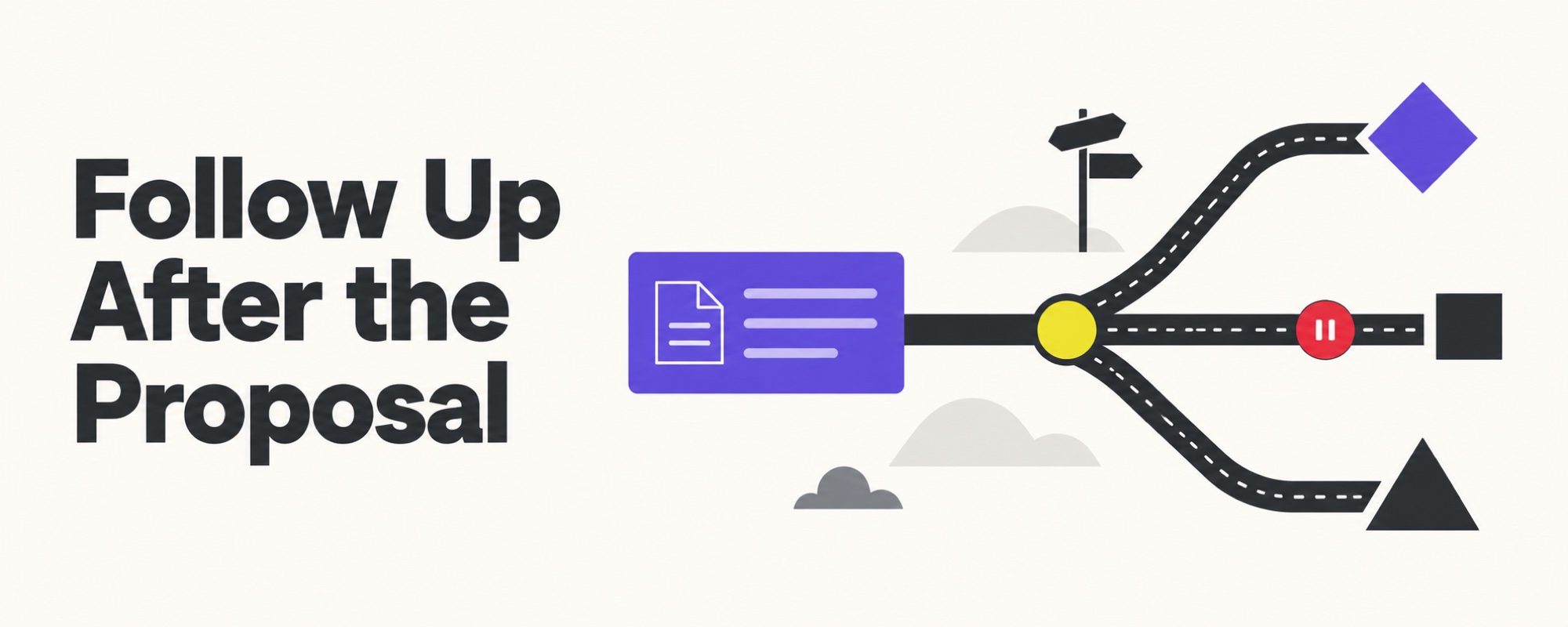
“No reply” is not one sales stage. Sort the opportunity into one of four states:
- Review scheduled: the buyer committed to a date and knows who will decide.
- Internal review: the proposal is circulating, but one or more criteria are open.
- Blocked: an objection, missing stakeholder, procurement step, or changed priority is known.
- Unknown: nobody confirmed receipt, ownership, timing, or next action.
Each state needs a different note. A scheduled review calls for preparation, not another pitch. An internal review calls for a question about the decision process. A known blocker calls for a specific answer or revised scope. An unknown state calls for a respectful reset. This is more precise than applying a generic cold-email follow-up sequence to an active opportunity: the buyer has already evaluated a concrete offer.
A five-field proposal follow-up brief
Write these five fields in the opportunity record before drafting:
- Decision: what exactly can the buyer approve, change, or reject?
- Reason: which buyer-stated problem does the proposal address?
- People: who reviews scope, budget, technical fit, and contract terms?
- Timing: what date did the buyer agree to, or what timing remains unknown?
- Next action: one useful question, document, or meeting with an owner.
Mark unknowns explicitly. “Finance must approve” is a fact only if the buyer said so. “Finance may need to approve” is a hypothesis. The distinction matters when an AI assistant summarizes the CRM: unsupported guesses must not become the reason for an aggressive chase.
Three proposal follow-up emails for three different situations
1. The agreed review date arrives
Subject: Review of the [project] proposal
Hi [name],
We planned to review the [project] proposal today. It covers [buyer-stated objective] and the [scope] we discussed. Has your team reached a view on that scope, or is there one point we should resolve before deciding?
If it helps, I can join a short review with [relevant stakeholder] to settle that point.
[Signature]
This references a real commitment without claiming that silence means agreement. Do not use “as promised” unless the buyer actually committed to this date.
2. The proposal is in internal review
Subject: One decision point on [project]
Hi [name],
You mentioned that [team] would review the proposal. Is the open question about [known criterion], or has another requirement emerged? I can send a concise answer on that point rather than another full presentation.
Who should be included in that answer, and when would it be useful?
[Signature]
Substitute a real criterion. If you do not know it, ask what the team is comparing; do not insert a fabricated objection. A decision might depend on implementation, contract language, security, internal capacity, or whether the problem is still a priority.
3. There is no agreed next step
Subject: Next step for the [project] proposal
Hi [name],
I sent the [project] proposal after our discussion about [buyer-stated problem], but we did not set a review step. Is this still being considered for [timeframe], or should I close the loop for now?
If the timing changed, a brief note is enough. I will not assume the original plan still holds.
[Signature]
This gives the buyer a low-friction way to say no or not yet. Avoid using the same message when the buyer already asked for a pause; honor the pause instead.
Choose the next action from the buyer's answer
- “We need a different scope.” Restate the change, confirm the trade-off, and send a revised proposal only after the buyer agrees to the new scope.
- “It is with procurement.” Ask which documents or approvals remain and who owns the review. Do not convert an estimated date into a commitment.
- “The price is high.” Ask what the buyer is comparing and which outcome or part of the scope is disputed before offering a discount.
- “Not this quarter.” Record the reason and a buyer-approved revisit point; stop sending decision-stage nudges.
- No reply. Send at most a relevant clarification or close-the-loop note according to the relationship and agreed cadence. Silence is not permission for an endless sequence.
This is why a good discovery conversation matters: the proposal should reflect criteria that the buyer actually expressed. If those criteria were never established, a better email cannot repair the missing diagnosis by itself.
Timing, records, and stop rules
The right follow-up date is the buyer's review date. If none exists, ask for one in the proposal delivery conversation or the first follow-up. Avoid claiming that a fixed two-, three-, or seven-day cadence works for every deal. A small service quote, a software security review, and a multi-stakeholder procurement process have different clocks.
Log the proposal version, buyer-stated criteria, stakeholders, agreed date, blocker, and next owner in the CRM. A pipeline review should distinguish “sent” from “buyer committed to review.” Those are not interchangeable stages. Close or pause the opportunity when the buyer declines, asks for no contact, says the project is not active, or the agreed process ends without a useful next step.
Use AI to prepare, not invent, the follow-up
AI can summarize verified notes, identify missing fields, and draft a concise email for a human to review. It should not invent a buyer deadline, a pricing exception, a stakeholder objection, or proof that the proposal was read. In Lead Scorer, keep the account research and qualification context attached to the prospect, then have a person verify the message before sending. The product does not replace the buyer's decision process or send a proposal on the buyer's behalf.
The test is simple: after reading the email, can the buyer answer a real decision question in one sentence? If not, the message is probably a reminder for the seller rather than help for the buyer. Explore Lead Scorer if you need a clearer place to keep the account context behind that decision.
Frequently asked questions
When should I follow up after sending a proposal?
Use the review date agreed with the buyer. If none was agreed, ask who needs to review the proposal and when a decision discussion would be useful. A universal day-count ignores the buyer's process.
What should a proposal follow-up email say?
Refer to the agreed problem and proposal, ask about the specific decision or unresolved issue, and offer one concrete next step. Avoid a generic just-checking-in message or an unrequested discount.
What if the buyer says the proposal is with procurement?
Ask what procurement needs, who owns the review, and whether legal, security, or budget approval is also involved. Record the actual process and its owner rather than treating procurement as a guaranteed close date.
How many times should I follow up on a proposal?
There is no universal number. Follow the agreed decision process, change the purpose of each message, respect a stated pause or rejection, and close the loop when no useful next action remains.