The SaaS Distribution Course #1: How Render Reached $10M ARR Before Spending on Marketing
A step-by-step course on Render's distribution system: underserved segment, fast time-to-value, manual migrations, engineer support, word of mouth, freemium, and unit economics.
TL;DR
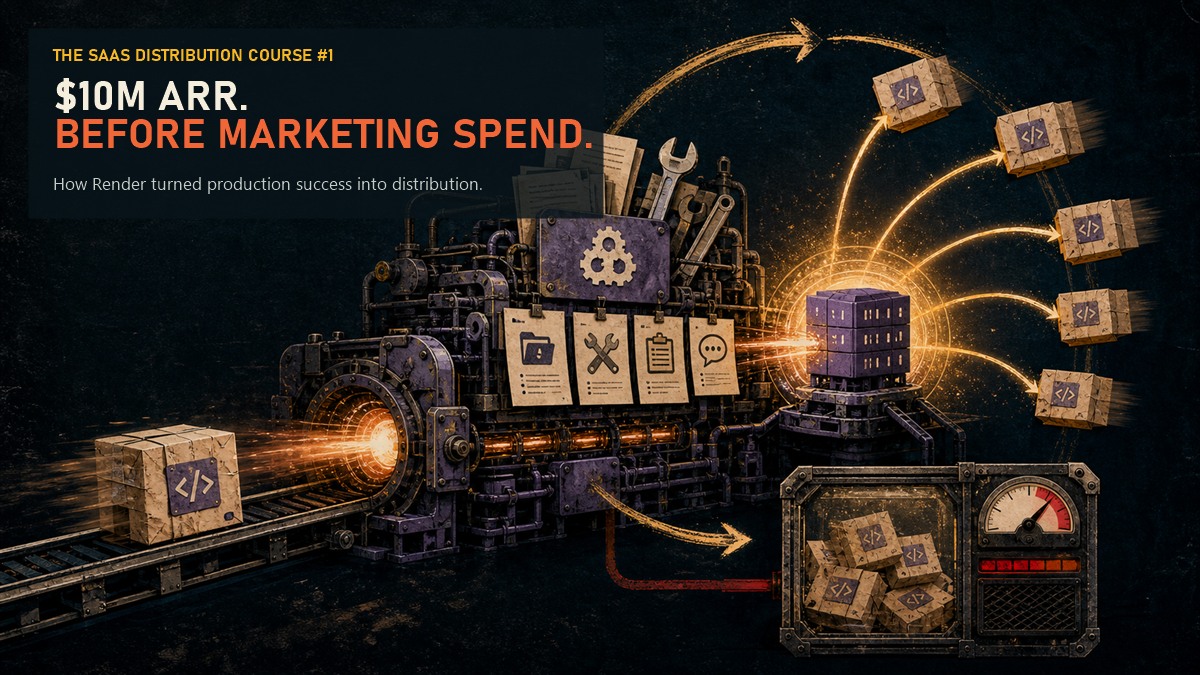
Render reached roughly $10 million in annual recurring revenue before spending on marketing and before it had an early free tier. But “zero marketing” did not mean zero distribution. The system included almost two years of product work, a TechCrunch Disrupt launch, migrations performed by the founder, support weeks handled by engineers, fast time-to-value, and developer word of mouth.
This course teaches how to reproduce the system for an AI-era SaaS: choose an underserved segment inside a large market, define a fast value moment, manually activate the first users, turn support into product improvements, make word of mouth measurable, introduce free access only when the economics can survive it, and adapt the product when a new wave changes customer behavior.
What you will build
- a segment thesis explaining why large incumbents underserve one buyer;
- a time-to-value target and activation event;
- a concierge onboarding protocol for the first ten customers;
- a technical support loop that changes the roadmap;
- a word-of-mouth dashboard and a free-tier decision model;
- a 30-day distribution plan that does not require a marketing budget.
This course is for you if
- you built a developer tool, AI app, infrastructure product, or technical SaaS;
- users can try the product themselves but need help reaching production value;
- you compete against a large platform that serves enterprises or specialists better than your buyer;
- you are considering freemium, product-led growth, or paid acquisition.
Do not use it if
- you think “product-led” means no founder conversations or onboarding work;
- your product has no observable activation event;
- every free user creates cost you cannot measure;
- you want a launch to compensate for a product people cannot retain.
Case snapshot: the complete distribution sequence
| Stage | Motion | Result | Constraint revealed |
|---|---|---|---|
| Before Render | Goel tests problem spaces and a one-click GPU notebook | About 10,000 data scientists through word of mouth | Founder-market fit mattered more than adjacent traction |
| 2018–2019 | Working prototype, four-person team, nearly two years building | A credible but incomplete production platform | Infrastructure needs more than an MVP landing page |
| October 2019 | TechCrunch Disrupt launch and Battlefield win | Large attention and signup wave | Many users left because expected features were missing |
| Early users | Friends recruited; Goel often performs migrations himself | Critical workloads and direct feedback | Switching cost had to be absorbed manually |
| Early growth | Fast deployment, engineer support, word of mouth | Natural developer acquisition without ads | The product itself had to carry activation and retention |
| Late 2021 | Free services introduced | Lower adoption barrier and more usage | Infrastructure burn increased |
| End 2021/start 2022 | Paid production workloads plus organic growth | About $10M ARR, founder-reported | Economics needed repair before marketing spend |
| 2022–2023 | Efficiency work and price increase | More sustainable model, slower growth | Growth and margin could not be optimized independently |
| 2024–2026 | AI application wave, workflows and sandboxes | New acceleration in deployments and revenue | The wedge had to evolve with developer behavior |
The model: fast value → technical success → recommendation → product improvement
Render's acquisition loop begins when a developer connects a GitHub repository and gets an application online in minutes. If the workload remains reliable as it grows, the developer has a low-risk recommendation to share. A friend tries it, encounters a missing capability, and talks to a technical person. The issue becomes product work. Activation improves for the next cohort.
The loop is not viral in the classic sense. A user receives no direct product benefit when another developer joins. Word of mouth happens because recommending the product creates social value: the recipient can experience the same result quickly. Render's founder argues that natural growth of this kind is a core sign of product-market fit.
Step 1: find the buyer a giant market has chosen not to optimize for
Render did not attempt to build new data centers or outspend AWS. It focused on application developers who wanted to deploy software without operating low-level infrastructure. Goel's thesis was organizational: hyperscalers earned large enterprise contracts from companies with DevOps teams, so their products and incentives naturally served DevOps engineers.
This left application developers using complex primitives or waiting for internal platform teams. Render promised the flexibility and reliability of cloud infrastructure at the application layer. The competitor could build a similar interface, but the underserved segment was not its main organizational priority.
Your segment thesis
- Large market: ______.
- Incumbent's best customer: ______.
- Underserved user: ______.
- Job they must do: ______.
- Why the incumbent will not prioritize it: revenue, organization, channel, architecture, or brand constraint ______.
- Boundary: we will not compete on ______.
Pass condition: ten target users already perform the job through a specialist, workaround, or low-level tool. Stop condition: the only advantage is a nicer interface the incumbent can add without hurting its main business.
Step 2: design the first value moment before the acquisition channel
Render optimized for the shortest path from source code to a live application. A user connected a GitHub repository; Render created the server, URL, certificates, networking, and settings. In many cases the result appeared in less than a couple of minutes. The promise still appears in its positioning: the fastest path to production.
Fast time-to-value reduced the social cost of a recommendation. A developer could tell a friend to try Render without assigning them hours of configuration. But the first moment was not enough on its own. Render also promised that the application could grow without a painful migration to AWS.
Define four numbers
- Time to first value: minutes from signup to the smallest useful result.
- Activation rate: percentage of qualified signups reaching that result.
- Time to production value: time until the result supports a real workflow or workload.
- Expansion proof: the usage event showing the product remains useful at greater scale.
Pass condition: a new user reaches value without a meeting and can explain the result to a peer. Stop condition: you celebrate signups while fewer than half of qualified users complete the core event. Fix activation before buying traffic.
Step 3: perform the first ten switches yourself
Render's public launch generated attention, but the first durable motion was manual. Goel recruited friends, convinced developers to leave older products, and often moved their sites himself. In an infrastructure product, the founder was absorbing the user's switching cost.
The objective was not to create a forever-service. Manual migrations exposed configuration gaps, missing features, documentation failures, trust objections, and scaling problems. Some users placed critical workloads on the young platform. Goel says Pete Buttigieg's 2019 campaign ran its infrastructure on Render; an imperfect experience showed the team how to handle national traffic.
Concierge activation protocol
- Select a user with a real deadline: launch, migration, cost event, or reliability problem.
- Capture the existing stack, dependencies, risk owner, and rollback plan.
- Perform the switch alongside them. Record every manual action and moment of hesitation.
- Observe the workload for seven days, not only the successful setup screen.
- Convert repeated manual actions into product, documentation, or an integration.
Pass condition: the second migration requires less founder work than the first. Stop condition: each customer needs unique consulting with no repeated product pattern.
Step 4: make support part of the product roadmap
Early Render engineers rotated through support for a full week. Daily rotation created too much context switching, so one engineer temporarily focused on customer problems while the others built. This meant the team was effectively down one engineer, but every builder developed direct customer empathy and intuition about repeated issues.
Fast technical fixes could convert a frustrated user into a champion. Around the time Render reached approximately 25–30 employees and the reported $10M ARR milestone, it added a small support team. It hired technical support engineers rather than a nontechnical first line. They could understand code, connect variants of a problem, and suggest product solutions.
Run a weekly support-to-product review
| Question | Output |
|---|---|
| Which issue blocked activation most often? | One onboarding change |
| Which issue threatened a production workload? | One reliability priority |
| Which answer was repeated manually? | Documentation or product automation |
| Which request belongs outside the product? | A clear boundary and response |
| Which fix created a vocal champion? | A future case study or referral moment |
Pass condition: ticket volume per activated customer declines while activation and retention improve. Stop condition: support wins applause through heroic work but the same issue returns every week.
Step 5: measure word of mouth as a system
Render's launch at TechCrunch Disrupt and its Startup Battlefield win created concentrated awareness. Many signups still left because the platform lacked expected features. The launch worked at its job; retention failed at another.
Afterward, natural developer recommendations became the main acquisition engine. To reproduce this, ask every activated user how they discovered the product and track invitations, shared templates, public mentions, direct traffic, and referred workspaces. Interview recommenders: what outcome made them comfortable attaching their reputation to the recommendation?
Word-of-mouth checkpoint: a stable share of new activated accounts must originate from users, communities, direct recommendations, or unprompted content. Referral incentives do not repair a result that is slow, fragile, or embarrassing to recommend.
Step 6: decide when free access helps more than it costs
Render originally required payment after a trial. The company wanted production users and early willingness-to-pay evidence. Goel later called the delayed free tier a mistake because many developers would not begin if payment might be required. Render introduced free instance types in late 2021.
The free tier widened adoption and increased infrastructure burn. Render then spent much of 2022 and part of 2023 making its systems more efficient. It raised prices in January 2023. Goel says churn did not spike dramatically, but growth slowed. The tradeoff was real: free accelerated usage; inefficient usage could consume the company.
Free-tier decision worksheet
- Variable cost per activated free user: ______.
- Qualified free-to-paid conversion within 30/90 days: ______.
- Retention difference between free and paid cohorts: ______.
- Organic users generated per activated user: ______.
- Hard cost or usage boundary that protects the business: ______.
Pass condition: free usage creates learning, referrals, or conversion worth more than its variable and support costs. Stop condition: every new user increases burn, margins are unknown, and paid acquisition would amplify the loss.
Step 7: spend on acquisition only after marginal growth is healthy
Render could have purchased more awareness. The product still needed features, and some additional users had negative contribution margin. Marketing spend would have accelerated both adoption and infrastructure losses. The team prioritized product coverage and efficiency before paid growth.
Use a simple gate before adding budget: retained gross profit from a cohort must exceed the combined cost of infrastructure, support, sales, and acquisition within a period the company can finance. If you cannot calculate this, your next marketing experiment is a measurement project.
Step 8: update the wedge when AI changes the market
The AI-app flood expanded Render's market. More developers and companies could produce software, while DevOps capacity did not expand at the same speed. Goel says deployments accelerated from late 2024, through 2025, and again in early 2026 as coding agents improved.
Render kept the same customer: application builders. It changed the primitives those builders needed, adding workflows for multi-step agents and sandboxes for machine-generated code. This is an important distribution rule for the AI era: follow the buyer's new job, not the fashionable label. A founder does not need to abandon the wedge when behavior changes; the product must extend around the same outcome.
Render reported more than two million developers in January 2025. The 2026 podcast gives a higher figure, but both are company-reported totals rather than audited active users.
Your 30-day zero-budget distribution plan
- Days 1–3: write the segment thesis and incumbent constraint. Interview five target users.
- Days 4–7: instrument one activation event and measure current time-to-value.
- Days 8–14: recruit and manually activate five users with real deadlines.
- Days 15–17: group every manual action and support issue. Choose the highest-frequency blocker.
- Days 18–21: ship one product or documentation fix that removes the blocker.
- Days 22–24: ask successful users what they would show a peer. Turn that result into a tutorial.
- Days 25–27: distribute the tutorial in one concentrated technical community or partner audience.
- Days 28–30: calculate activation, retention, organic acquisition, and variable cost before deciding on free or paid reach.
Run the first distribution loop with Lead Scorer
In Lead Scorer, define the underserved buyer and one urgent transition: launching an app, migrating an incumbent, hiring for an obsolete stack, announcing an AI product, or discussing a deployment problem. Capture these visible signals as audience sources, score companies and people against the use case, and enrich only qualified prospects.
Draft a small reviewed campaign that offers concierge activation around the trigger. Do not sell a feature list. Sell the production result and make the switching work explicit. Store recurring support evidence and tutorials in Content Studio, then score people who engage before writing follow-up.
Lead Scorer can automate discovery, qualification, enrichment, and first drafts. It cannot create fast time-to-value, calculate unknown unit economics, or make an immature product recommendable. Those are the course checkpoints the founder must own.
Saveable checklist
- One underserved user inside a large market.
- One organizational reason the incumbent will not prioritize them.
- One activation event reached in minutes, not days.
- Five to ten switches performed manually.
- Every repeated migration step converted into product or documentation.
- Technical support connected directly to roadmap decisions.
- Word of mouth measured through activated accounts, not mentions.
- Free access bounded by conversion and variable cost.
- Paid acquisition blocked until marginal growth is healthy.
- The wedge extended when customer behavior changes.
Sources and limits
- Anurag Goel on A Product Market Fit Show, published 29 June 2026. The complete local transcript was audited in contiguous windows from character 0 to 49,576.
- TechCrunch's April 2019 launch report.
- TechCrunch's Startup Battlefield result.
- Render's free-tier announcement.
- Render's January 2025 Series C announcement.
ARR timing, zero marketing spend, early signup behavior, support staffing, user totals, and the free-tier assessment are founder- or company-reported. “Zero marketing” means no marketing spend in the founder's account. It does not erase launch PR, founder migrations, support labor, or customer recommendations. Those activities are the distribution system this course makes explicit.
Frequently asked questions
Did Render really reach $10M ARR with zero marketing?
Founder Anurag Goel says Render reached roughly $10M ARR around the end of 2021 or beginning of 2022 without marketing spend. It still performed substantial distribution work through TechCrunch Disrupt, founder-led migrations, engineer support, and word of mouth.
What made Render's word of mouth work?
Render targeted application developers, reduced deployment time to minutes, supported production scaling, and routed customer problems directly to technical people who could fix them.
Should a new SaaS copy Render's free tier?
Not automatically. Render says delaying free access restricted signups, but opening it increased infrastructure burn. A founder should understand activation, retention, variable cost, and conversion before widening a free funnel.