Sales Negotiation: Diagnose Before You Discount
Prepare a B2B sales negotiation that protects margin: diagnose the constraint, price each concession, trade clear terms, and verify the outcome.
Sales negotiation is the process of agreeing on a workable exchange, including price, scope, timing, responsibilities, and risk. A discount is one possible change to that exchange. It should follow a diagnosis of the buyer's constraint, rather than substitute for one.
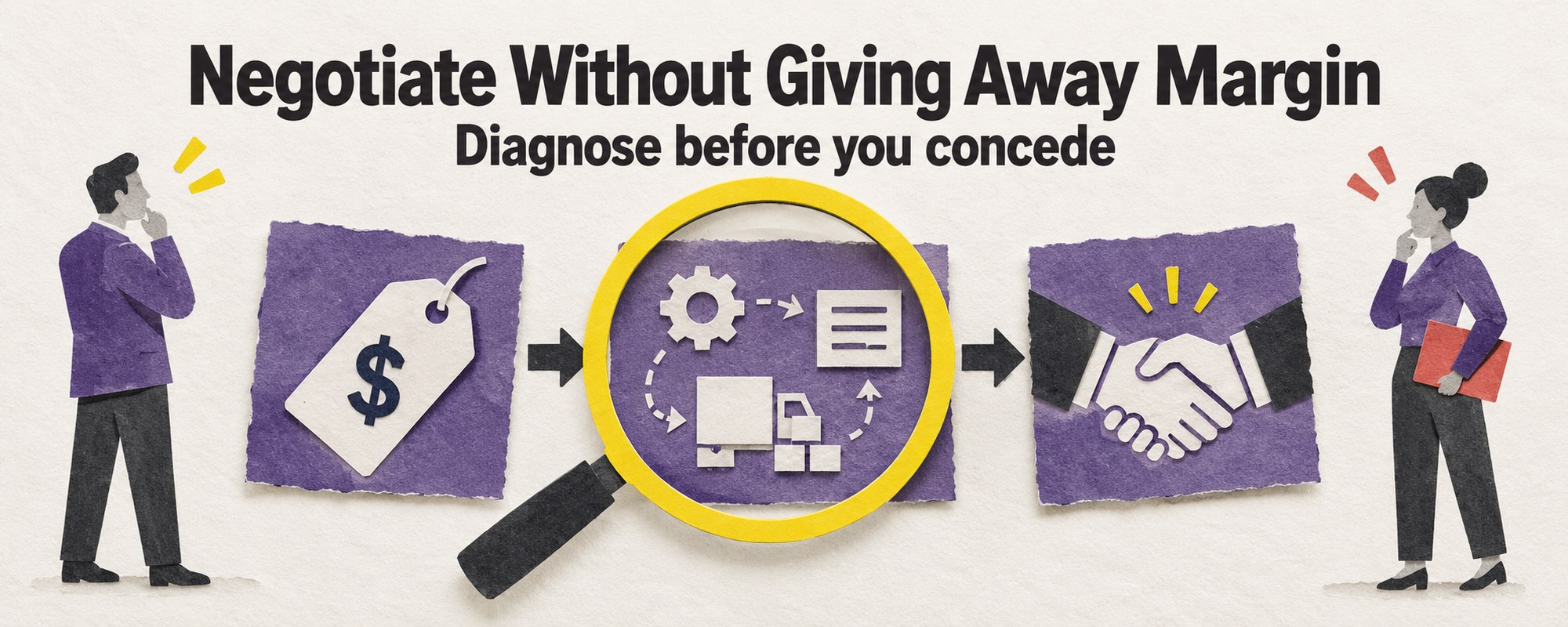
When a buyer asks for a lower price, the missing information is often what the lower price is supposed to solve. A budget ceiling, a cash timing problem, an uncertain outcome, and an oversized package require different responses. This guide gives B2B teams a preparation sheet, a five-step negotiation method, and a worked example for making that distinction.
A procurement dispute reveals the missing step
In a September 2026 episode of Higgle: The B2B Sales Club, Carlo Girasoli describes inheriting a recruitment client with a contract dispute and unpaid invoices. He says that reviewing the contract helped resolve the immediate disagreement. He then investigated why the supplier had failed to provide enough workers in the first place. Listen to Carlo's account.
His diagnosis was operational: the client's pay rates had become less competitive over time in a market with scarce talent. He describes reviewing the pay proposition and other aspects of the candidate offer, then meeting the client's staffing targets in the following season. The commercial dispute and the delivery problem required separate work.
That is the useful lesson for a sales negotiation. Resolving the immediate demand does not necessarily repair the process that produced it. A cheaper service can remain undeliverable. A better contract can coexist with an unattractive offer. Before proposing a concession, identify which problem the concession would actually change.
This is one practitioner's account, not evidence of a general improvement in win rate or margin. His interpretation of that contract is not a legal template. The five-step method below is our synthesis of the case, designed for ordinary B2B commercial discussions.
Sales negotiation versus objection handling
An objection asks whether the buyer should proceed. A negotiation asks which terms would make the exchange acceptable. “We cannot justify the value” calls for evidence about value. “We have an approved budget and need a smaller first phase” can call for a different package. Confusing the two leads sellers to cut price before establishing whether price is the blocker.
Use the objection-handling process to clarify the concern. Move into negotiation once both sides can identify the terms under discussion. The broader consultative selling playbook helps establish the diagnosis and the proof needed before that point.
Prepare a one-page sales negotiation plan
Preparation should expose decisions you might otherwise make under pressure. Write down the buyer's request verbatim, then keep the following fields separate. A claim made by the buyer belongs in the claim column until the supporting evidence is available.
- Desired outcome: what both sides need the agreement to accomplish.
- Confirmed constraint: its owner, source, timing, and effect on the decision.
- Unknowns: questions that could change the diagnosis or the economics.
- Boundaries: minimum workable scope, delivery capacity, payment terms, and approval limits.
- Options: feasible changes to scope, sequence, service, timing, or price.
- Concession cost: cash, delivery hours, exposure, and opportunity cost.
- Alternative: what you can realistically do if no agreement is reached.
A hoped-for replacement customer is not an available alternative. Nor is a promise of future volume the same as a signed commitment. Prepare from observable facts and identify who can authorize each change. The pre-call planning template provides a useful starting point for separating facts, assumptions, and questions.
A five-step sales negotiation method
1. Translate the demand into a constraint
Start with a neutral question: “What would the lower price make possible that is not possible under the current proposal?” Follow with one specific check. Is there an approved ceiling? Does the payment schedule conflict with cash availability? Is part of the scope unnecessary? Is the buyer concerned that the promised result will not materialize?
A request can contain several constraints. Record them separately and ask which one prevents the decision today. Avoid attributing hidden motives to procurement or assuming that every buyer is bluffing. If the answer remains unclear, the negotiation needs more information, not a more elaborate discount ladder.
2. Establish the facts and explain your boundary
Put the evidence for each position on the table. The seller might show delivery hours, a dependency, or the cost of maintaining a service commitment. The buyer might explain a budget rule or a rollout constraint. State what you can support, what requires approval, and what remains uncertain.
Harvard's Program on Negotiation discusses explaining genuine constraints when framing a counteroffer. It also explicitly distinguishes tested buyer-side findings from a seller-side suggestion. Use a credible rationale; do not present the suggestion as a guaranteed sales result. Read the primary teaching source.
3. Build options that change the right variable
If the issue is scope, remove work and show the corresponding price. If it is sequencing, propose a bounded first phase with an explicit decision point. If it is timing, examine payment or deployment dates within your approved limits. If it is uncertainty, specify acceptance criteria and the evidence needed to evaluate delivery.
None of those changes is free by default. A later payment creates cash exposure. A pilot consumes delivery time. A tighter deadline can require more capacity. Compare the complete package, including obligations and operating costs, before calling it a better deal. Offer options you can deliver, not concessions you hope someone else will absorb.
4. Make concessions conditional and authorized
Express a trade as a complete sentence: “If we reduce the first phase to this agreed scope, we can offer this price, with these acceptance criteria.” State what each side changes and confirm that the person discussing the trade can authorize it. An enthusiastic contact may still need procurement, finance, or a delivery owner to agree.
Do not exchange a real concession for a vague promise such as “more business later.” Define the commitment, its timing, and what happens if it is not fulfilled. Keep a ledger of changes so that a sequence of small adjustments does not quietly exceed the original economic boundary. Where contractual interpretation is involved, route it to qualified review.
5. Confirm delivery and close the feedback loop
Summarize the accepted package in writing: scope, price, responsibilities, milestones, acceptance criteria, approvals, and unresolved items. Ask the buyer to correct the summary. A friendly meeting is not confirmation that the terms or delivery conditions are shared.
After the decision, compare what was promised with what happened. Carlo recommends seeking feedback on won and lost deals without turning the request into an attempt to reopen the sale. Record why the buyer decided, which constraint changed, and which assumption remained wrong. Give each resulting action an owner.
A worked example: a discount request that changes scope
The following example is fictional. A B2B software team proposes a $12,000 implementation across three teams. The buyer requests $9,000. Before accepting or refusing, the seller learns that only one team can participate this quarter and the other two have no available owners. The first proposal included work the buyer could not use yet.
One option is a $6,000 first phase for the available team, with limited scope, named owners, and agreed acceptance criteria. Later phases require a new decision and are not included. Another option keeps the full package and price, with a start date when all owners are available. These are illustrative offers, not recommended prices or promises of equal value.
The team checks delivery costs before presenting either option. If the buyer instead needs all three teams immediately for $9,000, the constraint is different. The seller must assess whether that exchange is economically workable. The diagnostic method does not create room for a concession where none exists.
What to record and measure
For each negotiation, record the initial request, confirmed constraint, evidence, packages offered, changes accepted, approvals, outcome, and follow-up action. Keep buyer statements separate from seller interpretations. Account-level signals may guide preparation, but they do not prove a named person's intent or ability to approve terms.
Review realized margin alongside win rate, concession cost, payment timing, delivery exceptions, and scope changes. Compare similar deal sizes, segments, and stages. A higher close rate accompanied by unpriced work may be a worse outcome. A single successful negotiation is useful evidence for a case review, not proof that a technique works everywhere.
AI can organize approved notes and flag discrepancies between packages. Verify every source, calculation, and proposed commitment. The human task remains the same as in Carlo's example: understand the underlying problem, agree on a feasible exchange, and check whether delivery actually fixes it.
Frequently asked questions
What is sales negotiation?
Sales negotiation is the discussion through which a buyer and seller agree on the terms of an exchange. Those terms include scope, price, timing, responsibilities, payment, risk, and service. A useful negotiation makes the underlying constraints explicit before deciding which terms should change.
How do you negotiate without immediately discounting?
Ask what the requested discount is meant to solve. Distinguish a cash timing problem, a smaller required scope, an approval threshold, and uncertainty about value. Then offer a feasible package that addresses the confirmed constraint. Price any concession and make the corresponding commitment explicit.
What should a sales negotiation plan contain?
Record the desired outcome, verified buyer constraint, open questions, evidence, acceptable boundaries, cost of each possible concession, approval owners, and your realistic alternative if no agreement is reached. Avoid describing a hoped-for deal as an available alternative.
What is the difference between objection handling and negotiation?
Objection handling clarifies and answers a concern about moving forward. Negotiation changes the terms of the proposed exchange. A concern about price does not automatically call for a price change: establish whether the issue is value, budget, scope, risk, or another constraint first.
How should AI support a sales negotiation?
AI can organize approved source material, compare proposed packages, and flag inconsistencies or unanswered questions. People must verify the evidence, calculate the economics, interpret the buyer's constraint, and authorize commitments. AI output does not establish contractual rights or buyer intent.