The First 100 Customers Course #33: How Lightfield Turned Empty Office Space Into Its First 5 Customers
A source-backed course for turning a stranded asset into embedded product use, converting complaints into proof, and graduating from five early customers to a trusted referral network.
TL;DR
Lightfield did not begin with a polished CRM or a conventional paid pilot. Three months into the rebuild, the team had too much office space and too little product proof. Co-founder Keith Peiris says it offered desks to people willing to use the young CRM and provide training data. That exchange produced the first five founder-reported customers. Their daily use and eventual reduction in complaints became the first activation signal.
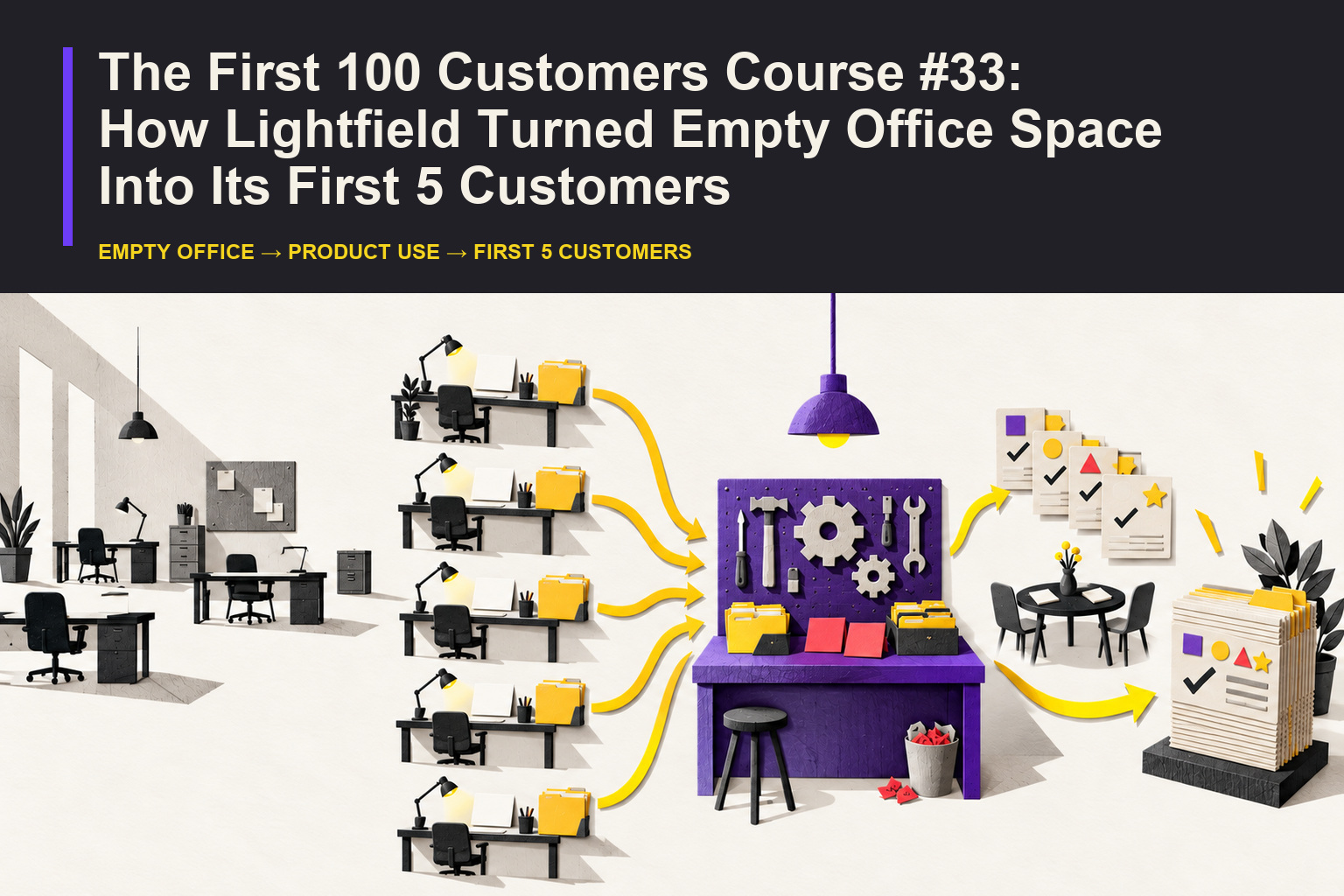
The mechanism was stranded asset → bounded non-cash exchange → embedded use → complaint-driven repair → trusted reference users → community referrals → useful events → first hundred. The evidence does not prove the first five paid money. It does not reveal how many of the first hundred paid, the channel split, price, conversion rate, CAC, or retention. Copy the exchange and evidence gates, not the mythology.
What you will build
You will build a seven-gate embedded-customer exchange for a product that is useful but still difficult to trust. The finished system includes an asset inventory, a bounded offer, a usage contract, a friction ledger, a reference gate, a small community event, and a pricing trigger. Each gate has an output, a pass condition, and a stop condition.
This is for a B2B founder who can name one narrow buyer and already has a working path to value. It is not for an idea with no usable product, a self-serve tool that needs no onboarding, or a founder who wants to inflate free users into customer proof. Lightfield had unusual advantages: founder reputation, investor and YC access, a large San Francisco office, and capital to host events. Your version must work at a smaller scale.
Case snapshot
| Stage | What the evidence supports | Evidence limit |
|---|---|---|
| Old product | Tome had about 20 million users and single-digit millions of ARR | Founder-reported; retention was weak |
| Reset | Team reduced from about 70 people to seven before the next product was proven | Not a realistic prerequisite for most builders |
| First build | Earliest Lightfield version took roughly three months | No dated build log is public |
| First five | Office access exchanged for CRM use and training data | Payment, identities, and contracts undisclosed |
| Next ten users | Free YC design partners received direct Slack access | The founder says they were not customers |
| Referral loop | Happy users reportedly shared Lightfield in Bookface and Telegram groups | No referral ledger or attribution percentage |
| Events | Useful speakers, a two-minute product mention, then 10–30 demo requests | Founder recollection, not a verified average |
| First 100 | Founder attributes the climb to YC founder outreach and events | No paid count, chronology, or channel split |
The model: pay for attention with an asset, not a discount
A discount lowers the price of an unproven product. Lightfield used a different currency. The oversized office was already paid for and temporarily underused. For the right early-stage founder, a reliable place to work near other builders had immediate value. Lightfield could therefore buy something scarce: repeated, observable CRM use.
The exchange worked only because the consideration was reciprocal. Users received workspace. Lightfield received usage, training data, complaints, and proximity. The founder's later account says the first signal was not praise. It was that those first five eventually stopped complaining about having to use the product. That is stronger than a signup and more useful than a friendly testimonial.
This is the core decision rule: trade an underused asset only for behavior that produces product truth. Free access with no required behavior creates spectators. A bounded exchange with frequent use, feedback, and a stop date creates a learning environment.
Step 1: inventory assets your narrow buyer already wants
List resources with low marginal cost to you and real standalone value to the ICP. Examples are workspace, proprietary benchmark data, access to a specialist, migration labor, a curated peer group, distribution to a relevant audience, or a weekly implementation clinic. Do not list generic discounts, vague mentorship, or your own unfinished software.
Score each asset from one to five on buyer value, your marginal cost, scarcity, relevance to the product job, and the quality of behavior it can buy. Lightfield's office scored well because the founders it wanted were local, the space was already a sunk cost, and regular presence made product use observable.
Output: one asset-to-behavior hypothesis. Pass: three target buyers would accept the asset even if your product were not included. Stop: the incentive is attractive mainly to students, hobbyists, or people outside the ICP.
Step 2: make the exchange bounded and explicit
Write a one-page agreement in plain language. Define the asset, term, expected product job, minimum weekly usage, feedback channel, data you may collect, confidentiality, support level, success review, and exit. If training data is part of the exchange, obtain clear consent and specify exactly what is collected and retained.
Use a small cohort. Lightfield's first five were enough to expose repeated friction without creating a support company. Your default can be three to five accounts for four weeks. Every account must attempt the same core job, or the feedback will fragment into unrelated feature requests.
Pass: at least three participants complete the core job twice in week one. Stop: usage happens only during calls with you, or the asset rather than the product remains the only reason to participate.
Step 3: treat complaints as activation evidence
In the selected Product Market Fit Show interview, Peiris contrasts passive Tome users with Lightfield users who filled Slack with problems. The complaints mattered because people were trying to complete a recurring job. Silence would have been worse.
Create a friction ledger with six fields: account, attempted job, blocker, workaround, frequency, and next product decision. Review it daily. Repair blockers shared by at least two accounts before satisfying unique requests. Track time-to-first-value, weekly active accounts, repeated core jobs, blocker recurrence, and unsupported manual minutes.
Pass: repeated use rises while blocker recurrence falls. Stop: complaints describe different products, or participants remain polite but inactive. The goal is not fewer messages. It is fewer repeated blockers and more completed jobs.
Step 4: earn reference language before scaling acquisition
Lightfield next gave the product to ten YC companies with direct Slack support. Peiris explicitly says these users were not customers. Once they were happy, he says they began mentioning the product inside trusted groups. That distinction matters: the company earned a reference surface before it earned a repeatable paid funnel.
Ask each embedded user three questions: What job would fail if this disappeared? Who has the same pain? What sentence would you use to explain the product to that person? Save the exact language. Request an introduction only when the user can name a recurring job and a concrete before-and-after change.
Pass: two users make unprompted references or accept a named introduction. Stop: compliments remain generic, every referral needs a reward, or the user would not be comfortable attaching their reputation to the introduction.
Step 5: turn a useful event into a permissioned demo queue
Lightfield did not lead with a product webinar. It invited founders to learn from operators such as a senior HubSpot leader or the author associated with Predictable Revenue. The company bought books to make the speaker exchange work. At the event, Peiris disclosed that Lightfield was building a CRM, showed it for about two minutes, and offered an optional demo afterward. He recalls 10 to 30 interested people per event.
Run a 12-person clinic around the buyer's current job, not your category. Teach for 40 minutes. Reserve five minutes for one product-assisted example. End with two explicit paths: take the worksheet and leave, or book a diagnosis. Never scan attendees into an automated campaign merely because they attended.
Pass: three ICP attendees request the next step and describe the same urgent job. Stop: attendance is high but no one asks to see the product, or the speaker's name is doing all the work.
Step 6: charge when the exchange has produced proof
The transcript says Lightfield started to charge “a little” after the referral loop formed. It provides no first price or paid-conversion count. Do not fill that gap. Your pricing trigger should be observable: the product completes the core job without founder rescue, at least three accounts repeat it, and one user would refer it.
Offer a paid 30-day implementation with a fixed job, support boundary, price, and renewal decision. Keep original participants separate from new paid accounts so free proof is not mistaken for paid traction. Report counts as “embedded users,” “paying accounts,” and “retained paying accounts.”
What failed and what cannot be copied blindly
- Roughly ten enterprise pilots lost interest in the original deck problem within weeks.
- Mid-market prospects liked the CRM thesis but would not replace an existing system.
- The team rejected a crowded point-solution layer that lacked proprietary data.
- Free YC users were useful design partners, but the evidence does not make them paying customers.
- YC access, founder reputation, capital, and a large office made this motion easier.
- The first-five and first-100 claims are founder-reported; no public ledger proves the funnel.
Your 7-day implementation plan
- Day 1: name one ICP, one repeated job, and five underused assets.
- Day 2: interview three buyers about the asset before mentioning the product.
- Day 3: write the four-week exchange, consent terms, usage requirement, and exit.
- Day 4: recruit three to five accounts through warm paths and direct research.
- Day 5: onboard every account to the same core job and open the friction ledger.
- Day 6: repair the first repeated blocker and return visible proof to the cohort.
- Day 7: review usage, classify users correctly, and decide continue, narrow, or stop.
Lead Scorer implementation: preserve the exchange, automate the preparation
Lead Scorer fits when the asset is relevant to a narrow professional buyer and the founder still owns recruitment, onboarding, and feedback. It does not fit when the offer depends on mass invitations, hidden scraping, or automatic sending. The agent can research and draft; it cannot decide that a free participant is qualified, activate a campaign, or send without review.
Phase 1: keep three lists separate
Create separate CRM lists for candidate accounts, embedded users, and paid accounts. Define the product and ICP with the `icp-offer-context` skill. Use a scoring rubric that gives most weight to the repeated job, asset relevance, urgency, and ability to use the product weekly. A useful pass threshold is 8/10. Reject anyone attracted only by the asset.
Copyable prompt: Build a 10-point rubric for founders who perform [job] every week. Give three points to
repeated pain, two to asset relevance, two to reachable decision authority, two to weekly
product usage, and one to willingness to share structured feedback. Disqualify
incentive-only interest.
Phase 2: research before spending enrichment credits
Discover a narrow company and person set, score public evidence first, and use contact discovery only for keepers. Keep a credit gate before paid enrichment. Store the source URL and date behind every qualification. Never infer local presence, current CRM, or willingness to share data without evidence.
Output: 15 reviewed prospects with at least two sourced reasons each. Pass: eight score 8/10 or higher. Stop: the list requires guessed facts or broadens beyond one job.
Phase 3: draft a human-reviewed exchange invitation
Use `cold-email-first-touch` or `linkedin-connection-requests` to draft one message per prospect. The message names the buyer's observed job, explains the bounded asset exchange, asks one small question, and makes the non-cash terms explicit. Keep every draft in review. Do not activate or send until the founder has checked the evidence and offer.
Copyable prompt: Draft a first touch for this scored prospect. Mention only the verified job signal. Offer
[asset] for four weeks in exchange for weekly use of [core job], a shared feedback channel,
and a final review. Ask whether that exchange is useful. Do not call it free, promise an
outcome, or send.
Phase 4: turn friction into the next audience
Tag replies as interested, timing, wrong person, objection, or no. Use `reply-triage` to draft one reviewed response. Store repeated objections and exact buyer language in Content Studio. Publish useful answers to recurring problems, then use signal-audience workflows only for people who visibly engage. Score those people before enrichment and keep them outside the embedded cohort until they accept the same terms.
This creates a controlled loop: sourced account → scored fit → reviewed invitation → embedded use → objection and friction evidence → useful content → visible engagement → newly scored account. Human approval remains at selection, enrichment spend, message review, cohort acceptance, and any future campaign activation.
Checklist
- Name one buyer, one recurring job, and one asset with standalone value.
- Limit the exchange to three to five accounts and four weeks.
- Require product behavior, feedback consent, and an explicit exit.
- Measure repeated jobs and blocker recurrence, not signups or praise.
- Call free design partners free design partners.
- Ask for references only after users can describe a concrete outcome.
- Make events useful without the product pitch.
- Separate embedded users, paying accounts, and retained paying accounts.
- Keep every enrichment, message, and campaign behind a human approval gate.
Sources and limits
The complete selected podcast transcript was audited from character zero through 51,326. A separate OpenSourceCEO founder interview supplies the first-five office exchange and first-100 sequence. A VentureBeat launch profile independently confirms the pivot, public launch, and more than 100 early daily users. Lightfield's launch post says the beta included a few hundred startups, while the later Series A post reports 5,000 company signups.
These counters use different definitions and dates. None supplies a paid-customer funnel. The first five, first hundred, channel sequence, and event response are founder-reported. No source publishes the early account list, invoices, pricing, channel split, activation denominator, CAC, churn, cohort retention, gross margin, or expansion revenue. The latest primary announcement says the Series A was $47 million; a stale Podscan episode title still says $45 million. No causal claim in this course depends on the funding amount.
Frequently asked questions
Were Lightfield's first five customers paying customers?
The public evidence does not establish that. Keith Peiris says Lightfield exchanged office access for product use and training data. Treat the first five as customers in the founder's language, but not as five verified paid accounts.
Were the first ten YC users customers?
No. In the selected interview, Peiris explicitly says the first ten YC companies used Lightfield free and were not yet customers. Charging began after the referral loop formed, but the price and paid conversion count are not public.
Did the office tactic produce Lightfield's first 100 customers?
It produced the founder-reported first five. Peiris attributes the next stage toward 100 to outreach to YC founders and events, while the selected interview also describes referrals through Bookface and Telegram. No public channel split proves one tactic caused all 100.
Can a remote founder copy this playbook without an office?
Yes, by copying the exchange structure rather than the asset. Offer a scarce resource your ICP already values, require recurring product use and structured feedback, define a short term, and stop if the incentive attracts people who would never need the product.