The First 100 Customers Course #26: How StatusPage Turned 20 Developer Relationships Into Its First $1,000 MRR
A source-backed course for turning practitioner relationships into a paid SaaS soft launch, segmenting buyer evidence, and crossing from warm trust to a repeatable channel.
TL;DR
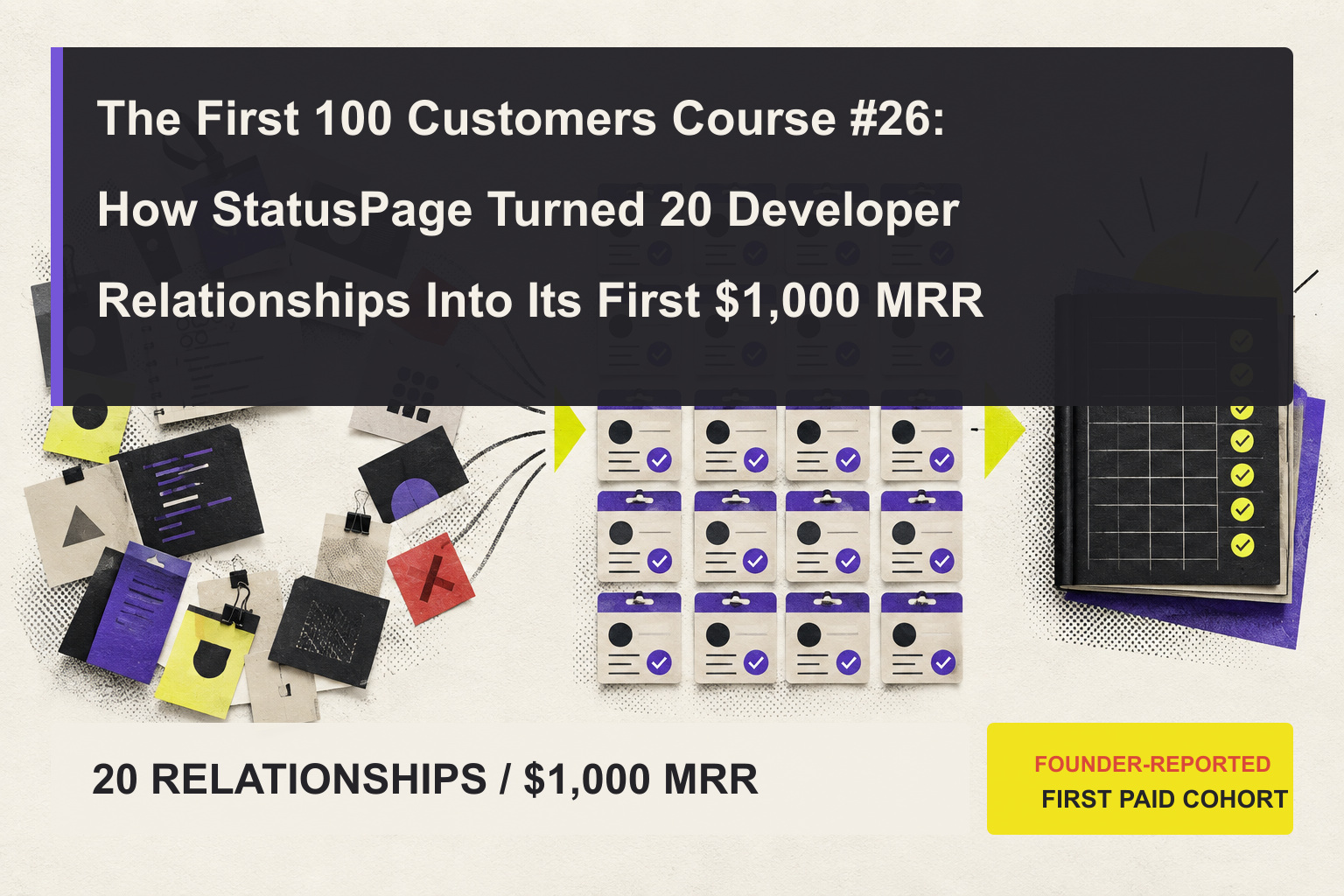
StatusPage did not launch to a giant audience. Its founders report turning 20 people from a developer community they already belonged to into $50-per-month customers, creating the first $1,000 in monthly recurring revenue.
The mechanism was relationship inventory, not friendship discounts. The founders had used the buyers' products, met them at conferences, discussed StatusPage before launch, and asked for feedback while building. A Show HN post added community attention. Then one founder spent most days calling, emailing, following up, and manually onboarding users while the others shipped. These numbers and the channel sequence are founder-authored; no public billing export or per-channel attribution exists.
What you will build
You will build a relationship-to-revenue launch system with seven outputs: a problem-proximity test, a 30-person relationship map, a one-session product wedge, a soft-launch list, a daily customer-contact queue, a request ledger, and a cold-proof checkpoint. Each output has a pass condition and a stop condition.
This is for a technical B2B founder serving a narrow practitioner group: developers, RevOps teams, security operators, finance leaders, or another community where people share tools and compare workflows. It is not for a founder who wants to scrape acquaintances into a campaign. It also does not fit a broad consumer product whose first useful cohort can come from high-volume self-serve traffic.
Case snapshot
| Stage | What the sources support | Evidence limit |
|---|---|---|
| Problem | Developers lacked a simple, external way to communicate service incidents | Founder experience and hypothesis, not independent demand research |
| Build | About four months part-time, from October 2012 to February 2013 | Founder-reported timeline |
| Soft launch | Known developer relationships plus a Show HN post | No per-channel signup or revenue split |
| First paid cohort | 20 customers at $50 per month, or $1,000 MRR | Founder-authored; customer names and invoices are not public |
| Learning pool | 200 free-trial signups within a month of the soft launch | No activation or cohort-retention denominator |
| Manual work | Daily calls, personal emails, follow-up, screen sharing, and setup help | No activity count or labor-cost record |
| Early expansion | Reported $5,000 MRR about six months after the first version launched | Founder-reported and not the title milestone |
| Later outcome | Y Combinator S13; acquired by Atlassian in July 2016 | Independent confirmation does not validate early attribution |
The model: trust before launch, proof after it
The causal chain is lived practitioner pain → narrow product wedge → relationships built before launch → warm community soft launch → first paid cohort → segmented requests → manual activation → cold proof.
The first half reduces trust risk. StatusPage's founders were not strangers arriving with a generic pitch. They were developers who used products made by their prospective buyers, met people in the same ecosystem, and had already explained what they were building. The second half reduces product risk. Paid users exposed where setup failed, which requested outcomes repeated, and whether the product could create value before the next real outage.
Warm trust is an ignition channel, not proof of a distribution engine. The system is incomplete until a qualified stranger activates and pays without a personal relationship. That cold-proof checkpoint is the important addition for today's builder: use relationships to learn faster, then test whether the offer survives without borrowed trust.
Step 1: prove you belong to the problem
Scott and Steve Klein had experienced opaque vendors and weak incident communication as developers, a product manager, and contractors. Their previous music product created the opposite condition. They were not musicians, did not attend shows, and found it difficult to understand or sell into that market. The failure was not lack of code. It was distance from the buyer's daily reality.
Write a problem-proximity sheet with five fields: the last time you experienced the problem, the exact workaround, the person responsible, the consequence of delay, and ten practitioners who could correct your account. If you cannot fill the first two from direct experience, conduct five incident interviews before defining the product.
Pass condition: three practitioners describe the same recent event, owner, and workaround. Stop condition: your evidence is trend commentary, generic survey answers, or enthusiasm from people who never do the job.
Step 2: map relationships by relevance, not closeness
StatusPage's first prospects were known personally, but the relationship was commercially relevant. The founders used their products, saw them at developer conferences, and participated in the same small DevOps community. This is different from asking relatives or former colleagues outside the ICP to buy.
Build a 30-person map in three groups:
- Ten people whose product or workflow you use and understand.
- Ten practitioners you have helped, interviewed, or learned from.
- Ten qualified strangers who share the same role, trigger, and constraints.
Record the relationship source, buyer role, company fit, recent trigger, current workaround, last useful exchange, and next honest reason to talk. A contact earns the warm label because relevant trust exists, not because their email is in your address book.
Pass condition: at least ten warm contacts match the same narrow buying problem. Stop condition: more than half the list would need a friendship favor to use the product.
Step 3: compress the product into one visible session
StatusPage's initial hypothesis was setup in under 30 minutes. The MVP let users create incidents, show component status, send email and SMS updates, and keep the page outside their own infrastructure. This was enough to ask for money even though customers still requested important features.
Define one session with a clock, input, action, and visible output. “Configure the platform” is not a wedge. “Connect one source and see one useful page in 15 minutes” is. Remove any feature that does not help the buyer complete that path or trust its result.
Pass condition: five target users reach the output in one call without founder rescue at every step. Stop condition: value depends on future integrations, custom services, or an event that may not happen for weeks.
Step 4: run a paid community soft launch
The public accounts differ slightly. Klein says he personally knew the first 20 customers. Danny Olinsky's contemporaneous article says friends in the community and a Show HN post supplied the initial user pool. The safe conclusion is that warm relationships and public community participation worked together; no source reveals their separate conversion rates.
Invite the ten warm contacts first. State the bounded outcome, price, missing parts, and the help you will provide. Then publish one useful launch artifact where the community already gathers: a Show HN, technical teardown, benchmark, template, or public workflow. Make the product inspectable. Do not hide the ask behind “feedback” if you need payment evidence.
We built [one-session outcome] because [specific incident] keeps happening to [role]. It is incomplete, but it produces [visible result] now. I am onboarding ten teams at [price] and doing setup personally. Does this replace enough of [workaround] to test it together?
Pass condition: one qualified account pays and five complete the first-value path. Stop condition: signups come from curious builders who do not own the problem.
Step 5: put one founder on customer contact every day
Klein credits much of the early result to Danny, the sales co-founder. His days were spent on calls, emails, nudges, and follow-up. The contemporaneous playbook adds personal email to every signup, screen-sharing setup, live intervention, and monitoring qualified users who had not yet been reached.
Create a daily queue with five states: new qualified signup, setup incomplete, first value reached, payment pending, and inactive but qualified. Every record needs an owner, last evidence, next action, and decision date. Reserve at least half of one founder's day for this work during the first paid cohort. Do not let product work consume every founder simultaneously.
Pass condition: every qualified signup receives a personal response within one working day and has a next decision. Stop condition: follow-up is a generic drip while founders cannot explain why active users stall.
Step 6: segment requests, then ask for the sale
StatusPage reports 200 trial signups within a month. The team grouped what users requested, noticed repeated demand for public metrics, shipped the feature with five integration partners, and followed up with the waiting leads. The founder article attributes another $1,000 MRR to that loop.
Use a request ledger with buyer role, account fit, requested outcome, blocked action, willingness to pay, and follow-up date. Build only when three qualified accounts request the same outcome or one target account supplies unusually strong payment evidence. When the feature ships, return to every relevant account and ask for a specific commercial decision.
Pass condition: the shipped change unlocks activation or payment for a named segment. Stop condition: a loud free user drives work that no target buyer has connected to a purchase.
Step 7: shorten the aha moment and test cold proof
A status page is easy to postpone until an outage. StatusPage reports that users understood the value earlier when they finished setup in under five minutes, added a metric, and viewed the page. That turned first value from “wait for an incident” into a visible artifact during the first session.
Instrument your equivalent sequence. Then run the same offer to the ten qualified strangers from the relationship map. Keep warm and cold results separate. Warm conversion answers whether relevant trust can start the loop. Cold conversion answers whether the buyer, trigger, offer, and message can travel without it.
Pass condition: at least one qualified stranger reaches first value and enters a paid decision. Stop condition: 30 well-researched strangers produce no problem-confirming response. Revisit the trigger and offer before increasing volume.
What failed, and what was merely premature
The music product was a structural failure: the founders lacked market empathy and access. The angry “I can build this in a weekend” emails were not proof that StatusPage had failed. They were objections from people with vocal opinions but weak willingness to build and maintain the workflow. The paid cohort mattered more than the argument.
Waiting for scalable acquisition would also have been premature. Personal onboarding and individual email were expensive, but they exposed the setup path and repeated requests. The danger is continuing manual work without extracting a reusable product or channel decision. Record what each intervention teaches, then remove the intervention only after the product can reproduce its result.
Your seven-day implementation plan
- Day 1: complete the problem-proximity sheet and write three disqualifiers.
- Day 2: create the 10-warm, 10-practitioner, 10-cold relationship map.
- Day 3: define and test the one-session first-value path.
- Day 4: draft ten warm invitations with one honest reason per person.
- Day 5: publish one inspectable community artifact and onboard personally.
- Day 6: segment requests and stalled users; choose one repeated blocker.
- Day 7: ask for payment, set the cold-proof test, and choose one keep/change/stop decision.
Lead Scorer implementation
Lead Scorer can reproduce the research, separation, and drafting parts of this motion. It cannot
manufacture a relationship or pretend that a scraped contact is warm. Begin by storing the
product and ICP context: responsible role, recent trigger, current workaround, one-session
outcome, complexity floor, and disqualifiers. Create separate lists named status-warm, status-community, and status-cold-proof.
Import only genuinely known people into the warm list and record why the relationship is relevant. For the cold list, use the daily vertical prospecting or signal-research workflow to find companies with the same operational trigger. Apply the ICP scoring rubric before enrichment. A practical gate is 8/10: correct role and company type are mandatory, and the lead needs either a verified trigger or a documented matching workflow. Enrich only keepers. Run contact discovery last because it is the expensive step. A human approves the list and the credit spend.
Build three separate lists for this launch: ten relevant people I already know, ten people active in the practitioner community, and ten qualified strangers. Score against this ICP. Keep relationship source and trigger evidence. Enrich only leads scoring 8/10 or above. Find contact data last. Do not draft yet.
For every keeper, run a signal dossier. Require two dated, sourced signals for cold leads; warm leads need the real relationship context plus one current company signal. Then use the cold-email first-touch or AI-authored campaign skill to create one draft per person with a single ask. The warm note can reference a real shared context. The cold note must stand on the buyer's trigger and bounded outcome. Never borrow fake familiarity. Review every draft before activation or sending.
Draft one first-touch message per approved lead. Use one verified trigger, one bounded outcome, and one ask. Do not describe a cold lead as a friend or community relationship. Leave the campaign as a draft for human review. Do not activate or send.
Classify replies as problem evidence, timing, wrong person, objection, or no. Store feature requests against the buyer segment and payment state. Three repeated requests from qualified buyers can become a product checkpoint. Repeated objections can become sourced Content Studio briefs; useful answers may create visible engagement signals for a new audience. Keep warm and cold conversion reports separate so the first cohort never hides a channel failure.
Pass condition: every lead has relationship truth, fit evidence, a source-backed trigger, and a human-reviewed next action. Stop condition: the agent increases volume while the first-value path or buyer definition remains uncertain. Lead Scorer does not guarantee customers, replace community participation, approve credit use, activate a campaign, or send without review.
Checklist
- The founder has direct evidence of the problem or five incident interviews.
- Warm means relevant trust, not merely a known email address.
- The product creates one visible output in one session.
- The soft launch asks for payment honestly.
- One founder owns customer contact every working day.
- Requests are segmented by fit, role, and payment evidence.
- The aha moment happens before the delayed pain event.
- Warm and cold channel results never share one conversion rate.
- Human review gates enrichment, drafting, activation, and sending.
Sources and evidence limits
- SaaS Club episode 86: complete founder interview and primary source for the build cadence, customer-contact role, first-20 relationships, pricing, and early community context.
- StatusPage's 2013 first-$5,000-MRR post: contemporaneous founder account of Show HN, 20 conversions, trial volume, feature segmentation, activation work, and MRR steps.
- Y Combinator's StatusPage profile: independent confirmation of the founders, Summer 2013 batch, and acquired status.
- Atlassian's acquisition announcement and FY2016 annual report: later independent confirmation that Atlassian acquired StatusPage in July 2016.
- Current Statuspage user guide: evidence that the product continues inside Atlassian; current capabilities must not be projected backward onto the 2013 MVP.
The first-20 attribution, $50 price, $1,000 MRR, 200 trial signups, feature-linked MRR, launch MRR, setup observations, and $5,000 MRR are founder-authored and not independently audited. No source publishes the first customer's identity, customer order, invoices, churn, retention, CAC, margin, or the split between warm relationships and Show HN. The later acquisition proves a substantial company outcome, not the accuracy of every early-funnel claim. Copy the sequence, evidence discipline, and cold-proof checkpoint. Do not claim that it guarantees 100 customers.
Frequently asked questions
Did StatusPage get its first 20 customers only from friends?
The founders describe a community soft launch that combined known developer relationships with a Show HN post. Scott Klein says he personally knew the first 20 paying customers; Danny Olinsky's contemporaneous article says friends and Hacker News both supplied initial users. No public source gives a per-channel split.
How much did StatusPage charge its first customers?
StatusPage reports converting 20 early users into customers at $50 per month, producing $1,000 in monthly recurring revenue. This is founder-authored and not independently audited.
Can this playbook work without an existing audience?
It can work without a large audience, but not without market proximity. Replace an existing network with four weeks of useful participation: interview practitioners, contribute to a narrow community, use relevant products, and build named relationships before asking for payment.
Can Lead Scorer automate a community-first launch?
Lead Scorer can separate warm and cold lists, score fit before enrichment, build evidence dossiers, draft personal outreach, and classify replies. The founder still owns community participation, product decisions, approvals, conversations, and sending.