The First 100 Customers Course #25: How Torii Turned 70 Free Alpha Companies Into Its First Unaffiliated Customer
A source-backed course for separating technology test beds from target buyers, narrowing an enterprise ICP, and proving a first-customer channel with an unaffiliated account.
TL;DR
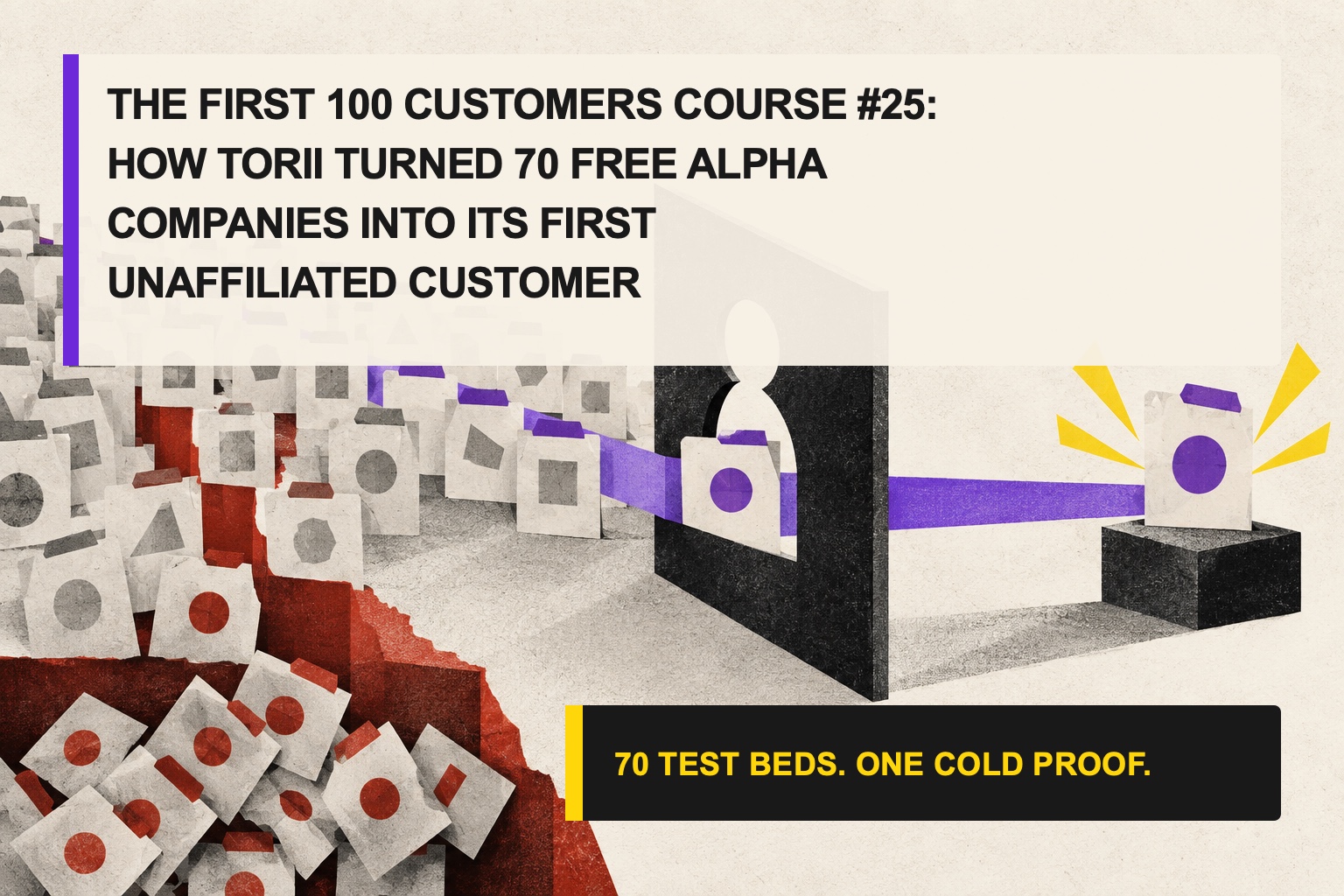
Torii spent about one year working with 70 free small companies before it earned revenue. The transferable lesson is not to give your SaaS away. It is to decide what each early account is allowed to prove.
Founder Uri Haramati says the free companies were technology test beds, not target buyers. Torii separately interviewed IT teams in larger organizations, narrowed its ICP to companies beginning around 200 to 300 employees, closed its first paying customers through founder connections, and then won Pipedrive as its first completely unaffiliated customer through outbound. The counts, timeline, customer order, and acquisition path are founder-reported. Pipedrive's public customer story independently confirms it used Torii, but not how or when the relationship began.
What you will build
You will build a first-customer evidence system with six outputs: an account-job ledger, a five-field ICP card, a target-buyer interview sheet, a 30-account bridge list, a commitment test, and a weekly evidence review. Every output has a pass condition and a stop condition. This keeps free activity from looking like paid validation and stops warm introductions from masquerading as a repeatable acquisition channel.
This system fits B2B software that touches sensitive data, requires founder-led onboarding, or introduces a category the buyer does not already search for. It is useful when the founder can access friendly test environments but the economic buyer works in a larger, more complex company. It is not designed for a low-risk consumer app where many self-serve activations can produce clean behavioral evidence quickly.
Case snapshot
| Stage | What the sources support | Evidence limit |
|---|---|---|
| Problem | SaaS sprawl experienced during the founder's prior company | Origin confirmed by founder and later independent coverage |
| Probe | A bank-account SaaS-spend report built in two to three weeks | No archived first version was found |
| Alpha | 70 free small companies used over about one year | Founder-reported and explicitly not target customers |
| Target buyer | IT functions in companies beginning around 200 to 300 employees | Retrospective ICP description |
| Warm revenue | Datorama, Monday, and Similarweb through founder connections | Order and contract dates are not independently verified |
| Cold proof | Pipedrive as the first fully unaffiliated outbound customer | Acquisition path and order are founder-reported |
| Early scale | Two founders sold the first roughly 25 to 30 deals | No CRM export or conversion denominator is public |
| Interview milestone | About 50 paying customers and near $1 million ARR | Founder-reported and unaudited |
The complete SaaS Club episode supplies the detailed sequence. A later TechCrunch report independently confirms the company origin, founder background, $10 million Series A, and later customer names. Neither source provides an audited early-customer ledger.
The model: give every early account one job
The causal chain is experienced pain → disposable technical probe → free alpha test beds → separate target-buyer discovery → narrow ICP → warm paid references → unaffiliated outbound proof → qualified scale. It looks linear when summarized, but Torii ran the middle loops in parallel.
The two-to-three-week MVP connected to bank-account data and mapped SaaS spending. Friends let the team install it in companies ranging from roughly ten to one hundred people. Those accounts helped the founders make the data flow work. They could not answer whether an IT operator inside a 300-person organization would buy, survive a security review, or use the product in the same way as a founder managing twenty employees.
Torii therefore treated accessible users and target buyers as different evidence sources. The free cohort tested the technology. Conversations with larger IT organizations shaped the buyer problem and upcoming product. This separation is the central mechanism. Without it, the easiest people to recruit become the loudest roadmap voters, even when they will never purchase.
Step 1: label the evidence job before onboarding
Create an account-job ledger. Every early account receives exactly one primary label: technology, problem, payment, or reference.
Add the buyer role, company size, trigger, requested feature, promised outcome, success metric,
price status, and next decision date.
A technology account answers whether the workflow executes, the data arrives, and time to value improves. A problem account supplies recent incidents and current workarounds. A payment account tests whether the responsible buyer will exchange money under real approval conditions. A reference account proves the delivered outcome is credible to a similar buyer. One account can graduate to another job, but only after you record the evidence that caused the change.
Pass condition: every active account has one job, one metric, and one decision date. Stop condition: “collect feedback” is the stated goal, or a free request enters the roadmap without confirmation from target buyers.
Step 2: write an ICP card that excludes your alpha cohort
Torii moved toward IT functions in companies starting around 200 to 300 employees. That choice was operational, not decorative. Larger companies distributed SaaS ownership across teams, used more tools, and created offboarding, spending, security, and visibility problems that a small company's founder did not experience in the same way.
Write an ICP card with five fields:
- Accountable function: who owns the consequence?
- Company trigger: what observable change makes the problem urgent?
- Current workaround: what happens without your product?
- Minimum complexity: what scale makes the outcome valuable?
- Disqualifier: who looks similar but lacks the buying problem?
Torii's retrospective card could read: “IT operations at a 200-plus-employee company, adding cloud tools across departments, managing discovery and access manually, with no central SaaS inventory. Exclude founder-managed stacks in very small companies.” Do not copy the employee threshold. Copy the job of the threshold: separate a real operating burden from superficial fit.
Pass condition: another operator can reject an account without asking you. Stop condition: the ICP is only an industry, geography, and employee range.
Step 3: run technology testing and buyer discovery in parallel
Keep the product usable with test beds while interviewing five target buyers per week. Use the same questions: What happened the last time the problem appeared? Who noticed first? Which tool, spreadsheet, or manual process handled it? What was delayed or put at risk? Who owns the budget? What approval would block a trial?
Store evidence as incidents, not opinions. “I like the idea” carries almost no weight. “Last month an employee left with access to twelve tools and IT needed three days to discover them” identifies a trigger, consequence, owner, and measurable outcome. Torii was creating a category, so buyers often understood the pain before they knew a product category existed. Incident language is more reliable than asking buyers to name a solution.
Pass condition: three target buyers describe the same costly event and responsible role. Stop condition: only the free cohort requests the feature, or every buyer describes a different job.
Step 4: build a bridge list from warm payment to cold proof
The three Torii founders mapped first- and second-degree IT connections. Haramati names Datorama, Monday, and Similarweb among the earliest paying customers. These deals were valuable because they exposed the team to real buying, onboarding, and product use. They did not prove that a stranger would respond.
Build a 30-account bridge list with three separate groups:
- Ten warm target accounts where trust already exists.
- Ten lookalike accounts matching the same buyer, trigger, and complexity.
- Ten cold accounts where you genuinely understand the prospect's product, workflow, or visible operating change.
Keep the groups separate in your CRM. Warm conversion measures whether the offer is ready to be bought. Cold conversion measures whether the channel can carry the message without borrowed trust. Combining them produces a conversion rate that answers neither question.
Pass condition: at least three warm buyers enter a real evaluation and produce a referenceable problem statement. Stop condition: warm contacts buy only as a favor, cannot use the product, or fall outside the ICP card.
Step 5: earn the first unaffiliated “yes”
Torii says it approached Pipedrive's IT team by leading with a genuine fact: the founders used Pipedrive and liked it. They then suggested that the team might want to see Torii. This was not a generic compliment added to a sequence. Product use gave the sender a credible reason to choose that account and a natural bridge into an IT-management conversation.
We use [specific product or workflow]. I noticed [relevant operational trigger]. We built [bounded outcome] for [responsible role]. Worth comparing it with how you handle [current job]?
The Pipedrive customer story later reported that Torii surfaced more than 600 applications and improved ongoing visibility. Because Torii published that case study, it is not independent proof of the acquisition story. It does establish that Pipedrive became a real customer with a concrete operational use case.
Pass condition: one unaffiliated target buyer begins a real evaluation and gives access to the problem. Stop condition: thirty qualified cold accounts produce no problem-confirming reply. Revisit the trigger, buyer, and bounded outcome before increasing volume.
Step 6: test commitment framing without giving away urgency
Torii initially expected a paid proof of concept to help enterprises feel comfortable connecting sensitive systems. One prospect reportedly spent about two months moving through finance, security, and legal approval. When the team offered a two-week free trial instead, the prospect agreed on the call and connected systems the next day.
This is one founder-reported experiment, not a rule that free is better. The transferable move is to isolate the friction. Keep the buyer and desired outcome fixed. Test one variable: scope, duration, data access, price, or approval path. Before the trial begins, name the owner, first-value event, decision date, success threshold, security boundary, and paid next step.
Pass condition: the target buyer reaches first value inside the test window and schedules a purchase decision. Stop condition: free access removes urgency, has no accountable owner, or requires production risk without a defined contract path.
What failed: demand without qualification
Haramati says Torii tried email outbound, LinkedIn outbound, PPC, and a conference with roughly $40,000 to $50,000 in total 2018 marketing spend. The interview does not provide a defensible channel-by-channel funnel, so this course does not rank those channels by conversion.
Two failures are clearer. An ungated self-serve trial attracted small companies and irrelevant roles inside large companies. Later, Torii increased inbound before its qualification system was ready. Account executives received more contacts and reportedly closed fewer deals because their attention moved away from the best accounts.
Classify this as a structural sequencing failure: demand was added before routing and rejection rules. The repair was not a better headline alone. Torii returned to request-a-demo, added initial qualification by size and role, qualified need and education level, and invested more deliberately in account-based outreach.
Your seven-day implementation plan
- Day 1: label every active account by evidence job. Output: account-job ledger.
- Day 2: write the five-field ICP card and three explicit disqualifiers. Output: one reviewable page.
- Day 3: interview two target buyers about their last concrete incident. Output: two incident records, not feature votes.
- Day 4: create the ten-warm, ten-lookalike, ten-cold bridge list. Output: three separate list views.
- Day 5: draft one evidence-led message per account. Output: reviewed drafts with a cited trigger.
- Day 6: classify replies and trial friction by list group. Output: warm versus cold evidence, never a blended rate.
- Day 7: choose one decision: keep the trigger, change the offer, narrow the ICP, change commitment framing, or stop. Output: one decision and its evidence.
Lead Scorer implementation
This motion fits Lead Scorer when you can define a narrow company type, responsible role, and
observable trigger. Begin with the reusable ICP and offer context. Separate lists by evidence
job: alpha-technology, target-discovery, warm-payment, and cold-channel. A free tester must never inflate the qualified pipeline.
Source the thirty bridge accounts, then run the ICP scoring rubric before expensive enrichment. Set a credit gate: only leads scoring at least 8/10 move to profile and company enrichment, and contact discovery runs last. Reject missing role evidence, companies below the complexity floor, and accounts without a visible trigger. A human reviews the keepers and approves credit use.
Find thirty IT operations leaders at 200-500 employee SaaS companies with visible SaaS-sprawl signals. Score against this ICP. Keep warm and cold lists separate. Enrich only leads scoring 8/10 or above. Find contact data last. Draft one message per lead, but do not activate or send.
Use the AI-authored campaign or cold-email first-touch skill only after the evidence dossier is complete. Each draft should contain one verified trigger, one bounded outcome, and one ask. Review every message before activation. Lead Scorer does not send without approval, guarantee a customer, or decide that free usage is product-market fit.
Classify every reply as problem evidence, timing, wrong person, objection, or no. Feed repeated objections into Content Studio as sourced briefs. Useful answers can attract visible engagers; those signal audiences can then be captured, scored, and researched as a new list. This creates a controlled loop from outreach evidence to content to better-targeted conversations.
Pass condition: the CRM can report technology evidence, payment evidence, and cold channel evidence separately. Stop condition: automation increases message volume while the ICP, trigger, or source evidence remains ambiguous.
Checklist
- Every early account has one evidence job.
- Alpha feedback cannot silently change the target-buyer roadmap.
- The ICP names a responsible role, trigger, workaround, complexity floor, and disqualifier.
- Warm and cold results stay in separate lists.
- The first unaffiliated buyer is treated as a channel checkpoint.
- Commitment tests change one variable and preserve a paid next step.
- Qualification exists before more inbound demand is added.
- Human review gates enrichment, outreach activation, and sending.
Sources and evidence limits
- SaaS Club episode 234: complete founder interview and the source of the early sequence.
- Torii's Pipedrive case study: vendor-authored confirmation of customer use and a reported 600-plus applications surfaced.
- TechCrunch's 2021 Torii coverage: independent confirmation of the origin, founder background, funding, and later customer names.
- Torii's current customer library: current company page that still features Pipedrive among the case studies.
The 70-company alpha count, one-year timeline, earliest customer names and order, Pipedrive acquisition path, first 25-to-30 founder-sold deals, 2018 marketing spend, 50-customer count, and near-$1-million ARR milestone are founder-reported. No public source gives early price, contract value, complete outreach volume, reply rate, demo conversion, sales-cycle distribution, retention, CAC, or margin. The Pipedrive story confirms the relationship and outcome, not first-customer attribution. Copy the evidence separation and decision gates, not the numbers.
Frequently asked questions
Did Torii get 70 paying customers before Pipedrive?
No. Founder Uri Haramati says Torii worked with 70 small companies for free while developing the technology. He explicitly distinguishes those alpha companies from target customers. Datorama, Monday, and Similarweb were early paying customers through founder connections; Pipedrive was the first paying customer reached without a first- or second-degree relationship.
Was Pipedrive Torii's first paying customer?
No. In the interview, Haramati corrects the host on this point. Pipedrive was the first unaffiliated paying customer acquired through completely cold outbound, not the first paying customer overall.
Should a SaaS founder offer a free trial instead of a paid pilot?
Not automatically. Torii reports one enterprise prospect that moved from two months of paid-pilot approvals to next-day activation after a two-week free-trial offer. Treat this as a commitment-framing experiment, then measure activation, ownership, security review, and the path to a paid contract.
Can Lead Scorer automate Torii's first-customer motion?
Lead Scorer can structure the ICP, source and score narrow account lists, gate contact discovery, create reviewed campaign drafts, and classify reply evidence. The founder still owns discovery calls, product decisions, approvals, trials, contracts, and sending decisions.